Martin Luther King Jr. stayed in the back bedroom of this house (left) on Walnut Street in Camden, according to the owner who inherited the property from her father-in-law. (Emma Lee/WHYY)
Thelma Lowery remembers a day in June 1950 when two young men at her family’s home discussed staging a sit-in at a bar in Maple Shade, New Jersey.
“Daddy told them” not to go, Lowery recalled in a 2017 interview. “And Martin said, ‘Well, it’s a free country, you know. They shouldn’t be segregated, you know.’ And they went. And they got locked up.”
Jeanette Hunt, who owns the home in Camden where Martin Luther King once lived. (Emma Lee/WHYY)
The “Martin” in her story is Rev. Dr. Martin Luther King Jr., then a 21-year-old seminary student studying at Crozer Theological Seminary in Chester, planning one of his first acts of civil disobedience. It culminated with the white tavern owner firing a gun in the air.
And the setting was 753 Walnut St., a two-story row house in Camden owned by relatives of King’s classmate.
That structure, which local activists want to preserve as a key waypoint in King’s early development, is now on the verge of collapse in the face of indecision by local and state officials.
(Bloomberg) — China’s top economic planner said it would cut the production and use of plastic over the next five years, helping reduce one of the world’s biggest sources of plastic pollution.
By the end of this year, non-degradable plastic bags will be banned in places such as supermarkets and shopping malls in major cities, as well as in the country’s ubiquitous food delivery services, according to a plan released by the National Development and Reform Commission on Sunday.
China will significantly reduce the use of disposable plastic in e-commerce, express deliveries and takeaway food by 2022, while promoting alternative materials, the NDRC said. The nation will also establish a system for producing, distributing, consuming, recycling and disposing of plastic products by 2025.
The use of plastic in the world’s most populous nation has risen as online shopping and food delivery apps have become part of everyday life, even in rural areas. Alibaba Group Holding Ltd., which organizes a 24-hour shopping marathon every year, has been criticized for shipping 1 billion packages in a single day.
The ease with which food can be ordered online, often with waiting times of only 10 to 15 minutes, means an increase in plastic bags, containers, and utensils that are then discarded.
China has taken steps to address the deluge of plastic, including introducing a mandatory recycling system that’s being piloted in cities such as Shanghai. The country will also completely ban the import of plastic waste, the NDRC said on Sunday, without giving a deadline.
The Asian nation will ban non-degradable, single-use plastic straws nationwide by 2020, it said, with the goal of reducing the “intensity of consumption” of such plastic utensils by takeout services in urban areas by 30% by 2025.
By 2022, some delivery services in major cities including Beijing and Shanghai will be forbidden from using non-degradable packaging, with the ban extended to the whole country by 2025.
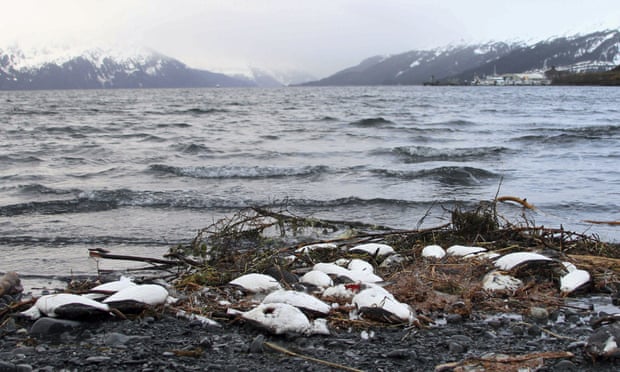
A million seabirds died in less than a year as a result of a giant “blob” of hot ocean, according to new research.
A study released by the University of Washington found the birds, called common murres, probably died of starvation between the summer of 2015 and the spring of 2016.
Most dead seabirds never wash ashore, so while 62,000 dead or dying murres were found along the coasts of Alaska, Washington, Oregon and California, researchers estimate the total number is closer to 1 million.
Alaska saw the most birds wash up. In Prince William Sound in southern Alaska, more than 4,500 bird carcasses were found every kilometer, or 0.62 miles.
The blob stems from a years-long severe marine heatwave, believed to be caused by an anticyclone weather system that first appeared in 2013. The weather phenomenon known as El Niño accelerated the warming temperatures beginning in 2015 and, by 2016, the rising heat resulted in water temperatures nearly 11F (6C) above average.
Anticyclones form when a mass of air cools, contracts and becomes more dense, increasing the weight of the atmosphere and the surface air pressure.
Heat maps at the time showed a huge red blob growing, spanning more than 380,000 sq miles (1m sq km). That’s nearly 1.5 times the size of Texas or four times the size of New Zealand.
The study found that the murres mostly likely starved to death. The seabird must eat half its body weight to survive, but food grew scarce amid intense competition from other creatures. Warming ocean waters gave fish such as salmon and halibut a metabolism boost, causing a fight for survival over the limited supply of smaller fish.
Researchers also uncovered other effects, including a vast bloom of harmful algae along the US west coast that cost fisheries millions of dollars in revenue. Other animals also died off, including sea lions, tufted puffins and baleen whales.
“Think of it as a run on the grocery stores at the same time that the delivery trucks to the stores stopped coming so often,” Julia Parrish, a co-author of the study and UW professor in the School of Aquatic and Fishery Sciences, said in a press release.
The murres’ population also took a hit. According to the study, a limited food supply resulted in reduced breeding colonies across the entire region. Between the 2015 and 2016 breeding seasons, more than 15 colonies did not produce a single chick. Researchers say those estimates could be low since they only monitor a quarter of all colonies.
If you liked this post you’ll love our daily newsletter, EnviroPolitics.It’s packed with the latest news, commentary and legislative updates from New Jersey, Pennsylvania, New York, Delaware…and beyond. Don’t take our word for it, try it free for an entire month. No obligation.
For years, we relied heavily on recycling operations in China to take our waste. But that came to an end in 2018, when Beijing barred the import of recycling materials. The result is a waste crisis that has caused at least dozens of municipalities to cancel curbside recycling programs, with many more implementing partial cuts. Huge amounts of recyclables are now going to landfills.
“When the biggest export market is no longer willing to accept your material, there’s an imbalance between supply and demand,” said David Biderman, the executive director of the Solid Waste Association of North America. “That’s just Economics 101.”
So, how can we fix the system?
Experts say that we would need to implement changes across the board. Legislators may need to pass laws requiring manufacturers to use more recyclable materials, companies would need to build much-needed recycling infrastructure and people would need to recycle properly.
Cities can’t do all that. But they can play an important role.
For a possible model, consider San Francisco, which runs one of the most successful waste-management programs in the United States. Through recycling and composting, the city manages to keep around 80 percent of its waste out of landfills.
San Francisco’s program has been years in the making. In 2000, it introduced the “fantastic three” citywide curbside collection program with separate, color-coded bins for recyclables, compost and trash. In 2009, it passed a law requiring residents and businesses to separate their waste.
City inspectors monitor bins to ensure that residents sort their waste correctly and leave tags if materials are found in the wrong bin. They can impose fines if they find repeat offenders.
President Trump says dishwashers don’t work like they used to. (AP Photo/ Evan Vucci)
The Trump administration just finished a major revision of the rules for setting energy efficiency standards for dishwashers and other appliances — just the sort of common household items President Trump regularly tells campaign crowds no longer work properly.
The Department of Energy this week put the final touches on new procedures for energy-savings standards for dozens of machines used daily in homes and businesses, including residential appliances like clothes dryers and microwave ovens, commercial equipment like walk-in refrigerators and industrial instruments like distribution transformers on the electric grid.
While the Energy Department says the move will save money for consumers and manufacturers, advocates for making appliances more efficient counter that the new rules will only encourage lawsuits from manufactures upset with toughened standards and make it harder for regulators to cut the climate-warming impact of home appliances.
Yet advocates for making appliances more efficient say the new rules will only encourage lawsuits from manufactures upset with toughened standards and make it harder for regulators to cut the climate-warming impact of home appliances.
“It seems to be that they’re issuing this rule to handcuff a future administration,” said Andrew deLaski, who runs the energy-efficiency advocacy group Appliance Standards Awareness Project.
With the new rules governing how energy-savings standards are written, Trump’s deputies appear to be addressing one of the president’s more peculiar obsessions — his view that modern appliances just don’t work as well as they used to.
‘Women tell me’: Trump says he’s heard from women about inefficient dishwashers
Still, the decision to add more steps to the standards-writing process is a peculiar one for an administration that has sought to cut red tape elsewhere in the federal bureaucracy.
Under the new regulation, the department will be required to publish the procedures for testing an appliance 180 days before setting the actual standard for manufacturers. That binding requirement, said deLaski, the energy-efficiency advocate, “will make it harder and more time-consuming to update the standards.”
In the past, the Energy Department could tweak the procedures for testing the energy efficiency of machines while working to set the actual minimum efficiency requirements for them.
The department also said it only will place standards on manufacturers if the energy savings meet a certain threshold — arguing that a big, 40 percent chunk of the standards issued over the past three decades account for only a small, 4 percent piece of total energy savings.
Over the next three years, net-new renewable energy generating capacity will be 18 times greater than that of gas, coal, oil, and nuclear combined
By Editorial team at pv/buzz
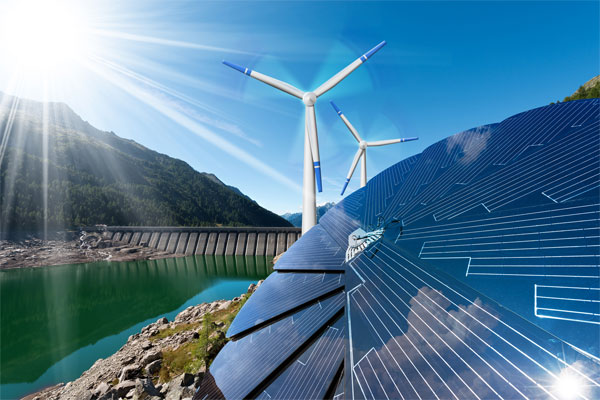
Renewable energy is the energy that is collected from renewable resources, which are naturally replenished on a human timescale, such as sunlight, wind, rain, tides, waves, and geothermal heat (Image: Alberto Masnovo)
According to a review by the SUN DAY Campaign of data released by the Federal Energy Regulatory Commission (FERC) for the first eleven months of 2019, the mix of renewable energy sources (i.e., biomass, geothermal, hydropower, solar, wind) is now in first place in the race for new U.S. generating capacity added in 2019.
FERC’s latest monthly “Energy Infrastructure Update” report (with data through November 30, 2019) reveals renewable sources (i.e. biomass, geothermal, hydropower, solar, wind) accounted for 8,784 MW of new generating capacity through the end of November. That is 8% more than that of natural gas (7,819 MW), nuclear (155 MW), oil (77 MW), and coal (62 MW) combined.
Combined, renewables provided 52% of new generating capacity through the first eleven months of 2019 and seem poised to increase their share once the final December numbers are released.
Renewables have now also surpassed 22% (i.e., 22.03%) of the nation’s total available installed generating capacity – further expanding their lead over coal capacity (20.92%). Among renewables, wind can boast the largest installed electrical generating capacity – 8.52% of the U.S. total, followed by hydropower (8.43%), solar (3.43%), biomass (1.33%), and geothermal (0.32%).