In Thailand, where a major plastic bag ban went into effect on Jan. 1, 2020, shoppers are trying out creative new ways to transport their groceries, like wheelbarrow shopping above or the plant pot carryout method, below.
Justin Auciello reports for WHYY
New Jersey environmentalists are lamenting the state Assembly’s failure to vote on a comprehensive ban on single-use plastic, the most stringent of its type in the nation.
The legislation targets the sale of single-use plastic items, including single-use plastic straws, shopping bags and polystyrene containers, and paper bags. The Senate voted favorably on the statewide ban on Monday but the legislation was not posted by a vote by the Assembly.
The ban on single-use plastic and paper bags would be implemented after one year, and a ban on polystyrene containers, such as Styrofoam, would take effect after two years. Plastic straws would only be permitted by customer request.
And that lack of action is angering environmentalists.
Representatives of Clean Ocean Action, a regional coalition based in Sandy Hook that fights for clean water off the New Jersey and New York coastlines, said they’re disappointed, but will continue to fight and work with local municipalities to expand and build upon the foundation already set. Forty-eight towns have already taken action against single-use plastics.
‘Environmental Protection 101’
“How many more whales, turtles and other marine life must die before our elected leaders act? Single-use plastics cause needless misery and blight,” said Cindy Zipf, the organization’s executive director. “We call upon the Legislature to get a bill on Governor Murphy’s desk no later than Earth Day that would ban these initial plastics within the year. No more excuses. This is Environmental Protection 101.”
During Clean Ocean Action’s beach sweeps in 2018, volunteers removed more than 450,000 pieces of debris, with plastics accounting for the vast majority of items.
New Jersey Sierra Club director Jeff Tittel said the lack of a vote on the legislation “failed the people of New Jersey.”
“Because of these setbacks, we will redouble our efforts to get this comprehensive plastic bag ban passed in the next session. We will keep going until the Legislature acts and passes a full statewide ban,” he said.
Critics said the legislation was unnecessary because of advances in recycling technology. Others decried one aspect of the proposal that would force food retailers like grocery stores to give away reusable bags for free for the first two months of the ban.
An October 2019 Monmouth University poll found that about two in three New Jersey residents said they supported a plastic bag ban, but many backed away from that zeal when presented with specifics about how it would impact their shopping habits.
When given several options, only 31% of respondents supported a complete ban on single-use plastic bags. Another 27% suggested that consumers should pay a fee for the bags, and 39% stated that stores should be able to continue to give them out for free.
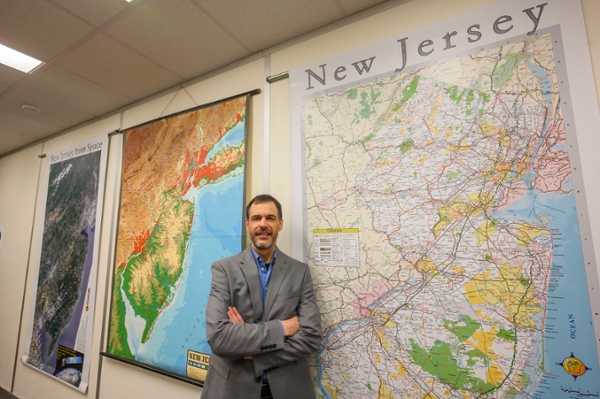
Rowan University Professor of Geography John Hasse and a team of researchers have compiled a massive trove of New Jersey land use data and moved it all online for easy access, a project that will benefit students, journalists, municipal officials, developers and residents for decades to come.
Dubbed, appropriately, NJ MAP, the project spawned numerous research offshoots including the New Jersey Conservation Blueprint to help guide development in the state and to preserve valuable and often sensitive parcels for future generations.
In December, Hasse and the team that compiled that work, including his partners at the Nature Conservancy and the N.J. Conservation Foundation, were among the recipients of the 2019 Governor’s Environmental Excellence Awards.
Hasse described NJ MAP (which is available at NJMAP2.com) as an interactive atlas, a 21st Century resource that makes finding detailed ecological and environmental information easy, and puts it literally in the palm of one’s hand, be it from a laptop, a desktop computer or a smartphone.
“Mapping is something humans did long before we were even writing,” he said. “Prehistoric humans first created maps on cave walls. Humans evolved to think graphically about what’s around them in the environment and, for many centuries, it was done on paper maps. Now we can make those graphical representations on a computer screen where we can do much more like dynamically zoom in and out, generate animations and create vast databases within them. With NJ MAP, we have many dozens of digital layers that help us understand and interpret the environment.”
The Conservation Blueprint – a collaboration between Rowan researchers and students, the Nature Conservancy, the New Jersey Conservation Foundation and 22 other partner organizations – received the state award in the Land Conservation Category, one of nine groups or individuals recognized during the program Dec. 9 at the New Jersey State Museum in Trenton. The Blueprint also earned an Environmental Achievement Award from the N.J. Association of Environmental Commissioners, which advises environmental commissions in all 21 counties.
Hasse said the NJ MAP program and side projects such as the Conservation Blueprint not only help illustrate the state in an unprecedented way but are helping to save resources, financial as well as physical.
“There’s a limited amount of money to protect open space,” he said. “Some parcels are more vulnerable and those would be the most logical to preserve.”
He noted that, from a business perspective, information that is readily available, without having to pay a third party to develop it, helps ensure smarter, more economically feasible planning.
“These resources help developers be more responsible and it helps them save money by mapping where they shouldn’t go,” Hasse said. “Plus, for example, we can show parcels that already have sewer or that are near highway infrastructure, and that type of information can help steer developers to smarter places.”
Significantly, Hasse said, data collected to produce NJ MAP and related projects show that development of environmentally sensitive areas has been recently declining in the state and that there’s been an uptick in farmland preservation, both of which can help offset the rising impact of climate change.“The question is, how much can we mitigate how climate change will affect life in New Jersey?” he said. “That remains unknown.”
Rowan University Professor of Geography John Hasse and a team of researchers have compiled a massive trove of New Jersey land use data and moved it all online for easy access, a project that will benefit students, journalists, municipal officials, developers and residents for decades to come.
Dubbed, appropriately, NJ MAP, the project spawned numerous research offshoots including the New Jersey Conservation Blueprint to help guide development in the state and to preserve valuable and often sensitive parcels for future generations.
In December, Hasse and the team that compiled that work, including his partners at the Nature Conservancy and the N.J. Conservation Foundation, were among the recipients of the 2019 Governor’s Environmental Excellence Awards.
“The New Jersey Conservation Blueprint is one of about a dozen projects that run out of the platform, NJ MAP,” Hasse said. “While the Blueprint is about conservation and preserving lands from overdevelopment, other projects include animations of environmental change, property parcel information and tracking the waste stream in New Jersey but they’re all powered by NJ MAP.”
Hasse described NJ MAP (which is available at NJMAP2.com) as an interactive atlas, a 21st Century resource that makes finding detailed ecological and environmental information easy, and puts it literally in the palm of one’s hand, be it from a laptop, a desktop computer or a smartphone.
“Mapping is something humans did long before we were even writing,” he said. “Prehistoric humans first created maps on cave walls. Humans evolved to think graphically about what’s around them in the environment and, for many centuries, it was done on paper maps. Now we can make those graphical representations on a computer screen where we can do much more like dynamically zoom in and out, generate animations and create vast databases within them. With NJ MAP, we have many dozens of digital layers that help us understand and interpret the environment.”
The Conservation Blueprint – a collaboration between Rowan researchers and students, the Nature Conservancy, the New Jersey Conservation Foundation and 22 other partner organizations – received the state award in the Land Conservation Category, one of nine groups or individuals recognized during the program Dec. 9 at the New Jersey State Museum in Trenton. The Blueprint also earned an Environmental Achievement Award from the N.J. Association of Environmental Commissioners, which advises environmental commissions in all 21 counties.
Hasse said the NJ MAP program and side projects such as the Conservation Blueprint not only help illustrate the state in an unprecedented way but are helping to save resources, financial as well as physical.
“There’s a limited amount of money to protect open space,” he said. “Some parcels are more vulnerable and those would be the most logical to preserve.”
He noted that, from a business perspective, information that is readily available, without having to pay a third party to develop it, helps ensure smarter, more economically feasible planning.
“These resources help developers be more responsible and it helps them save money by mapping where they shouldn’t go,” Hasse said. “Plus, for example, we can show parcels that already have sewer or that are near highway infrastructure, and that type of information can help steer developers to smarter places.”
Significantly, Hasse said, data collected to produce NJ MAP and related projects show that development of environmentally sensitive areas has been recently declining in the state and that there’s been an uptick in farmland preservation, both of which can help offset the rising impact of climate change.
“The question is, how much can we mitigate how climate change will affect life in New Jersey?” he said. “That remains unknown.”
By Ryan Sharrow – Editor in Chief, Philadelphia Business Journal
Longtime media executive Lisa Hughes will become the next publisher of the Philadelphia Inquirer, replacing Terry Egger who plans to retire after less than five years in the job.
Hughes will officially take over for Egger on Feb 3. She has been on the board of the Inquirer since 2018 and is the former publisher and chief business officer at the New Yorker.
Hughes becomes the first woman publisher and CEO of the Inquirer in the daily newspaper’s 190-year history.
“Philadelphia is the birthplace of free speech, and now in many ways it is ground zero for demonstrating that a deep community commitment to preserving local journalism matters and can be successful,” Hughes said in a statement.
In a memo to colleagues, Egger wrote the timing is right to step down as publisher and said he is looking forward to spending more time with his family.
During his tenure, Egger, 62, led the transformation of the Inquirer to nonprofit ownership by the Lenfest Institute, a structure designed to enable the long-term sustainability of the paper.
Hughes spent more than eight years as chief business officer at the New Yorker before departing from the role in 2017. She’s also held the role of vice president at Conde Nast Traveler.
Josh Kopelman, chairman of the Inquirer’s board of directors, called Hughes “a seasoned, high-integrity, high-performance media leader who embodies our values and our strategy.”
More than 13,000 people have been evacuated from the area surrounding Taal Volcano
Niharika Mandhana, Wall Street Journal Updated Jan. 13, 2020 11:25 am ET
A volcano to the south of the Philippine capital of Manila spewed ash and steam for a second day and pushed out fountains of lava, with authorities warning a larger eruption could occur and send deadly clouds surging over land at high speeds.
More than 13,000 people have been evacuated from the area surrounding Taal Volcano, said Mark Timbal, a spokesman for the National Disaster Risk Reduction and Management Council. In some places, the falling ash from the eruptions was so severe that vehicles carrying locals out of the high-risk zone had to halt operations temporarily because of near-zero visibility, Mr. Timbal said.
The volcano, which is about 65 miles from Manila, “entered a period of intense unrest” Sunday, according to the Philippine Institute of Volcanology and Seismology, or Phivolcs. Strong winds carried ash to the capital city, where flights were disrupted, the stock market was closed and schools were suspended.
Government volcanologists said Monday they would keep the alert level at four out of a possible five, which indicates a hazardous eruption may occur in a matter of hours or days. If that happens, the volcano could send large amounts of hot lava flying into the sky. But a different and possibly more-dangerous phenomenon could also occur known as base surge.
The Taal Volcano is a tourist attraction that sits in a picturesque lake. PHOTO: TED ALJIBE/AGENCE FRANCE-PRESSE/GETTY IMAGES
Base surge is when massive clouds of ash, rocks and gas are thrust out horizontally at speeds of more than 35 miles an hour. The clouds move with such force that they could travel over the lake that surrounds Taal Volcano and sweep across the mainland, potentially damaging life and property, Renato Solidum, who is in charge of Phivolcs, said in an interview.
These clouds “can burn you, asphyxiate you, crush you, mangle you,” Dr. Solidum said. “This is the worst-case scenario.”
Base surges have occurred at Taal before, giving the relatively small volcano a violent history. An eruption in 1965 accompanied by outward-pushing clouds killed 200 people. A similar disaster in 1911 left an estimated 1,300 dead, Dr. Solidum said. And in 1754, the clouds extended to areas all around the volcano, but accurate records of the number of casualties aren’t available.
A major eruption could also cause a volcanic tsunami, authorities warned. That could result from debris shooting out of the volcano and hitting the waters of the surrounding lake, generating big waves. Dr. Solidum said there was no reliable way to estimate how likely it was that a base surge or volcanic tsunami would occur.
Since Sunday afternoon, seismologists have recorded at least 144 volcanic earthquakes in the Taal region. That is an indication that the magma is moving up the volcano with such force, it is causing fissures or cracks in the ground to shake, Dr. Solidum said.
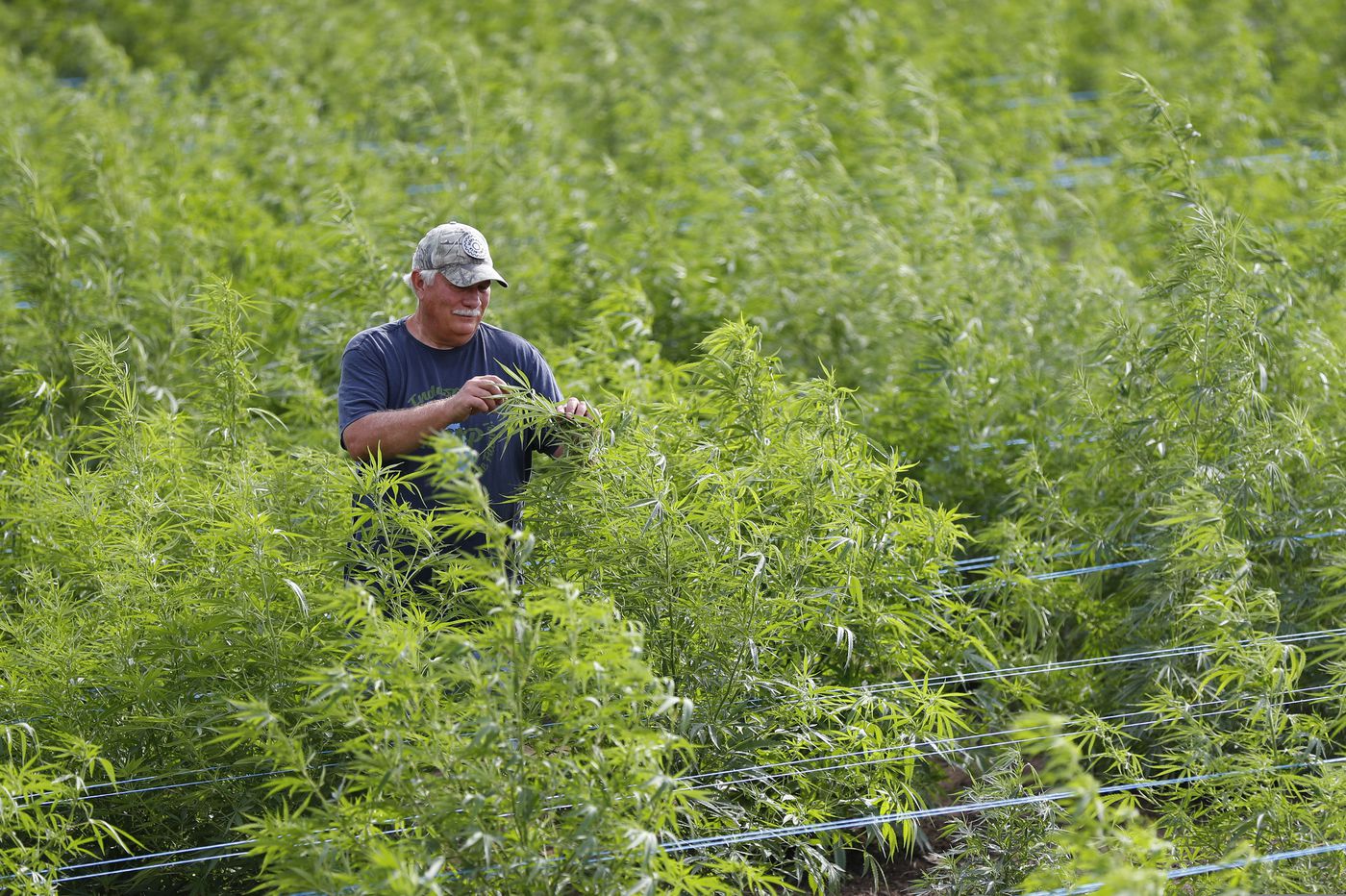
Hemp could soon become as ubiquitous as corn, tomatoes or blueberries in the Garden State. And it may one day earn the right to be labeled “Jersey Fresh.”
The U.S. Department of Agriculture this week approved New Jersey’s plans for hemp production. The state was among the first three to receive the USDA’s official federal endorsement. The agency also gave the OK to proposals submitted by Louisiana and Ohio.
Hemp is a close cousin of what most of the world knows as marijuana. Both are forms of cannabis. In some cases, the two varieties are indistinguishable without testing.
The major difference between the two varieties is this: Hemp by definition must contain less than 0.3 percent of THC, the intoxicating compound that gives marijuana its kick. Some experimental hemp growers have a hard time keeping THC below that limit.
Where marijuana is grown for its psychoactive effects, industrial hemp is cultivated to be used as paper, textiles, building materials, food, oils, and dietary supplements such as CBD.
Nationwide, farmers last year grew more than 500,000 acres of hemp in 34 states. That’s up from 112,000 acres in 2018, according to the hemp advocacy organization Vote Hemp.
The CBD market alone could be valued at $16 billion by 2025, according to a recent Cowen report. And, analysts predict that hemp could drive a $20 billion industry by 2025.
While about 8,000 acres were licensed in Pennsylvania in 2019, no hemp was legally grown in the Garden State. With the USDA’s approval, the new crop will need an entirely new supply chain that will include processors, testing labs, and distributors.
“Jersey has some catching up to do with Kentucky, Colorado, Pennsylvania and Tennessee,” said Brett Goldman, a former lobbyist who serves as the Philadelphia-based vice president of government and industry for the multi-state hemp grower, GenCanna of Kentucky.
Said Goldman: “Now it’s time for farmers to get farming.”
Under the New Jersey program, everyone’s a farmer.
Anyone in the state who wants to grow hemp will be permitted to do so, said New Jersey’s Secretary of Agriculture, Douglas H. Fisher.
But every aspiring grower will have to go through a formal application process and be approved by the Department of Agriculture before planting seeds.
There will be no limits on the number of permits issued, Fisher said. Hemp will be treated like any other agricultural crop and may someday be eligible for promotion under the state’s Jersey Fresh program, “though we haven’t quite gotten there yet,” Fisher said.
Application forms will be posted next week on the Department of Agriculture website. Once the applications are submitted, the state will move quickly to grant approvals.
“Some states had pilot programs, experimental programs as in Pennsylvania,” Fisher said. “We wanted to go right to letting anyone who wants to grow it do that, and they can grow it anywhere.”
New Jersey’s hemp legislation was signed into law by Gov. Phil Murphy in August.
Growers won’t be limited in the amount they can cultivate, Fisher said, but they will have to register and know the state regulations.
“The only thing they have to do is register their plots, their fields or their indoors facilities,” Fisher said. “We have to know what they are growing and where. But there’s no limit.”
It will be legal to import hemp seeds from other states.
Goldman, of GenCanna, said it is still undetermined which strains and cultivars will do best in New Jersey.
Growers will be eligible to receive help from experts at the state university.
“Rutgers will be very much involved and has real expertise in this realm,” Fisher said. “They’ve been waiting to help growers find the right seed, maximize the yields and find new uses for their crops.”
Currently, there are no hemp processing facilities in New Jersey. Although it is legal to ship hemp across state lines, finding processors is a state priority.
“We want aspiring processors to know New Jersey is open for business,” Fisher said. “We want them to locate here in the Garden State.”
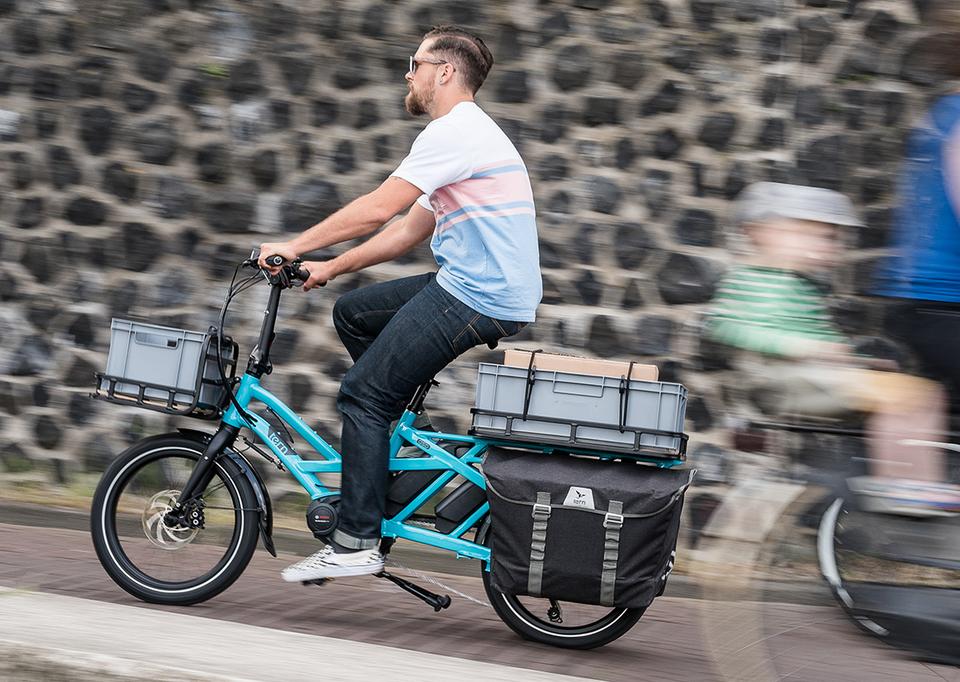
Tern GSD electric cargo bike makes riding up hills a breeze.TERN
Robots. AI. Podcasts. 5G. All of these are the sort of subjects you would expect to find plugged in a long-running annual tech predictions report. Bicycles? Not so much. But in a major innovations publication issued on December 10, 200-year-old bicycling is highlighted as a technological solution to many modern urban ills. Robots. AI. Podcasts. 5G. All of these are the sort of subjects you would expect to find plugged in a long-running annual tech predictions report. Bicycles? Not so much. But in a major innovations publication issued on December 10, 200-year-old bicycling is highlighted as a technological solution to many modern urban ills. Robots. AI. Podcasts. 5G. All of these are the sort of subjects you would expect to find plugged in a long-running annual tech predictions report. Bicycles? Not so much. But in a major innovations publication issued on December 10, 200-year-old bicycling is highlighted as a technological solution to many modern urban ills.
“Growth in urban bicycle use can drive profound societal changes,” suggests Deloitte’s Technology, Media & Telecommunications Predictions 2020 report. This will be achieved through “reductions in traffic and pollution, less-crowded public transit systems, and improvements in public health,” stressed the report, now in its 19th year.
The 136-page report from the global consultancy firm predicts that bicycle usage in cities will double by 2022.
Deloitte’s “Technology, Media & Telecommunications Predictions 2020” report.DELOITTE
“By 2050, 2.5 billion more people are expected to be living in cities than today,” stated the firm’s study, and more bicycle usage will be necessary because “moving all these people around may strain capacity on existing transport options.”
Urban bike-share schemes will be essential for cities of the future, and bicycling of all stripes will be boosted by “an array of diverse technological innovations,” according to Deloitte’s crystal-ball gazers. They believe predictive analytics, smartphone apps, wireless connectivity, and digital urban planning tools will get more people on bikes.
The growth in demand for e-bikes will also accelerate, said the firm, citing a Forbes story on how there already now more e-bikes sold in The Netherlands than non-electric bikes.
Innovations—and freshly-built cycling infrastructure—will make bicycling safer, faster, and even more convenient.
“This makes it a more attractive option for first-mile, last-mile, and overall travel, furthering its rising popularity,” said the firm’s U.S. report.
A U.K. version of the report added that “increased participation in cycling over the coming years can only be good news,” especially as “more cycling means lower car usage and lower emissions.”
The U.K. version continued: “Our cities are currently heaving with traffic; mostly for journeys that are under five miles—under two miles in London—so for short, routine trips, cycling could tick all the boxes.”
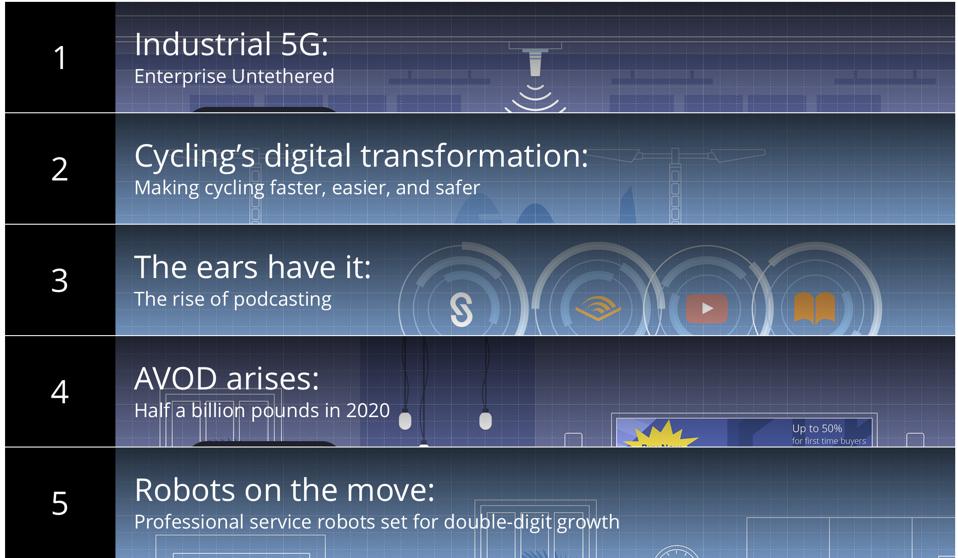
U.K. version of Deloitte’s innovations report cites cycling as second most important innovation to … [+]DELOITTE
Cycling is listed as the second most important innovation to keep tabs on. The roll-out of industrial 5G was first, and the continued rise of podcasting was third.
The fastest-selling electric vehicle in the years ahead will be e-bikes, stated the Deloitte report: “Between 2020 and 2023, we expect over 130 million electric bikes to be sold worldwide, reaching 40 million units and £16 billion revenue in 2023.”
According to Deloitte, this will “far outpace electric [motor] vehicles, which we expect to grow from 5.1 million in use globally in 2018, to around 12 million likely to be sold in 2025.”