Stocks losses deepen as a key recession warning surfaces
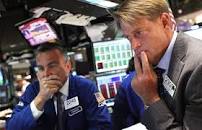
The Dow plunged more than 800 points as investors feared a recession following poor economic data from Germany and China. (Reuters)
Damian Paletta, Thomas Heath and Taylor Telford report for the Washington Post August 14 at 4:02 PM
The global economy has begun to shudder.
On Wednesday, the U.S. stock market tumbled after a reliable predictor of looming recessions flashed for the first time since the 2008 financial crisis. The Dow Jones industrial average fell around 800 points, or 3 percent, and has lost close to 7 percent in the past three weeks.
Two of the world’s largest economies, Germany and the United Kingdom, appear to be contracting. Argentina’s stock market fell nearly 50 percent in recent days, and growth in China has slowed.
Whether the events presage an economic calamity or just an alarming spasm are unclear. But unlike during the Great Recession, global leaders are not working in unison to confront mounting problems and arrest the slowdown. Instead, they are increasingly at each other’s throats.
And President Trump has responded by both claiming the economy is still thriving while dramatically ramping up his attacks on Federal Reserve Chairman Jerome Powell, seeking to deflect blame.
Wednesday’s sharp selloff was caused by an unusual development in the bond market, called an “inverted yield curve,” that often foreshadows a recession.
For the first time since the run-up to the Great Recession, the yields – or returns – on short-term U.S. bonds eclipsed those of long-term bonds. Normally, the government needs to pay out higher rates to attract investors for its long-term bonds. But with so many losing confidence in the near-term prospects of the economy and rushing to buy longer-term bonds, the U.S. government now is paying more to attract buyers to its 2-year bond than its 10-year note.
This phenomenon, which suggests investor faith in the economy is faltering, has preceded every recession in the past 50 years.
“The stars are aligned across the curve that the economy is headed for a big fall,” said Chris Rupkey, chief financial economist at MUFG Union Bank. “The yield curves are all crying timber that a recession is almost a reality, and investors are tripping over themselves to get out of the way.”
[‘An absurdly odd world’: Why nervous banks are paying people to take loans]
It’s the latest in a string of worrisome news about the U.S. economy. The government is expected to spend roughly $1 trillion more than it brings in through revenue this year, creating a ballooning deficit. Business investment has begun to contract — largely due to the uncertainty surrounding President Trump’s trade war — and manufacturing jobs have begun to slide. The big hiring and investment announcements that piled up at the beginning of the Trump administration have ceased, as have the announcements of bonuses and pay increases that came after a tax cut law was passed in 2017.
Several White House officials have become concerned that the economy is weakening faster than expected, but they are not working on proactive plans to try and change its course. The Treasury Department has had an exodus of senior advisers in recent months, and the White House just announced a replacement for chairman of the Council of Economic Advisers.
Instead of rolling out new policies, Trump and other top aides have escalated their attacks on the Federal Reserve, trying to pin much of the U.S.’s problems on what Trump alleges is elevated interest rates that are strangling growth.
In a series of Twitter posts on Wednesday, Trump appeared to try and calm investors while also unloading vicious language aimed at Powell, whom he nominated in late 2017.
“China is not our problem, though Hong Kong is not helping,” Trump wrote. “Our problem is with the Fed. Raised too much & too fast. Now too slow to cut…Spread is way too much as other countries say THANK YOU to clueless Jay Powell and the Federal Reserve. Germany, and many others are playing the game! CRAZY INVERTED YIELD CURVE! We should easily be reaping big Rewards & Gains, but the Fed is holding us back. We will Win!”
The Twitter posts reflected a growing anxiety within the White House about problems in the economy, particularly because just a few hours earlier Trump had tried to spin the inverted yield curve as a positive, saying it has occurred because “Tremendous amounts of money pouring into the United States. People want safety!
In the past, Democrats and Republicans in control of the White House have scrambled when there were signs of an economic downturn. They met and often consulted with Congress about ways to protect the economy or advance some kind of economic stimulus, either through tax cuts or spending increases.
But the Trump administration has already cut taxes and boosted spending, and there appears to be little political appetite to do more of either. White House officials have discussed a plan to make changes to the way capital gains taxes are levied, but that would only impact certain investors and has already faced criticism from Democrats for being a boon to the rich. Complicating matters, a number of investors and foreign leaders have blamed Trump’s trade war for causing a contraction in business investment and forcing companies to pull back.
The U.S. economy has shown signs of weakening in recent months, but high levels of consumer spending in the United States have helped enormously. Still, the escalating trade war between Trump and Chinese leaders has stopped many businesses from investing. And there are signs that the large tariffs he has placed on many Chinese imports is costing U.S. businesses and consumers billions of dollars.
In a rare admission of the economic consequences of his adversarial trade approach, Trump on Tuesday announced he was delaying many of the tariffs he had promised on cellphones and laptop computers until December 15. That announcement brought the stock market up sharply higher on Tuesday, but all of those gains evaporated in minutes Wednesday amid fears about the yield curve.
Aside from the drop in the Dow, the Standard & Poor’s 500-stock index, a broader measure of stocks, was down about 2.4 percent, and the tech-heavy Nasdaq composite index dropped about 2.7 percent. Ten of the 11 market sectors were in the loss column Wednesday, with energy, consumer staples and financial services leading the way.
Bank stocks slumped off the news. Bank of America and Citigroup saw their shares sink more than 4 percent, and JPMorgan’s shares fell 3.6 percent. Gold, a safe haven for investors, rose. And the influx of investors scrambling for safety pushed U.S. 30-year Treasury yields to their lowest level ever.
Darkening skies overseas gave investors more to worry about. New data indicated Germany was slipping into recession with the country’s economy shrinking 0.1 percent between April and June. If it experienced another contraction during this quarter, Germany officially would meet the definition of a recession. Officials blamed the drop-off on the U.S.-China trade war and the looming threat of a hard Brexit. The European Stoxx 600 benchmark was down nearly 6 percent in midday trading.
Meanwhile China reported more signs of a weakening economy Wednesday, with factory output falling to a 17-year low and high unemployment. The report fed fears about a broader global slowdown as the trade conflict appears to be stalling some of the world’s most powerful economies.
[Trump finally acknowledges his tariffs could hit consumers]
Several factors have contributed to the market turbulence in recent sessions, including China’s threat to devalue its currency, massive protests in Hong Kong that could prompt a response from the Chinese government, an escalation of the U.S.-China trade war and the flight to bonds.
The trade roller coaster has fostered a feeling of uncertainty among American businesses, making it more difficult for companies to make long-term plans. The uncertainty has been felt in stock prices. The Dow is about 5 percent off its all-time high of one month ago. Trade concerns have now worked its way to the U.S. Treasury bond market.
“The big concern is around trade,” said Dan Ivascyn, group chief investment officer at Pimco. “The longer we remain in limbo, the more damage to the global economy. You already have a fragile global economy, and with this trade tension you are beginning to see people shift into safer assets with almost complete disregard for what they are earning on those assets.”
The spate of economic warning signs across the globe followed a rare moment of easing Tuesday in the U.S.-China trade war, after the White House announced that tariffs on certain consumer goods — such as laptops, cellphones and toys — would be postponed a few months to give shoppers and companies a break during Christmas shopping. Some of the tariffs on the remaining $300 billion in Chinese goods will still go into effect Sept. 1 as planned, while the items covered under the delay won’t be affected by tariffs until Dec. 15.
“Just in case they might have an impact on people, what we’ve done is delayed it so they won’t be relevant for the Christmas shopping season,” President Trump told reporters Tuesday.
It was the first time Trump has publicly acknowledged that American people and businesses bear some of the burden from his tariffs.
The delay offered a glimmer of hope in an otherwise grim outlook in U.S.-China trade policy and was announced after a phone call between trade negotiators, which Trump lauded as productive. Chinese officials are planning to come to the United States in September to continue talks.
“The delay impacts around half of the $300 billion of imports and quite clearly focuses on popular consumer products that could have made the Christmas shopping period a lot more expensive for American consumers,” Craig Erlam, an analyst with OANDA, wrote in a note to investors Wednesday. “Trump’s decision to protect consumer’s from tariffs in such an important period makes a lot of sense, but it also recognizes that 2020 could become much more expensive for them if progress is not made.”
Some White House officials have become increasingly concerned about the strength of the economy heading into the 2020 election, and they have pressed the Federal Reserve to cut interest rates, which they believe will free up more money for investing.
Trump sought in his first two years to juice economic growth through a combination of tax cuts, spending increases, regulatory changes, and low-energy costs, but many critics said the steps he took were just short-term patches that did little to fix problems in the economy. Trump has said repeatedly that the economy is now the strongest in American history, but there are numerous signs that this is not the case.
The government is set to spend almost $1 trillion more than it brings in through revenue this year, an unusual occurrence when the jobless rate is low. Parts of the manufacturing sector have shown signs of contracting in recent months, and business investment has stalled.
A drop in the yield of the closely watched 10-year U.S. Treasury bond is a sign that investors are heading away from the risk of stocks and toward the safety of long-term bonds. Yields drop when bond prices rise. Some European countries also have negative bond yields. That means people are paying governments to hold their money for them. Historically, people buy government bonds and expect interest payments on those bonds as a reward for lending the government money.
Stocks losses deepen as a key recession warning surfaces Read More »