Plastics, Fuels and Chemical Feedstocks From CO2? They’re Working on It

SUNCAT researchers discover a way to improve a key step in these conversions and explore what it would take to turn the climate-changing gas into valuable products on an industrial scale.

Researchers at Stanford and SLAC are working on ways to convert waste carbon dioxide (CO2) into chemical feedstocks and fuels, turning a potent greenhouse gas into valuable products. The process is called electrochemical conversion. When powered by renewable energy sources, it could reduce levels of carbon dioxide in the air and store energy from these intermittent sources in a form that can be used any time.
Researchers at Stanford and SLAC are working on ways to convert waste carbon dioxide (CO2) into chemical feedstocks and fuels, turning potent greenhouse gas into valuable products. The process is called electrochemical conversion. When powered by renewable energy sources, it could reduce levels of carbon dioxide in the air and store energy from these intermittent sources in a form that can be used any time. Credit: (Greg Stewart/SLAC National Accelerator Laboratory)

The DOE Science News Source

One way to reduce the level of carbon dioxide in the atmosphere, which is now at its highest point in 800,000 years, would be to capture the potent greenhouse gas from the smokestacks of factories and power plants and use renewable energy to turn it into things we need, says Thomas Jaramillo.

 As director of SUNCAT Center for Interface Science and Catalysis, a joint institute of Stanford University and the Department of Energy’s SLAC National Accelerator Laboratory, he’s in a position to help make that happen.

 A major focus of SUNCAT research is finding ways to transform CO2 into chemicals, fuels, and other products, from methanol to plastics, detergents and synthetic natural gas. The production of these chemicals and materials from fossil fuel ingredients now accounts for 10% of global carbon emissions; the production of gasoline, diesel, and jet fuel accounts for much, much more.

 “We have already emitted too much CO2, and we’re on track to continue emitting it for years, since 80% of the energy consumed worldwide today comes from fossil fuels,” says Stephanie Nitopi, whose SUNCAT research is the basis of her newly acquired Stanford PhD.

 “You could capture CO2 from smokestacks and store it underground,” she says. “That’s one technology currently in play. An alternative is to use it as a feedstock to make fuels, plastics, and specialty chemicals, which shifts the financial paradigm. Waste CO2 emissions now become something you can recycle into valuable products, providing a new incentive to reduce the amount of CO2 released into the atmosphere. That’s a win-win.”

 We asked Nitopi, Jaramillo, SUNCAT staff scientist Christopher Hahn and postdoctoral researcher Lei Wang to tell us what they’re working on and why it matters.

 First the basics: How do you convert CO2 into these other products?

 Tom: It’s essentially a form of artificial photosynthesis, which is why DOE’s Joint Center for Artificial Photosynthesis funds our work. Plants use solar energy to convert CO2  from the air into carbon in their tissues. Similarly, we want to develop technologies that use renewable energy, like solar or wind, to convert CO2 from industrial emissions into carbon-based products.

 Chris: One way to do this is called electrochemical CO2 reduction, where you bubble CO2 gas up through water and it reacts with the water on the surface of a copper-based electrode. The copper acts as a catalyst, bringing the chemical ingredients together in a way that encourages them to react. Put very simply, the initial reaction strips an oxygen atom from CO2 to form carbon monoxide, or CO, which is an important industrial chemical in its own right. Then other electrochemical reactions turn CO into important molecules such as alcohols, fuels and other things.

 Today this process requires a copper-based catalyst. It’s the only one known to do the job. But these reactions can produce numerous products, and separating out the one you want is costly, so we need to identify new catalysts that are able to guide the reaction toward making only the desired product.

 How so?

 Lei: When it comes to improving a catalyst’s performance, one of the key things we look at is how to make them more selective, so they generate just one product and nothing else. About 90 percent of fuel and chemical manufacturing depends on catalysts, and getting rid of unwanted byproducts is a big part of the cost. 

We also look at how to make catalysts more efficient by increasing their surface area, so there are a lot more places in a given volume of material where reactions can occur simultaneously. This increases the production rate. 

Recently we discovered something surprising: When we increased the surface area of a copper-based catalyst by forming it into a flaky “nanoflower” shape, it made the reaction both more efficient and more selective. In fact, it produced virtually no byproduct hydrogen gas that we could measure. So this could offer a way to tune reactions to make them more selective and cost-competitive.

Stephanie: This was so surprising that we decided to revisit all the research we could find on catalyzing electrochemical CO2 conversion with copper, and the many ways people have tried to understand and fine-tune the process, using both theory and experiments, going back four decades. There’s been an explosion of research on this – about 60 papers had been published as of 2006, versus more than 430 out there today – and analyzing all the studies with our collaborators at the Technical University of Denmark took two years.

We were trying to figure out what makes copper special, why it’s the only catalyst that can make some of these interesting products, and how we can make it even more efficient and selective – what techniques have actually pushed the needle forward? We also offered our perspectives on promising research directions.

Read the full story

Plastics, Fuels and Chemical Feedstocks From CO2? They’re Working on It Read More »
Unfurling The Waste Problem Caused By Wind Energy

By CHRISTINA STELLA
Heard on All Things Considered – September 10, 20194:37 PM ET

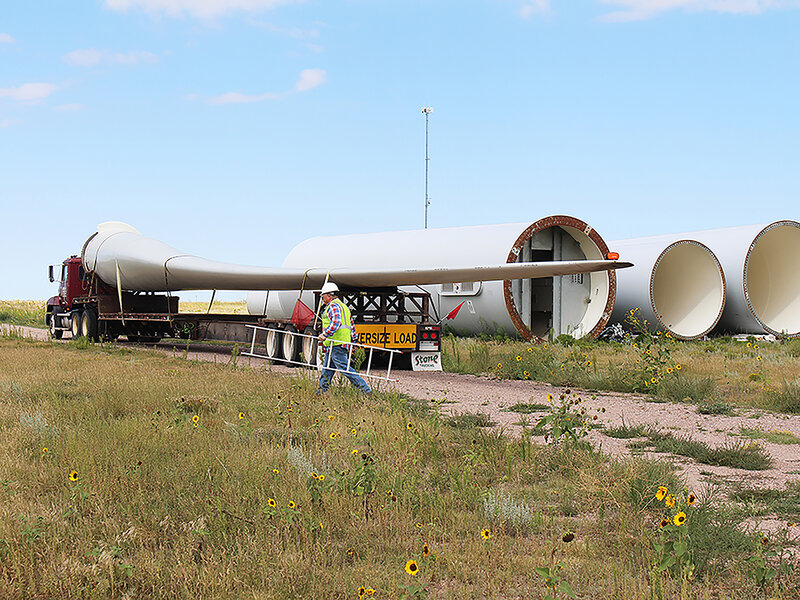
Rob Van Vleet secures a wind turbine blade on to an oversize truck at the Kimball Wind Farm in southwest Nebraska. Christina Stella/Harvest Public Media

While most of a turbine can be recycled or find a second life on another wind farm, researchers estimate the U.S. will have more than 720,000 tons of blade material to dispose of over the next 20 years, a figure that doesn’t include newer, taller higher-capacity versions.

There aren’t many options to recycle or trash turbine blades, and what options do exist are expensive, partly because the U.S. wind industry is so young. It’s a waste problem that runs counter to what the industry is held up to be: a perfect solution for environmentalists looking to combat climate change, an attractive investment for companies such as Budweiser and Hormel Foods, and a job creator across the Midwest and Great Plains.

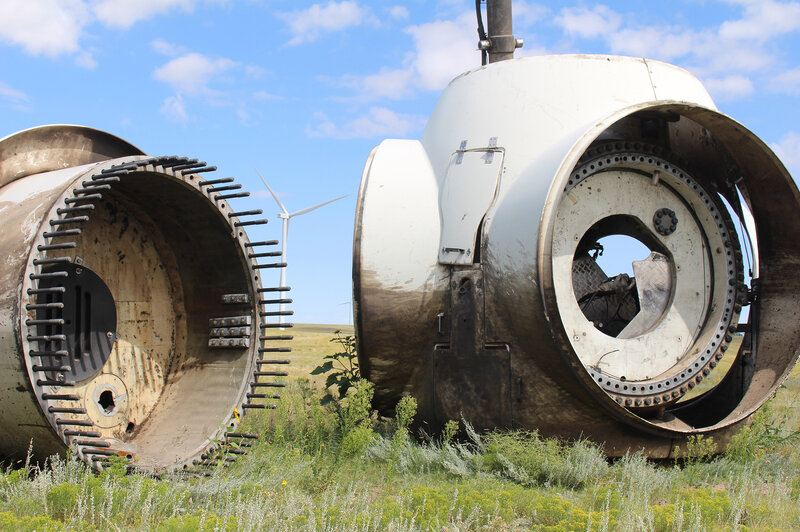
At the end of a long gravel road on the southwest Nebraska prairie, the state’s first wind farm, Kimball Wind Project, is caught in the breeze. But the turbine scrap area looks more like a sci-fi drama set. Rob Van Vleet climbed atop a 127-foot-long turbine blade, and walked the length like a plank.

“These towers may be supporting as much as 150,000 pounds, 250 feet in the air,” Van Vleet said. “The stands are an inch and a half thick steel … so they’re very strong.”

Ninety percent of a turbine’s parts can be recycled or sold, according to Van Vleet, but the blades, made of a tough but pliable mix of resin and fiberglass — similar to what spaceship parts are made from — are a different story.

“The blades are kind of a dud because they have no value,” he said.

Decommissioned blades are also notoriously difficult and expensive to transport. They can be anywhere from 100 to 300 feet long and need to be cut up on site before getting trucked away on specialized equipment — which costs money — to the landfill.

Once there, Van Vleet said, the size of the blades can put landfills in a tough spot.

“If you’re small utility or municipality and all of a sudden hundreds of blades start coming to your landfill, you don’t want to use up your capacity for your local municipal trash for wind turbine blades,” he said, adding that permits for more landfill space add another layer of expenses.

These old wind turbine hubs will be scrapped. Christina Stella/Harvest Public Media

Cindy Langstrom manages the turbine blade disposal project for the municipal landfill in Casper, Wyo. Though her landfill is one of the only ones in the state — not to mention the entire U.S. — with enough space to take wind farm waste, she said the blades’ durability initially posed a financial hurdle.

“Our crushing equipment is not big enough to crush them,” she said.

Langstrom’s team eventually settled on cutting up the blades into three pieces and stuffing the two smaller sections into the third, which was cheaper than renting stronger crushing machines that are usually made for mining.

Read the full story

Unfurling The Waste Problem Caused By Wind Energy Read More »

Proposals sought for Economic Stability Plan for New Jersey’s Highlands Region

The Highlands Water Protection and Planning Council is soliciting proposals to develop an Economic Sustainability Plan for the Highlands Region of New Jersey. Proposals must be submitted no later than 5:00 p.m. Monday, November 4, 2019.

Complete details are available in the RFP: https://www.nj.gov/njhighlands/news/rfps/esplan/esplan_rfp.pdf

Don’t miss information like this Click to receive free updates

Proposals sought for Economic Stability Plan for New Jersey’s Highlands Region Read More »

NJ Senate sets voting session for Thursday

New Jersey Senate session. Photo by New Jersey Photography

Among 15 bills scheduled for a vote on Thursday in the New Jersey Senate are these energy and environment measures:

A1040 / S3928 (Houghtaling / Andrzejczak / Taliaferro / Andrzejczak) – Establishes NJ “Landowner of the Year” award program.

A1212 / S611 / S874 (McKeon / Gusciora / Vainieri Huttle / Sweeney / Smith / Bateman) – Clarifies intent of P.L.2007, c.340 regarding NJ’s required participation in Regional Greenhouse Gas Initiative.

AJR150 (Johnson / Conaway / Houghtaling) – Designates October 8 of each year as “Hydrogen and Fuel Cell Day” in NJ.

 Also scheduled is a vote to concur with Assembly Amendments on:

S606 (Smith / Greenstein / Kennedy) – Encourages local units to plan for electric vehicle charging infrastructure

NJ Senate sets voting session for Thursday Read More »

Michele Brown to lead Christie’s think tank

Michele Brown, a former top aide to Gov. Chris Christie, will serve as executive director of the Christie Institute for Public

Former NJ EDA CEO will be paid executive director of the Christie Institute for Public Policy

David Wildstein reports for New Jersey Globe
September 09 2019 4:57 pm

Former Gov. Chris Christie has tapped a longtime member of his inner circle, Michele Brown, to run his new public policy institute, the New Jersey Globe has learned.

Brown, a former federal prosecutor who held several positions in the Christie administration, will serve as executive director of the Christie Institute for Public Policy.  She will receive a six-figure salary for the part-time post, two sources confirmed to the Globe.

The new Christie Institute will focus on civility in politics and will hold an inaugural lecture on September 26 at Seton Hall University with New York Gov. Andrew Cuomo. Priority seating for the event is $500-per-person, with general seating priced at $100-per-person.

Don’t miss stories like this Click to receive free updates

Brown told the Globe that the institute will hold quarterly lectures. When asked about her salary, she abruptly terminated the call.

The Christie Institute is also seeking corporate and individual contributions.

Until she was ousted by Gov. Phil Murphy last year, Brown was the $450,000-a-year CEO of Choose New Jersey, a privately-funded group formed by Christie allies to help attract new businesses to the state.

Brown has close personal ties to Christie from their time at the U.S. Attorney’s office, and her financial ties to the governor became an issue in the 2009 gubernatorial campaign when State Sen. Loretta Weinberg (D-Teaneck) — at the time the Democratic candidate for Lt. Governor — said Brown should recuse herself from reviewing Freedom of Information Act requests dealing with Christie’s travel as a federal prosecutor.

Brown later joined Christie’s staff as Appointments Counsel and became executive director of the now-embattled New Jersey Economic Development Authority.

In May 2017, Christie filed a notice of intent to nominate Brown to a Superior Court judgeship, but Brown inexplicably withdrew her name from consideration a few days later.

As a consolation prize, Christie gave Brown a seat on the Horizon Blue Cross Blue Shield Board of Directors.

While the first lecture will be held at Seton Hall University Law School, the college has said it has no formal connection to the Christie Institute.

Nikita Biryukov contributed to this story.

Like this? Click to receive free EnviroPolitics Blog updates

Michele Brown to lead Christie’s think tank Read More »

Partnership for Delaware Estuary captures national award for living shoreline project

By Kate Layton, Partnership for the Delaware Estuary


Partnership for the Delaware Estuary (PDE) is one of four agencies to receive top national honors for exemplary work in coastal restoration.


WILMINGTON — The American Shore & Beach Preservation Association (ASBPA) announced today that PDE is a winner of the 2019 Best Restored Shore award for “implementing creative solutions to eroding shores, rising seas, and degrading environmental conditions,” specifically for its living shoreline project at the DuPont Nature Center in Milford, Delaware. Projects in Texas, Louisiana, and Virginia also won the award.

“We are honored to be recognized by the ASBPA for our living shoreline project on the Mispillion River located in the Delaware Estuary,” PDE Executive Director Kathy Klein said. “Our science team has worked tirelessly on this and similar projects that have resulted in stabilizing coastal edges and creating habitat for living resources.”

“Living shoreline” describes a variety of nature-based techniques used for erosion control, water quality improvement, and/or habitat enhancement along shorelines experiencing erosion and/or ecological stress. As living shorelines develop, the services they provide, such as habitat for wildlife, shorebirds, and shellfish, increase. The Mispillion Living Shoreline Project is one of several that PDE has installed and monitored since 2008 throughout Delaware, Pennsylvania, and New Jersey.

PDE first installed the Mispillion Living Shoreline project in 2014 at the DuPont Nature Center and has maintained and monitored it ever since. The goals of the living shoreline were to enhance water quality and stabilize eroding portions of the shoreline adjacent to the nature center.  To accomplish this goal, materials suitable for shellfish habitat, including recycled oyster shells and matter made of a composite of oyster shell and concrete, were arranged to provide a suitable home for young oysters and salt marsh mussels while intercepting waves and lessening energy impacts to keep the shoreline from eroding.

Shellfish feed by filtering materials from the water, making the water clearer and more suitable for underwater plants and reducing nutrients that can result in algal blooms.  As the shellfish beds grow, the more material the shellfish can filter from the water.

Don’t miss stories like this Click to receive free updates

Over the last five years, more than 70,000 oysters and mussels have made the living shoreline their home, resulting in a significant increase in water quality from shellfish filtration. There also has been a reduction in erosion due to the physical structure of the living shoreline materials and shellfish community as a whole.  Monitoring the living shoreline on an annual basis has provided valuable information about the effectiveness of living shorelines, not only to meet goals related to shoreline stabilization but objectives associated with shellfish-mediated water quality improvements.

“The Mispillion Living Shoreline is a great example of how we can often use nature-based tactics to address multiple societal goals such as flood protection and clean water, avoiding expensive methods such as bulkheads that degrade the environment and don’t keep pace with sea-level rise,” said Dr. Danielle Kreeger, PDE’s science director. “It’s one thing to say a living shoreline can do these things, but it’s far more useful to actually show it by directly measuring project outcomes using scientific monitoring.” 

The Mispillion Living Shoreline project serves as a vital source of information for agencies that regulate water quality. Furthermore, the project demonstrates the advantage of this approach for shoreline designers, builders, and the public.

The work that PDE performed in collaboration with partners at the Delaware Department of Natural Resources and Environmental Control, as well as the DuPont Nature Center, highlights the value of monitoring a project to see if it is meeting its goals. Because the first few years of the project — 2014 to 2016 — were so successful, the team installed a second phase to the shoreline in 2018. PDE is pursuing additional funding to sustain the monitoring into at least 2022.

“By installing and maintaining the appropriate habitat, we could see the shellfish community slowly develop over the first few years,” said Dr. Joshua Moody, PDE’s restoration programs manager. “This initial stage is a vulnerable time for young shellfish communities, as they are susceptible to outside forces such as erosion and predators.  By creating the right type of habitat, you can provide refuge from these forces in early stages of development. As the community grows, it becomes more resistant to these forces. By year three, we could see the population stabilize with more, larger animals, and as a result, measure higher annual increases in their ability to filter water.  The time it takes for these communities to develop highlights the importance of providing and maintaining the appropriate habitat in early stages of living shoreline development.  If you can provide a foundation of proper, stable habitat, we will reap the rewards of the natural services provided by the animals the colonize them.” 

Best Restored Shore is a new award category in 2019 from the ASBPA, which makes PDE among its first recipients. ASBPA added this category to recognize innovative shore restoration projects and the hard work that goes into securing funds and ensures project success, thus encouraging other communities to undertake these efforts. It already gives awards for categories such as Best Restored Beach.

Moody will accept the award on behalf of PDE on Oct. 23 at the 2019 ASBPA National Coastal Conference in Myrtle Beach, South Carolina.

Related:
Hiring, promotion at Partnership for the Delaware Estuary
NOAA: Understanding Living Shorelines

Like this? Click to receive free EnviroPolitics Blog updates

Partnership for Delaware Estuary captures national award for living shoreline project Read More »