Gov. Phil Murphy and political rival George Norcross III are at the center of a fight over the state Economic Development Authority investigation. Michael Mancuso and Aristide Economopoulos | NJ Advance Media for NJ.com)
Efforts by South Jersey powerbroker George E. Norcross to shut down a governor’s task force investigating the state’s troubled Economic Development Authority were dealt a major blow in court Wednesday after a judge refuted arguments that the inquiry was little more than a political hit job.
Superior Court Judge Mary C. Jacobson dismissed a lawsuit brought by attorneys for Norcross and several business entities with ties to him, who charged that the task force appointed by Gov. Phil Murphy represented an illegal exercise of the governor’s power.
“To prevent the governor from investigating the EDA just didn’t make sense to me,” she said.
The judge rejected assertions by lawyers for Norcross that the work of the task force looking into the state’s tax incentive program “was not a bona fide investigation.” She was especially scathing in her criticism of their arguments in court urging her to ignore the findings of the state auditor who sparked the creation of the task force, while at the same time citing the posts of the political news website New Jersey Globe regarding the case.
“That was very telling to me. You didn’t want me to look at something that was important, but you did want me to look at a blog post,” she said. “The court does find the governor has the authority to initiate an investigation.”
New Jersey should pass its own bill against finning to take a stand and join a dozen other states — including our neighbors Delaware, Maryland, and New York — in doing its part to stop this unsustainable and abhorrent cruelty, local animal group say
By Brian R. Hackett, Tim Dillingham and Marie Levine (Star-Ledger guest columnists)
During 2019 Shark Week, The Humane Society of the United States, The Shark Research Institute, and The American Littoral Society, along with a broad coalition of more than 25 New Jersey businesses, environmental groups, and animal protection organizations have appealed to Speaker Craig Coughlin to advance an Assembly vote on A4845, a widely supported bill to ban the sale and trade of shark fins in New Jersey, and send an approved version of the bill to Gov. Phil Murphy’s desk.
This is the second time the bill has passed both House committees and the full Senate, and it has never had more support.
Over the last several years, Garden State residents have learned more about the horrors of shark finning — the practice of cutting the fins off sharks, often while they are still alive, and then throwing the animals overboard to slowly die. Every year, tens of millions of sharks are killed globally for their fins, which are used for shark fin soup.
The bill is also backed by U.S. Senator Cory Booker (D-NJ), author of a federal bill to ban the purchase, possession and sale of shark fins. S. 877, the Shark Fin Sales Elimination Act of 2019, enjoys broad bipartisan support. While the act of shark finning itself is prohibited under federal law, the U.S. market for fins continues to fuel the practice in foreign and high seas that have lax shark finning bans or inadequate shark management and conservation policy.
New Jersey, as a leading coastal state, should pass its own bill to take a stand and join a dozen other states — including our neighbors Delaware, Maryland, and New York — in doing its part to stop this unsustainable and abhorrent cruelty.
Public Service Electric & Gas has tentatively agreed to a sharply scaled-down plan to make its gas and power grids more resilient, accepting a $842 million, four-year program instead of a $2.5 billion, five-year spending program.
In a separate proposed agreement with stakeholders, the state’s largest utility also agreed to put off a decision on its $2.8 billion energy-efficiency filing until early 2020, one of the company’s biggest priorities. Instead, PSE&G will spend $42 million on existing programs aimed at cutting energy use by hospitals and multi-family housing, and installing smart thermostats.
Both agreements need to be finalized among stakeholders — the utility itself, staff of the Board of Public Utilities, and the New Jersey Division of Rate Counsel. The proposed settlements could be up for approval by the BPU at its initial September meeting.
The accords reached with regulators signal worries among regulators about spikes in customers’ bills resulting from the Murphy administration’s clean-energy goals, and its efforts to decrease power outages may be starting to resonate even though those policies already enjoy wide backing from the public and government officials.
The tentative agreements come in the wake of the administration approving a controversial $300 million subsidy to keep open three power plants operated by PSEG Power, an affiliate of the utility, this past April. Last month, the BPU also approved ratepayer subsidies to build 1,100 megawatts of offshore-wind capacity off Atlantic City, a project expected to cost $1.68 billion.
Energy Solutions Inc. announced it signed a term sheet with FirstEnergy to acquire and transfer Unit-2 of the Three Mile Island nuclear generating station located near Middletown, Pa.
To perform decommissioning work, EnergySolutions and Jingoli, a construction company headquartered in Lawrenceville, NJ, formed a joint venture called ES/Jingoli Decommissioning LLC.
Mile Island’s Unit-2 has been in a safe and stable storage condition known as Post Defueling Monitored Storage for the last 30 years under the regulatory oversight of the Nuclear Regulatory Commission. Its nuclear fuel was removed in the 1980s after a pump failure in March of 1979 triggered an emergency shutdown that resulted in a partial meltdown and a radiation leak. It remains the worst nuclear accident in U.S. history. Unit-2 was then relocated to an offsite storage facility at the Idaho National Laboratory.
The remaining decommissioning work will result in complete dismantlement and removal of all nuclear waste.
Jingoli says it has successfully managed and executed nuclear projects on behalf of numerous utilities in the United States and Canada with experience in the nuclear field from pre-construction, construction management, project controls and decommissioning.
With the term sheet signed, EnergySolutions and FirstEnergy will proceed with definitive agreements and applications to the NRC for the transfer of all licenses and assets.
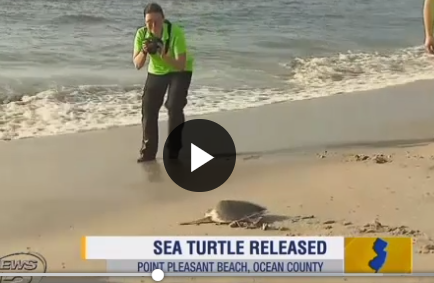
A sea turtle that was hospitalized and rehabilitated at the Turtle Back Zoo was released at Point Pleasant Beach Tuesday morning.
The turtle, a 5-year-old Kemp’s ridley sea turtle, became stranded after coming to New Jersey from Cape Cod in November 2018. Sea Turtle Recovery says this is the 41st turtle it has rehabilitated and released since opening two and a half years ago.
Bill Deerr of Sea Turtle Recovery says this species of sea turtle is critically endangered, so it’s important to release them to hopefully increase their population. He says this turtle was their sickest turtle this year.
Cargill buys large quantities of soy from local farmers in the Cerrado, a vast Brazilian savanna. Photo credit Nelson Almeida/Agence France-Presse — Getty Images
For years, the American agricultural giant Cargill has been on relatively good terms with environmental advocates, praised for agreeing to a landmark moratorium on buying soybeans grown on deforested land in the Amazon rain forest.
In recent weeks, though, that relationship has soured over the company’s refusal to agree to a similar moratorium in another environmentally sensitive region of Brazil and, more broadly, over its failure to meet its anti-deforestation targets. This month, the environmental advocacy group Mighty Earth released a report titled “Cargill: The Worst Company in the World.”
The fierce reaction shows how corporations that fall short of ambitious environmental commitments can be received. And it demonstrates the speed with which a company can go from environmental leader to scourge in the eyes of some advocates.
“What was disappointing was that Cargill got lauded and then didn’t follow through,” said Nathalie Walker, a director at the National Wildlife Federation. “I don’t think anyone is taking a personal view or an emotional view about a company. It’s judging them by their actions.”
Cargill, which acts as a middleman between farms and big food companies, is one of the top exporters of Brazilian soy. Before it committed to the soy moratorium in 2006, advocacy organizations like Greenpeace had pressured the company to stop working with farmers who cleared native vegetation in the Amazon, where rampant deforestation was creating an environmental catastrophe. Eventually, Cargill agreed to the moratorium — a move that environmental groups say has helped significantly reduce deforestation in the region.
The largest privately-owned company in the United States, Cargill has never exactly been the darling of the environmental community. But over the years, advocacy groups, often pugnacious in their criticism of powerful corporations, have occasionally lauded the company for its promises to do better. Cargill even received a Leadership in Environment Award for its role in the Amazon moratorium from the Keystone Policy Center, a nonprofit focused on compromise and civil dialogue.
Recently, however, the goodwill seems to have evaporated. Last month, Greenpeace questioned the company’s commitment to ending deforestation in Brazil, shortly before Mighty Earth released its scathing 7,000-word condemnation of Cargill, which criticized the company for pollution and meat contamination, as well as deforestation.
“It’s hard to hear,” said Ruth Kimmelshue, Cargill’s chief sustainability officer. “It doesn’t feel very good.”
Much of the recent criticism of Cargill is focused on the continuing deforestation in the Cerrado, a vast Brazilian savanna where the company buys large quantities of soy from local farmers. The Cerrado accounts for around 60 percent of Brazil’s total soy production, roughly 20 times the amount grown in the Amazon.