Citing the short-term rental tax enacted last year, shore homeowners and businesses say they’re bringing in less money at the height of the summer season.
Despite being steps from the shore during the summer season, some shore rentals sit unused and empty. The owners say a tax on short-term rentals that went into effect in 2018 is to blame. The tax adds a nearly 12% surcharge on all short-term rentals lasting less than 90 days and was originally designed to make reservations made through home-sharing platforms like Airbnb and VRBO subject to the same taxes as hotels and motels.
Begging for action, shore rental owners sent a letter this week urging Gov. Phil Murphy to a sign a bipartisan bill to tweak the bill’s language. They’ve railed against the law requesting an exemption, saying it’s drastically hurt their ability to rent and unfairly carved out the tax for real estate brokers. And there’s a trickle-down effect, say business owners. Vacant weekly rentals mean less money spent at local shops.
A giant lime-green storage container parked behind Robbinsville Township’s Senior Center is not what I imagined I’d be looking at when I learned the town had a public garden. But that’s exactly what it is and the magic happening inside the 40-foot-long space might surprise you.
Affectionately called the “leafy green machine” by the staff that runs the garden in a box, it operates on a hydroponics system, which, after stepping inside, made me feel like I was inside a sci-fi movie with its eery lights and machinery.
The storage container-turned-garden, which cost the town $104,000, was first installed in 2017. Its main focus is to provide local residents with fresh vegetables that are able to be grown year-round in nutrient-rich water without the need for dirt or pesticides.
Lettuce being prepared for packaging at Robbinsville’s hydroponic garden.
“This is really a great urban solution to bring localized greens to residents,” said Kyle Clement, the farm’s coordinator. Clement was hired shortly after graduating from Rutgers to oversee the farm’s production.
Despite its tiny size, the storage container allows them to grow the same amount of crops as a 32,000-square-foot plot of land, which amounts to about 500 heads of lettuce harvested a week. The majority of the produce — lettuce and kale, and eventually herbs like basil — is donated to the town’s senior center and the Mercer Street Friends food bank. The rest is sold to residents who sign up through the town’s program and pay $20 for four weeks of veggies.
I got a tour of the space on a recent afternoon. The inside of the container was mostly dark and was almost solely lit by blue and red LED lights. The closest I’ve come to have an experience like this is when I took a darkroom photography workshop in middle school.
The sides of the storage box are lined with rows and rows of white vertical shelves, which is where the heads of lettuce grow.
As Clement walked me through the process of farming, he pulled one of the inward-facing shelves off its stop to reveal the most perfect and symmetrical heads of lettuce that I’ve ever seen.
The reason these veggies look so perfect has to do with their growing process, which goes a little something like this:
Everything is grown from seeds. They first start out in the seed nursery for about three weeks until the lettuce bulb is big enough to fit into the vertical rack. From there, the entire growing process is controlled and monitored by the farm’s computer system.
“The sensors take all of the readings of water, temperature and pH levels, which are sent to the farm computer, and the computer reads it and adjusts the environment as needed,” Clement said.
The vertical growing system requires no soil and uses a drip water method that conserves 90% of the water used. Any water that isn’t absorbed by the vegetables is collected by the box’s irrigation system to be reused.
Instead of sunlight, the LED lights provide the energy the plants need to grow. The red and blue wavelength lights provide optimal light to the leafy vegetables growing in each garden.
Once the vegetables are fully grown, they are harvested by Clement and a team of volunteers each week. The heads of the lettuce are pulled from the vertical stacks and are cleaned on a workbench before being bagged and prepared for customers.
The state agency that oversees development in the Highlands region is seeking a senior counsel. The full-time position pays between $70,000 and $85,000 annually.
According to a job notice posted by the Council, the senior counsel, under the direction of the Chief Counsel, would provide legal support and guidance to Highlands Council legal department and management team.
“The position of Senior Counsel requires an individual who is capable of working independently under the direct supervision of Chief Counsel and possesses a professional disposition that interfaces well with the public, staff, and Council. Senior
“Counsel will also assist Chief Counsel in the formulation, interpretation, and administration of Highlands Council policies and procedures as well as the implementation of the Highlands Act and Regional Master Plan.”
Additional information about the position is available here.
TRENTON – A package of legislation sponsored by Senate Environment and Energy Chair Senator Bob Smith, Senator Linda Greenstein, and Senator Richard Codey, which will work with the Infrastructure Bank on a number of appropriations for environmental infrastructure projects, was signed into law by Governor Phil Murphy.
The first law, originally S3818, will revise the pre-conditions for the disbursement of transportation loans to concurrence from the Department of Transportation and certification in writing from the bank, to make the pre-conditions consistent with the actual roles and responsibilities of the partnership.
The law will also revise the Department of Transportation Loan Original Fee Fund to the “Transportation Loan Origination Fee Fund.” This is to reflect that the bank’s transportation loans are actually issued by the bank, rather than the department. The revision will allow the bank to impose loan origination fees on borrowers of transportation loans, and then allow those loan origination fees to be used to reimburse the bank and the department for their administrative costs in administering the transportation loan program.
“The New Jersey Infrastructure Bank is key to funding infrastructure projects around the state,” said Senator Smith (D-Middlesex / Somerset). “We need to rebuild and reinforce infrastructure throughout this state. Today, no projects are more important than environmental ones. It is imperative that we fund environmental infrastructure projects that help to repair and improve the resiliency of our environmental infrastructure systems.”
The second law, originally S3819, will authorize the New Jersey Infrastructure Bank to expend up to $655.04 million and any unexpended balances from previous authorizations to provide loans with an interest rate at or below the prevailing market rate to project sponsors of environmental infrastructure projects for fiscal year 2020. These loans are for a portion of or total cost of 117 eligible environmental infrastructure projects across the state.
“Since its creation in 1985, the Infrastructure Bank has worked in partnership with the Department of Environmental Protection to provide low-cost loans for the construction of environmental infrastructure projects that enhance and protect both ground and surface water resources,” said Senator Greenstein (D-Mercer / Middlesex). “These loans have ensured the safety of drinking water supplies throughout New Jersey. This has made possible responsible and sustainable economic development.”
The third law, originally S3820, will appropriate certain federal and State funds to the Department of Environmental Protection for the purpose of implementing the State Fiscal Year 2020 New Jersey Environmental Infrastructure Financing Program, which is expected to finance approximately $655.04 million in Storm Sandy and other environmental infrastructure projects for State Fiscal Year 2020.
“We are in desperate need to make investments in our environmental infrastructure. And there are numerous locations around the state that are in desperate need of repair,” said Senator Codey (D-Essex / Morris). “We saw the destruction that came from Superstorm Sandy, we have to be prepared for the next time a storm of that magnitude comes to New Jersey. Due to Climate Change, storms like Sandy and stronger are bound to happen more and more frequently.”
It’s mid-July, and Lake Hopatcong has been desecrated by huge splotches of green slime that you keep at a safe distance, one measured by your tolerance for a horrid stench.
The largest lake in New Jersey is usually filled with swimmers, boats, jet skis, and fishing lines. Now it’s an untouchable vacation fantasy — yes, during the hottest week of the year, and the hottest year ever recorded — because you can’t tip a toe in it without risking a skin rash right now.
A harmful algal bloom has forced the Department of Environmental Protection to shut down all activity on the lake since June 17 (except for boating), and maybe it’s something you could endure if this slop had an expiration date. But the truth is, nobody knows. The DEP cannot even guarantee that the lake will be swimmable before summer’s end, though it seemed to be making progress in the most recent water sampling.
But that’s only one problem area: On Thursday, Greenwood Lake also got a no-swim advisory after tests registered levels of cyanobacteria that were 10 times higher than our health standard. Blooms have also appeared in four smaller lakes.
This is manmade damage created by environmental apathy — a foul-smelling ooze that kills marine life, chokes ecosystems, ruins vacations, kneecaps businesses, sickens pets, and wrecks home values.
And it demands an aggressive response on state and local levels, because when you ask DEP Deputy Commissioner Debbie Mans whether this is the new normal, she replies, “Well, we’re not sure.”
We can be sure about this: Even if Mother Nature lifts this stain in her own time, preventing its recurrence will require effort from every stakeholder – the DEP, the four communities around the lake, and the property owners.
Harmful Algal Blooms (HABs) are triggered by phosphorus, a nutrient that generates algae. During heavy rain, the phosphorus leaches into the runoff from home septic systems and lawn fertilizer and ends up in the watershed, so with virtually every inch of Lake Hopatcong’s shoreline developed, it tends to proliferate.
This is manmade damage created by environmental apathy — a foul-smelling ooze that kills marine life, chokes ecosystems, ruins vacations, kneecaps businesses, sickens pets, and wrecks home values.
And it demands an aggressive response on state and local levels, because when you ask DEP Deputy Commissioner Debbie Mans whether this is the new normal, she replies, “Well, we’re not sure.”
We can be sure about this: Even if Mother Nature lifts this stain in her own time, preventing its recurrence will require effort from every stakeholder – the DEP, the four communities around the lake, and the property owners.
Harmful Algal Blooms (HABs) are triggered by phosphorus, a nutrient that generates algae. During heavy rain, the phosphorus leaches into the runoff from home septic systems and lawn fertilizer and ends up in the watershed, so with virtually every inch of Lake Hopatcong’s shoreline developed, it tends to proliferate.
This is manmade damage created by environmental apathy — a foul-smelling ooze that kills marine life, chokes ecosystems, ruins vacations, kneecaps businesses, sickens pets, and wrecks home values.
And it demands an aggressive response on state and local levels, because when you ask DEP Deputy Commissioner Debbie Mans whether this is the new normal, she replies, “Well, we’re not sure.”
We can be sure about this: Even if Mother Nature lifts this stain in her own time, preventing its recurrence will require effort from every stakeholder – the DEP, the four communities around the lake, and the property owners.
Harmful Algal Blooms (HABs) are triggered by phosphorus, a nutrient that generates algae. During heavy rain, the phosphorus leaches into the runoff from home septic systems and lawn fertilizer and ends up in the watershed, so with virtually every inch of Lake Hopatcong’s shoreline developed, it tends to proliferate.
Climate change is a major factor. More rain means more runoff, and higher temperatures can make algae turn into a toxic bloom within days.
It hardly matters now whether the state provided adequate funding for lake maintenance (short answer: no), whether the towns were alert to root causes, or whether property owners act responsibly. What matters is what happens next.
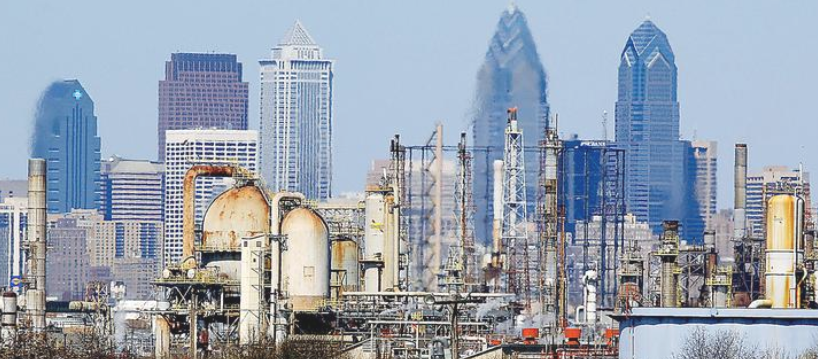
Philadelphia Energy Solutions is filing for Chapter 11 bankruptcy on Sunday for the second time in less than two years, court filings show, after an explosion and fire-ravaged its already financially struggling oil refinery complex in South Philadelphia last month.
The newest attempt to restructure the refinery’s heavy debt load comes on the heels of both PES’ decision to close the complex entirely after the fire, laying off more than 1,000 workers, and efforts by elected officials and union leaders to keep the plant open for a potential sale, although analysts doubt there will be buyer interest.
The two refineries that make up PES’ operation are Point Breeze and Girard Point, which combined make up the largest oil refinery on the East Coast. The explosion occurred at the Girard Point refinery.
In a statement, PES said the company’s entered into a “proposed debtor-in-possession financing agreement with holders of the company’s outstanding term loan debt” that provides up to $100 million in new funding. That funding will make it possible for the refinery to “safely wind down our refining operations and, with the support of our insurers and stakeholders, best position the company for a successful reorganization, the rebuilding of our damaged infrastructure, and a restart of our refining operations,” CEO Mark Smith said in the statement.
Both PES’ assets and liabilities are between $1 billion and $10 billion, the bankruptcy documents show. Its largest unsecured creditor listed is Trinity Industries Leasing Co., which it owes roughly $4 million and CSX Transportation Inc., which is owes about $3.8 million. The full list of the top 50 unsecured credits is largely made up of other industrial vendors. PES states funds will be available to distribute to unsecured creditors.