Contractors pour concrete into steel that will support the racking for a solar array on top of a landfill cell at the Frederick County landfill. Staff photo by Bill GreenSteve Bohnel reports for the Frederick News-PostA prominent company known for its electric cars is building a solar array at Frederick County’s landfill, which will power multiple county facilities in Maryland.
Mike Marschner, the county’s special administrative director and the project manager, said Tesla is building the array of solar panels after three or four years of working through permitting with state and county officials.The panels, which are being placed on top of a geosynthetic cap at one of the facility’s closed landfill sites, will produce a maximum of about 1.9 megawatts of power. A total of 7,776 photovoltaic modules will produce 3,669,961 kilowatt-hours of energy in the array’s first year — enough to power about 10 county buildings or facilities, roughly 20 percent of the county’s general building power needs, Marschner said.Marschner said the county entered a 20-year Power Purchase Agreement with Tesla, where it will pay 6.6 cents per kilowatt-hour during that time span. The county is not purchasing additional power through the agreement, but rather using the array versus other forms of energy such as steam or coal.The power will be routed off the landfill site by Potomac Edison, through a virtual net metering system. That system allows the county to receive solar credits for excess solar power produced.“The value to us, because you are in this virtual net metering mode, is we don’t pay for certain things that you normally pay for when you’re buying commercial power from the power company,” Marschner said, adding those could be fees and other charges from Potomac Edison.Read the full storyLike this? Click to receive free updates
The New York state legislature passed multiple waste-related policy changes in its $175.5 billion FY20 budget deal over the weekend.A proposal from Gov. Andrew Cuomo to expand the list of accepted products in the state’s container deposit program wasn’t among them, but two other key items moved after years of effort.
Effective January 2022, any establishment that generates more than two tons of food waste per week must separate material for donation and arrange for inedible scraps to be taken to an organics recycler within 25 miles. Temporary waivers will be granted by the state based on factors such as cost and distance.
Effective March 2020, the state will prohibit distribution of any “plastic carryout bag” (with some exemptions) and allow cities or counties to implement their own five-cent fees on paper bags. New York City, among other local governments, is now expected to take that step.
The last days of the budget season in Albany are often hectic, with many policies getting added or dropped, and this year’s negotiations were no exception. As details emerged into the weekend and final votes were taken on Sunday, it became clear legislators had made multiple significant changes to environmental policy. Some attribute this to the fact that the New York Senate is now controlled by Democrats for the first time in multiple years.
While the plastic bag ban has been getting most of the attention, the organics mandate is arguably an even bigger change. Once enacted, New York will become the sixth state to pass some version of an organics diversion mandate – following California, Connecticut, Massachusetts, Rhode Island and Vermont.
Similar versions of this proposal have been backed by Cuomo and other state lawmakers for multiple years, but repeatedly got cut from final budget deals and weren’t taken up separately in prior legislative sessions. If the policy works as intended, it will put a notable dent in waste volumes for areas of the state that don’t already have commercial diversion mandates in place — all but New York City — and encourage the development of more regional processing infrastructure. Currently, much of the city’s organic material is traveling to other Northeast states.
The policy’s passage also comes with some compromise. The required distance between covered generators and organics recyclers (which will also include animal feed) has been reduced from previous lengths of 50 and 40 miles down to 25. Hospitals, nursing homes, adult care facilities and grade schools are also exempted from complying at all. Ongoing opposition from the healthcare industry was said to be a key issue in 2018. Next, the state’s Department of Environmental Conservation is required to determine if sufficient capacity exists by June 2021 before covered establishments are expected to make arrangements for compliance.
That said, the plastic bag news is also notable. Following a 2016 ballot referendum in California, and a de facto ban in Hawaii across every county, New York is the only other state to enact such a policy to date. After the back-and-forth drama that involved New York City passing its own plastic ban/paper fee in 2016, the state legislature overriding that in 2017 and a Cuomo-appointed task force yielding minimal results in 2018, this move is seen as a long time coming. Supporters believe it will lead to a broader culture change around reusable bags, especially if the New York City Council can seal the deal with its own paper bag fee.
As for Cuomo’s pitch to expand New York’s bottle bill for the inclusion of non-alcoholic beverage containers such as juice, tea-based beverages and sports drinks, there has been little attention given to its demise. Stiff and concerted lobbying pressure from the NWRA, every major recycler in the state, multiple counties and even some environmental groups — all concerned about losing valuable local revenue on PET bottles and aluminum cans — appears to have been successful.
Contractors pour concrete into steel that will support the racking for a solar array on top of a landfill cell at the Frederick County landfill. Staff photo by Bill Green
A prominent company known for its electric cars is building a solar array at Frederick County’s landfill, which will power multiple county facilities in Maryland.
Mike Marschner, the county’s special administrative director and the project manager, said Tesla is building the array of solar panels after three or four years of working through permitting with state and county officials.
The panels, which are being placed on top of a geosynthetic cap at one of the facility’s closed landfill sites, will produce a maximum of about 1.9 megawatts of power. A total of 7,776 photovoltaic modules will produce 3,669,961 kilowatt-hours of energy in the array’s first year — enough to power about 10 county buildings or facilities, roughly 20 percent of the county’s general building power needs, Marschner said.
Marschner said the county entered a 20-year Power Purchase Agreement with Tesla, where it will pay 6.6 cents per kilowatt-hour during that time span. The county is not purchasing additional power through the agreement, but rather using the array versus other forms of energy such as steam or coal.
The power will be routed off the landfill site by Potomac Edison, through a virtual net metering system. That system allows the county to receive solar credits for excess solar power produced.
“The value to us, because you are in this virtual net metering mode, is we don’t pay for certain things that you normally pay for when you’re buying commercial power from the power company,” Marschner said, adding those could be fees and other charges from Potomac Edison.
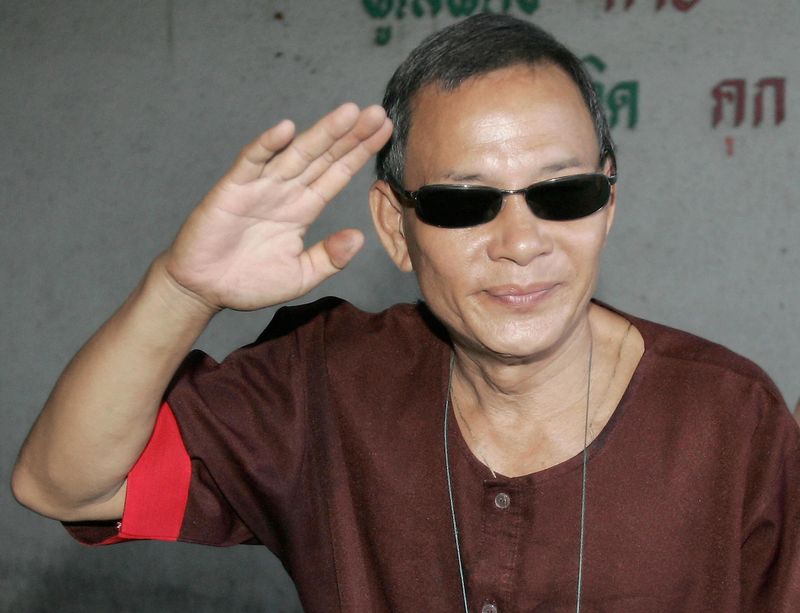
Former fighter pilot Ly Tong hijacked a plane flying from Thailand to Vietnam in 1992 to distribute thousands of leaflets calling for the overthrow of the communist government. Above, Tong waves as he arrives at court in Bangkok in 2006. (Pornchai Kittiwongsakul / AFP/Getty Images)
Anh Do reports for the Los Angeles Times
They called him the Vietnamese James Bond.
On a September day in 1992, Ly Tong hijacked an Airbus A310 on a charter flight for Vietnam Airlines, flew over Ho Chi Minh City, formerly known as Saigon, and dropped his munition: thousands of little paper bombs calling for the overthrow of the communist government.
After the rain of leaflets, he jumped from the aircraft, parachuting right into a swamp.
Today, hooked to tubes, the former South Vietnamese fighter pilot lies on a hospital bed and battles for consciousness as he nears his final descent, diagnosed with liver disease.A longtime supporter, Thien Thanh Nguyen, leaned toward him. “If you can hear me, please let me know,” he said.
In a coma in San Diego since March 21, Tong turned his head slightly.
“He’s trying his best,” Nguyen said.
For many Vietnamese immigrants from the older generation — staunch Republicans and parents and grandparents who saw their progeny become increasingly liberal — Tong, 74, was an uncompromising enemy against communism. And that, in their eyes, made him a hero.
“Many Vietnamese in the community respect how he risked himself in the name of freedom for everyone,” said Hoa Thai Cu, president of the South Vietnamese Air Force Assn. of San Diego. Cu is coordinating Tong’s medical treatment and promises that the group will pay for his funeral.
But to many members of the younger generation, Tong is a relic of the past — if they think of him at all.
“I respect the beliefs of the older people, but they are not my beliefs,” said Jessie Nguyen, 21, of Los Angeles. The graphic designer said she would “protest against the same government by not buying any products made in Vietnam. But I would not line up for a demonstration.”
Sipping jasmine milk tea from Snow Monster in Westminster, Lili Bui, 25, said she grew up hearing about Tong’s escapades from her grandparents.
“Every generation has its heroes…. But people like my grandpa focus on the past because that’s what they understand best,” said Bui, who is studying to be a cosmetologist. “They grew up with an anti-communist philosophy that sometimes favor extreme situations. I don’t agree with that, but then I was raised in America.”
For a man like Tong, the Vietnam War never truly ended.
Tong joined the South Vietnamese Air Force and at 17 was assigned to the Black Eagle fighter squadron. In the 1970s, his A-37 jet was shot down, and at the end of the Vietnam War, the North Vietnamese imprisoned him, sending him to reeducation camp outside the coastal city of Nha Trang.
He tried several times to escape, succeeding in 1980. On the loose, he would recall an 18-month adventure on foot, bicycling or riding buses through Cambodia, Thailand and Malaysia — ultimately swimming across the Johore Strait to Singapore, where he strode into the U.S. Embassy to ask for asylum.
In 1984, he resettled in Louisiana, later enrolling in a political science graduate program at the University of New Orleans. After graduating, he moved to San Jose, where he got involved in community politics, joining protests and eventually writing books on Vietnamese history and culture.
A longtime supporter, Thien Thanh Nguyen, leaned toward him. “If you can hear me, please let me know,” he said.
In a coma in San Diego since March 21, Tong turned his head slightly.
“He’s trying his best,” Nguyen said.
For many Vietnamese immigrants from the older generation — staunch Republicans and parents and grandparents who saw their progeny become increasingly liberal — Tong, 74, was an uncompromising enemy against communism. And that, in their eyes, made him a hero.
“Many Vietnamese in the community respect how he risked himself in the name of freedom for everyone,” said Hoa Thai Cu, president of the South Vietnamese Air Force Assn. of San Diego. Cu is coordinating Tong’s medical treatment and promises that the group will pay for his funeral.
But to many members of the younger generation, Tong is a relic of the past — if they think of him at all.
“I respect the beliefs of the older people, but they are not my beliefs,” said Jessie Nguyen, 21, of Los Angeles. The graphic designer said she would “protest against the same government by not buying any products made in Vietnam. But I would not line up for a demonstration.”
Sipping jasmine milk tea from Snow Monster in Westminster, Lili Bui, 25, said she grew up hearing about Tong’s escapades from her grandparents.
“Every generation has its heroes…. But people like my grandpa focus on the past because that’s what they understand best,” said Bui, who is studying to be a cosmetologist. “They grew up with an anti-communist philosophy that sometimes favor extreme situations. I don’t agree with that, but then I was raised in America.”
For a man like Tong, the Vietnam War never truly ended.
Tong joined the South Vietnamese Air Force and at 17 was assigned to the Black Eagle fighter squadron. In the 1970s, his A-37 jet was shot down, and at the end of the Viet nam War, the North Vietnamese imprisoned him, sending him to reeducation camp outside the coastal city of Nha Trang.
He tried several times to escape, succeeding in 1980. On the loose, he would recall an 18-month adventure on foot, bicycling or riding buses through Cambodia, Thailand and Malaysia — ultimately swimming across the Johore Strait to Singapore, where he strode into the U.S. Embassy to ask for asylum.
Kyle Bagenstose reports for the Bucks County Courier-Times
During a Senate Environment and Public Works committee Thursday, U.S. Sen. Tom Carper, of Delaware, and an EPA official went back and forth on the speed of the agency’s response to PFAS chemicals.
Department of Defense and Environmental Protection Agency officials faced scrutiny over their response to toxic chemicals during a Senate hearing Thursday morning, but repeated past assurances that their agencies were doing all they could to address growing contamination.
The subject of the two-hour Senate Environment and Public Works Committee hearing was per- and polyfluoroalkyl substances, or PFAS, a family of durable chemicals that have been used for decades in non-stick cookware, water-resistant clothing, firefighting foams used by the military, and other applications. Bucks and Montgomery counties are the site of one of the worst PFAS contaminations in the country, with at least 70,000 people previously exposed to dangerous amounts of the chemicals.
Citizens, towns and environmental groups nationwide have been critical of the military and EPA over the response to PFAS, saying they’ve been too slow to respond to a growing national health crisis. Committee minority leader Sen. Tom Carper, D-Delaware, voiced such concerns Thursday, saying the EPA lacked a sense of urgency.
“I know it when I see it,” Carper said. “That’s not the case, at least so far.”
David Ross, assistant administrator in the EPA’s Office of Water, referred to the agency’s PFAS Action Plan, reiterating previous congressional testimony that the EPA has committed to considering a nationwide drinking water standard, listing some PFAS as hazardous substances under the Superfund law, creating groundwater recommendations, and other measures.
When Carper tried to pin Ross down on a precise date for setting a drinking water standard, Ross said the process didn’t allow for such a prediction.
“We are going to move as expeditiously as we can,” Ross said.
Asked by Sen. Ben Cardin, D-Maryland, about how the EPA will support water suppliers and treatment operators hit by PFAS contamination costs, Ross referred to the agency’s consideration of a Superfund listing.
“If we list (PFAS) as hazardous substances … that helps in the cost recovery aspect,” Ross said.
Le Tong, Vietnamese fighter pilot and anti-communist
Anh Do reports for the Los Angeles Times
They called him the Vietnamese James Bond.
On a September day in 1992, Ly Tong hijacked an Airbus A310 on a charter flight for Vietnam Airlines, flew over Ho Chi Minh City, formerly known as Saigon, and dropped his munition: thousands of little paper bombs calling for the overthrow of the communist government.
After the rain of leaflets, he jumped from the aircraft, parachuting right into a swamp.
Today, hooked to tubes, the former South Vietnamese fighter pilot lies on a hospital bed and battles for consciousness as he nears his final descent, diagnosed with liver disease.A longtime supporter, Thien Thanh Nguyen, leaned toward him. “If you can hear me, please let me know,” he said.
In a coma in San Diego since March 21, Tong turned his head slightly.
“He’s trying his best,” Nguyen said.
For many Vietnamese immigrants from the older generation — staunch Republicans and parents and grandparents who saw their progeny become increasingly liberal — Tong, 74, was an uncompromising enemy against communism. And that, in their eyes, made him a hero.
“Many Vietnamese in the community respect how he risked himself in the name of freedom for everyone,” said Hoa Thai Cu, president of the South Vietnamese Air Force Assn. of San Diego. Cu is coordinating Tong’s medical treatment and promises that the group will pay for his funeral.
But to many members of the younger generation, Tong is a relic of the past — if they think of him at all.
“I respect the beliefs of the older people, but they are not my beliefs,” said Jessie Nguyen, 21, of Los Angeles. The graphic designer said she would “protest against the same government by not buying any products made in Vietnam. But I would not line up for a demonstration.”
Sipping jasmine milk tea from Snow Monster in Westminster, Lili Bui, 25, said she grew up hearing about Tong’s escapades from her grandparents.
“Every generation has its heroes…. But people like my grandpa focus on the past because that’s what they understand best,” said Bui, who is studying to be a cosmetologist. “They grew up with an anti-communist philosophy that sometimes favor extreme situations. I don’t agree with that, but then I was raised in America.”
For a man like Tong, the Vietnam War never truly ended.
Tong joined the South Vietnamese Air Force and at 17 was assigned to the Black Eagle fighter squadron. In the 1970s, his A-37 jet was shot down, and at the end of the Vietnam War, the North Vietnamese imprisoned him, sending him to reeducation camp outside the coastal city of Nha Trang.
He tried several times to escape, succeeding in 1980. On the loose, he would recall an 18-month adventure on foot, bicycling or riding buses through Cambodia, Thailand and Malaysia — ultimately swimming across the Johore Strait to Singapore, where he strode into the U.S. Embassy to ask for asylum.
In 1984, he resettled in Louisiana, later enrolling in a political science graduate program at the University of New Orleans. After graduating, he moved to San Jose, where he got involved in community politics, joining protests and eventually writing books on Vietnamese history and culture.
A longtime supporter, Thien Thanh Nguyen, leaned toward him. “If you can hear me, please let me know,” he said.
In a coma in San Diego since March 21, Tong turned his head slightly.
“He’s trying his best,” Nguyen said.
For many Vietnamese immigrants from the older generation — staunch Republicans and parents and grandparents who saw their progeny become increasingly liberal — Tong, 74, was an uncompromising enemy against communism. And that, in their eyes, made him a hero.
“Many Vietnamese in the community respect how he risked himself in the name of freedom for everyone,” said Hoa Thai Cu, president of the South Vietnamese Air Force Assn. of San Diego. Cu is coordinating Tong’s medical treatment and promises that the group will pay for his funeral.
But to many members of the younger generation, Tong is a relic of the past — if they think of him at all.
“I respect the beliefs of the older people, but they are not my beliefs,” said Jessie Nguyen, 21, of Los Angeles. The graphic designer said she would “protest against the same government by not buying any products made in Vietnam. But I would not line up for a demonstration.”
Sipping jasmine milk tea from Snow Monster in Westminster, Lili Bui, 25, said she grew up hearing about Tong’s escapades from her grandparents.
“Every generation has its heroes…. But people like my grandpa focus on the past because that’s what they understand best,” said Bui, who is studying to be a cosmetologist. “They grew up with an anti-communist philosophy that sometimes favor extreme situations. I don’t agree with that, but then I was raised in America.”
For a man like Tong, the Vietnam War never truly ended.
Tong joined the South Vietnamese Air Force and at 17 was assigned to the Black Eagle fighter squadron. In the 1970s, his A-37 jet was shot down, and at the end of the Vietnam War, the North Vietnamese imprisoned him, sending him to reeducation camp outside the coastal city of Nha Trang.
He tried several times to escape, succeeding in 1980. On the loose, he would recall an 18-month adventure on foot, bicycling or riding buses through Cambodia, Thailand and Malaysia — ultimately swimming across the Johore Strait to Singapore, where he strode into the U.S. Embassy to ask for asylum.

 Contractors pour concrete into steel that will support the racking for a solar array on top of a landfill cell at the Frederick County landfill. Staff photo by Bill Green
 Steve Bohnel reports for the Frederick News-PostA prominent company known for its electric cars is building a solar array at Frederick County’s landfill, which will power multiple county facilities in Maryland.