Oh no! 30th Street Station’s famous flipping sign in Philadelphia is coming down soon

Amtrak’s iconic departures board is heading to the Railroad Museum of PA as soon as January.

The antique Amtrak Solari board

The antique Amtrak Solari board

DAVID WILSON / FLICKR CREATIVE COMMONS


Michaela Winberg reports for BillyPenn:
More than two years after
news broke that Amtrak would replace the iconic departures board at 30th Street
Station, the move looks like it’s finally about to happen.

The Pennsylvania Historical and Museum Commission expects to take ownership of the world-famous Solari board as soon as January 2019. The model, which flips individual panels each time a train’s status is updated, providing that classic “clicking” sound familiar to travelers around the globe, is considered an antique.
An official agreement hasn’t yet been signed, so the transfer date is subject to change. But Howard Pollman, spokesperson for the historical commission, is pretty certain he’ll receive the board in late January or early February.
At that point, the sign will move 60 miles to its new home: The Railroad Museum of Pennsylvania in Strasburg.
And it’s not a moment too soon, per museum site manager Patrick Morrison. They’ve been negotiating an agreement with Amtrak for more than two years. Morrison is thrilled to acquire what he calls an “electromechanical wonder” and incorporate it into an existing exhibit.
Amtrak officials, who are expected to replace the analog board with a digital one, repeatedly declined to comment.

BILLY PENN VIDEO

‘An amazing time capsule’

Display panels of this type are named for the manufacturer Solari di Udine, of Udine, Italy. They grew in popularity in the 1950s, and were installed en masse in airports and train stations worldwide. Even early seasons of game shows like Family Feud used them.
Now, they’re nearly extinct in the United States. To mixed emotions, New York Penn Station got rid of its Solari board two years ago. The entire Metro-North transit system replaced its network of Solari boards by 2014.

Oh no! 30th Street Station’s famous flipping sign in Philadelphia is coming down soon Read More »

NJ sets wetness records. Trump denies it’s climate change


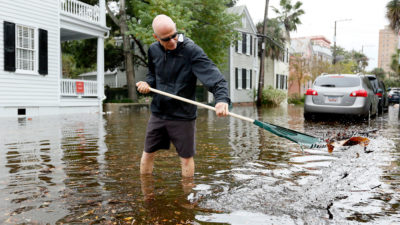
New Jersey’s gotten wetter over the last couple decades, and 2018 could rank among the state’s top five wettest years stretching back to 1895. A federal climate report released last week says far worse effects are coming. President Donald Trump’s response? “I don’t believe it.”


NJTV’s Brenda Flanigan reports from a once-again-flooded
Fairfield, NJ.

Like this? Click to receive free updates

NJ sets wetness records. Trump denies it’s climate change Read More »

The 13 NJ counties that clean up the most dead deer

Bill Gallo Jr. | For NJ.comThe population of white-tailed deer in New Jersey has exploded and caused problems. Bill Gallo Jr. reports for NJ.com:The white-tailed deer population in New Jersey was so critically low from over-harvesting that state wildlife officials restocked some of the woodlands to revive the dwindling population.That was a century ago.The handful of deer grew through the 20th century and into the 21st until today when deer are everywhere from the most rural to even urban areas. One of the most dangerous times for motorists — and deer — is in the breeding or rutting season from mid-September through November.Where the most dead deer were collected in 2017When deer and vehicles meet, it becomes a dangerous situation.
Where the most dead deer were collected in 2017Following is a list of the 13 counties with the most deer collected after being found dead along New Jersey state highways. The figures are from the New Jersey Department of Transportation and represent just those deer carcasses picked up along state roadways. They do not include the dead deer picked up by counties and municipalities from the roads which they have jurisdiction over. All counties in New Jersey had dead deer collected from their state roads. The counties not on our list below and the number of deer collected there are: Atlantic, 69; Camden, 76; Cape May, 5; Cumberland, 36; Essex, 69; Gloucester, 87; Hudson, 6; and Salem, 50.13. Union County13. Union CountyDuring 2017 in Union County there were 97 dead deer picked up from state highways. That number is up by 28 from the 69 collected in 2016.  12. Burlington County12. Burlington CountyIn 2017, the state Department of Transportation picked up 155 deer carcasses from the roadways it has jurisdiction over in Burlington County. That number is just two more than the 153 that were gathered from the state roads there in 2016.11. Passaic County11. Passaic CountyIn Passaic County, the state picked up 183 dead deer from its roadways in 2017. That number is 63 more than the 120 collected in 2016.10. Ocean CountyIn Ocean County the state collected 304 dead deer in 2017 along the roadways over which it has jurisdiction. That number is 55 more than the 249 collected in 2016 on those same roads.9. Bergen CountyIn Bergen County the number of dead deer collected by the Department of Transportation from its roadways in 2017 totaled 340. In 2016, 308 deer carcasses were picked up, 32 fewer. 8. Sussex CountyIn rural Sussex County, in the northwestern corner of the state, 355 dead deer where removed from its roads by the Department of Transportation in 2017. That’s 19 less than the 374 collected from the roads there in 2016, the state says.7. Warren CountyWarren County is one of the state’s most rural areas where deer are plentiful. During 2017, 438 dead deer were picked up along state roads. That’s down by one from 2016 when 439 were collected.6. Middlesex CountyIn Middlesex County, 482 dead deer were collected from roadways the state has jurisdiction over in 2017. During 2016, 3 fewer deer — 479 — were picked up, according to officials. 5. Mercer CountyMercer County had 539 deer carcasses carried away from its state roads in 2017, down 27 from the 566 collected in 2016, according to officials.4. Morris CountyIn 2017, 624 dead deer were picked up from state roads in Morris County. That number is down 62 from the 686 that were found in 2016, according to state officials.3. Hunterdon CountyIn Hunterdon County, 888 deer carcasses were collected in 2017 from its roads, the state says.  The number was 45 more — 933 — in 2016.2. Somerset CountyThe state Department of Transportation picked up 930 dead deer during 2017 from the roads it has jurisdiction over in Somerset County, officials say. That’s a big jump, 120 more than the 810 collected in 2016.1. Monmouth CountyOnce again, the most dead deer picked up from along state roadways in a single county in 2017 was in Monmouth.  There, 1,026 carcasses were collected, 27 more than in 2016 when 999 dead deer were removed.Accidents with deer are most common in rural areas. (File Photo)You can make sure dead deer are picked upThe New Jersey Department of Transportation is responsible for removing deer carcasses from interstate and state highways. Individual counties and municipalities are responsible for removing deer and other dead animals on roadways under their jurisdiction.In the calendar year 2017, NJDOT removed 6,762 dead deer from its roads. That’s 237 more, officials said, than were collected in 2016 by the state — 6,525.Go online at http://www.state.nj.us/transportation/commuter/potholeform.shtm and report the location of deer carcasses seen on state roads on the NJDOT website or call 1-800-POTHOLE (This is the same site and number to report potholes, litter, or other maintenance issues).Like this? Click to receive free updates

The 13 NJ counties that clean up the most dead deer Read More »

Garden State salad lovers, emerge from your bunkers

The good stuff. A  field of New Jersey romaine lettuce  (NJ Department of  Agriculture)

By Frank Brill, EnviroPolitics editorIn the mood for a nice, crisp salad filled with romaine lettuce?


If it was grown in New Jersey, you needn’t be concerned by those pre-Thanksgiving health warnings.

The New Jersey Department of Agriculture today announced:

“The U.S. Food
& Drug Administration and Centers for Diseases Control and Prevention have
announced that their agencies have narrowed down the source of contaminated
romaine lettuce at the heart of a recent outbreak of E. coli 0157:H7, and
that no New Jersey-grown lettuce is connected to the outbreak.
The New Jersey Department of Agriculture, therefore, reminds
consumers and retailers that romaine lettuce grown in New Jersey can be
purchased with confidence. Consumers should make sure that any romaine they buy
is clearly labeled as to where it was produced.
In announcing the
modification of its earlier advisory against eating any romaine, the FDA said
in a statement that,
There is no recommendation for consumers or
retailers to avoid using romaine lettuce that is certain to have been harvested
from areas outside of the Central Coast growing regions of northern and central
California
.”

Like California doesn’t have enough problems already.

Garden State salad lovers, emerge from your bunkers Read More »

NJ lawmakers tap $170M in pollution damages for habitats

Money from ExxonMobil case would be part of allotment for several restoration projects, but environmentalists concerned that funds are not properly targeted


Seagulls

Tom Johnson reports
for NJ Spotlight:
The state is moving to spend tens of millions of dollars on restoration of natural resources, an issue that led to voter approval last year of a constitutional amendment preventing money from pollution settlements being diverted to plug budget deficits.
The Senate Environment and Energy Committee yesterday approved legislation (S-3110) that would funnel more than $160 million from two natural-resource damage claims to a range of habitat restoration and water quality improvement projects.
The bill includes $50 million to be set aside from a controversial $225 million settlement with ExxonMobil to clean up contamination of more than 1,800 acres of wetlands and marshes around two refineries it operated in Linden and Bayonne. The bulk of the settlement — $125 million — was diverted to the general fund by the Murphy administration and $50 million covered attorney fees in the protracted litigation in the ExxonMobil case.
Those diversions, common during Gov. Chris Christie’s two terms, were supposed to end with approval in the fall of 2017 of a constitutional amendment dedicating funds from natural-resource damage claims to restoration and other environmental projects. The Murphy administration contended the amendment did not apply to the ExxonMobil settlement, a stance backed by a legal opinion from the Office of Legislative Services.
The legislation also allocates another $110 million from a separate natural-resource damage settlement to a range of environmental projects, including $30 million to prevent saltwater intrusion in groundwater supplies in Cape May and $19 million to restore the Atlantic White Cedar watershed in South Jersey.

Cleaning up the Hudson-Raritan Estuary

Other restoration projects that will be covered by the legislation include $10 million to improve water quality in the Hudson-Raritan Estuary by fixing combined sewer overflow systems that often spew raw sewage into waterways during heavy rainfall. Another $20 million is targeted for improvements to water supply and wastewater treatment systems and $10 million for habitat restoration.
That separate natural-resource damage claim involved a lawsuit brought more than a decade ago against three oil companies charged with polluting groundwater with a potential human carcinogen, methyl tertiary butyl ether (MTBE).
Environmentalists, who lobbied hard for the constitutional amendment, expressed concern the bill allocating the money did not specifically target it on areas harmed by the pollution incidents.
“The bill is too vague on where the money is going to go,’’ said Jeff Tittel, director of the New Jersey Sierra Club. “We want to make sure the funding for restoration projects is going directly to areas impacted by Exxon.’’
But Sen. Bob Smith (D-Middlesex), the chairman of the committee, disagreed. “I think that it’s just fabulous,’’ he said, saying it is the first time money from pollution settlements is being allocated to the restoration of natural resources since the constitutional amendment was approved. “It’s a shame we didn’t do it before.’’

NJ lawmakers tap $170M in pollution damages for habitats Read More »

Bridgegate appeal denied, ex-Christie associates face jail

Bridget Anne Kelly and Bill Baroni leaving federal court after sentencing in Newark last year. (Julio Cortez | AP file photos)
 Bridget Anne Kelly and Bill Baroni leaving federal court after sentencing in Newark last year. (Julio Cortez | AP file photos)


Ted Sherman reports for NJ.com:
A federal appeals court today upheld a major part of the convictions of two members of former Gov. Chris Christie’s inner circle in the high-profile Bridgegate scandal of political retribution that played out five years ago on the world’s busiest bridge.
However, the U.S. Court of Appeals for the Third Circuit in Philadelphia threw out a part of the case dealing with civil rights violations against the two former Christie associates.
The ruling will likely mean that both Bill Baroni and Bridget Kelly will now face prison. Both have remained free since their trial pending the appeal.
In its 78-page ruling, the court said federal prosecutors presented evidence sufficient to prove that the two fraudulently obtained the labor of public employees, and in a harsh rebuke, said there was no “legitimate justification” for Baroni and Kelly’s conduct.
A spokesman for the U.S. Attorney’s office said it was “reviewing the opinion and is grateful for the court’s consideration of all of the issues raised in the appeal.”

Bridgegate appeal denied, ex-Christie associates face jail Read More »