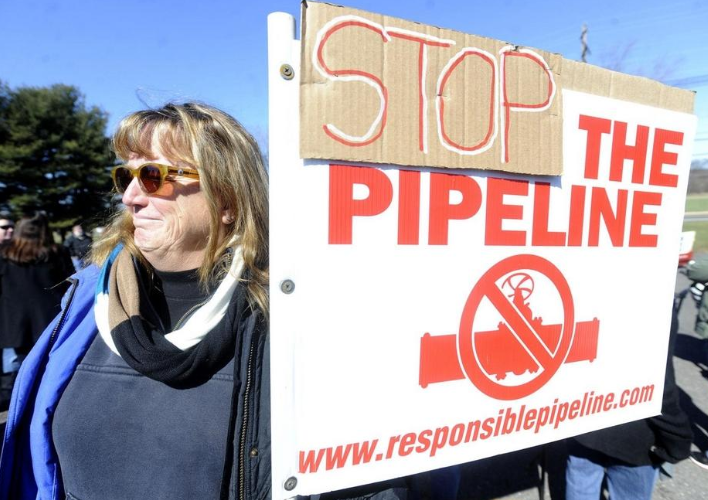
NJDEP denies permit application for Transco/Williams fracked-gas compressor station, citing “deficiencies”

Fracked gas compressor station proposed for construction in Franklin Twp., NJ


Ashley Jankowski reports for TAPinto.net:

The New Jersey Department of Environmental Protection recently denied Transco/Williams, the permit application necessary for advancing the construction of the Northeast Supply Enhancement pipeline project.
The Northeast Supply Enhancement project (NESE) is a fracked gas pipeline that would potentially run from Raritan Bay in New Jersey to a pipeline offshore of the Rockaways in Queens, New York. It is an expansion of the preexisting Transcontinental Gas Pipeline, which brings natural gas from as far south as the Gulf Coast of Texas up to the New Jersey and New York region.
The $1 billion project includes the highly controversial construction of a compressor station on a 52-acre site in Franklin, near State Highway 27 and County Route 518.
In June, Transco/Williams submitted an application to the Division of Land Use Regulation for a series of permits, including a Flood Hazard Area Individual Permit, a Flood Hazard Area Verification, a Freshwater Wetlands Individual Permit, a Waterfront Development Permit, and a Coastal Wetland Permit. This application was first denied on July 18th, and while Transco/Williams reapplied, The Division of Land Use Regulation determined that the application still remained deficient on September 12th.
Citing the NJDEP’s deficiency letter, the New Jersey Chapter of the Sierra Club released a statement condemning the project.
“The DEP has once again found Transco’s application for water permits for their NESE project deficient,” said Jeff Tittel, Director of the New Jersey Sierra Club, in the press release. “This is because it’s a bad project and the applications are incomplete. Now we need to urge the NJDEP to throw out Transco’s application together.”
The New Jersey Sierra Club argues that the proposed compressor station would create detrimental air, water, and noise pollution in its surrounding areas, and that the pipeline poses pollution risks to New Jersey waterways, especially the Raritan Bay.
“This project would cut through the already polluted and sensitive Raritan Bay and the New York Bay,” Tittel said. “It could carry and release contaminated sediment into the environment and both bodies of water and disturb contaminated sites. When you cut through a bay like the Raritan, it has an impact on the fisheries as well as the ecology of the Bay. The fish, plants and other living creatures in the Bay would be threatened by this pipeline.”
Along with a number of other opponents to the project, the New Jersey Sierra Club also asserts that NESE would be a step backward in New Jersey and New York’s respective transitions to renewable energy.
Transco/Williams regarded the deficiency letter as “a normal part of the state’s permit application process” and that it is “common for a permit application [of] this size”.
“We continue to actively collaborate with NJDEP to satisfy its application requirements so that it can be considered administratively complete and processed in a timely manner,” said Christopher L. Stockton, a Williams media representative for Atlantic Gulf and Transco. “In that regard, we plan to file a response to NJDEP’s notification shortly. It is unfortunate that some organizations would attempt to misrepresent what is a normal step in the permit application process.”
A closer look at the deficiency letter shows that the application failed to a number of missing components, rather than proven environmental hazards.
What are the problems with the application?

NJDEP denies permit application for Transco/Williams fracked-gas compressor station, citing “deficiencies” Read More »

Assembly Speaker’s bills address hunger in New Jersey

New Jersey Assembly Speaker Craig Coughlin today discussed the hunger gap faced by many families in the state while unveiling a comprehensive legislative bill plan aiming to close this gap, ensuring no one, especially children, go hungry.

Speaker Coughlin said each bill is a meaningful step in addressing broader hunger concerns, such as food deserts, poverty, access to state programs and resources and excessive food waste.

“Too many families in New Jersey have to choose between paying their bills and eating a nutritious meal. In our urban and rural communities, some families live more than a mile away from a supermarket, limiting their access to healthy food options,” said Coughlin (D-Middlesex) after touring the Community FoodBank of New Jersey in Hillside. “These bills not only address the rising number of young children affected by hunger but also the increasing trend of hunger surfacing on our college campuses. We’re improving access to state resources, engaging food banks and bringing together schools and state departments to fight hunger in New Jersey.”

Among the bills in the package is legislation that would establish an “Anti-Hunger” link to be posted on all state government websites, listing all of the state’s food programs including food pantries, shelters and soup kitchens; two bills addressing food insecurity among students on college campuses – The Hunger-Free Campus Act- and reimbursing school districts that purchase NJ grown produce for their school breakfast and lunch programs; and also a measure that would enact the “Food Desert Elimination Act” by establishing incentives to attract and retain qualified supermarkets in the state’s food deserts.

Assemblywoman Annette Quijano, Anti-Poverty Network of New Jersey Executive Director Renee Koubiadis, and constituents actively involved in food banks also attended the event

“One of nearly every six children you see on the playground is facing food insecurity at home. One in every six,” said Quijano (D-Union). “We have to do something to feed families. We have to do something to connect families to programs and give those programs greater resources. Making nutrition programs easier to find and apply for will help put food on the table for many who are currently fighting hunger.”

“Direct legislative action to combat hunger is long overdue in New Jersey,” said Koubiadis, Anti-Poverty Network of New Jersey Executive Director. “I applaud the efforts of the Speaker and Assembly members to turn the spotlight on the hunger crisis being faced in many homes and communities throughout the state.”

Like this? Click to receive free updates

© 1983-2018 Government News Network. All rights reserved. Contents ma

Assembly Speaker’s bills address hunger in New Jersey Read More »

Up for votes in the NJ State Senate on Thursday

The New Jersey Senate will meet at 2 p.m. on Thursday, September 27. Among the bills scheduled for consideration are the following:


S1707 (Oroho / Bateman) – Exempts governmental entities acquiring lands for open space located in a deed-authorized common interest community from paying community fees if, at time of acquisition, the community has never been formed or has been dissolved or discontinued.

S1821 (Singleton) – Establishes a procedure for the removal of certain abandoned water control structures causing property erosion.


S2511 (Madden) – Changes title of DEP “conservation officer” to “conservation police officer.”


A1330 / S2491 (Gusciora / Pinkin / Reynolds-Jackson / O’Scanlon / Gopal) – Directs Dept. of Agriculture to create pilot program to research cultivation of industrial hemp.


Votes to consider adoption of the Governor’s recommendations on the following bills:


S1057 (Van Drew / Gopal / Houghtaling) – Requires EDA, in consultation with Department of Agriculture, to establish a loan program for certain vineyard and winery capital expenses.


A3676 (Mazzeo / Armato / Giblin) – Creates Garden State Growth Zone at Atlantic City International Airport and the surrounding area; adjusts full-time employee designation requirements.

A vote to concur with the Assembly amendments to the following bill:

S2333 (Gordon / Lopez / Benson) – Requires NJT to establish an office of real estate economic development and transit-oriented development; requires an annual report of certain real property information.


Like this? Click to receive free updates

Up for votes in the NJ State Senate on Thursday Read More »

New spark for energy-saving measures in New Jersey

For years, energy conservation has been a state priority more in theory than in practice. The Murphy administration has set new goals, but there’s disagreement about how to achieve them

Tom Johnson reports for NJ Spotlight:

Steve Gabel

More than a decade ago, New Jersey ranked among the nation’s ten best states in promoting energy-saving actions for its residents and businesses.

Not anymore. A recent ranking by the respected American Council for Energy Efficiency Economy put New Jersey in the middle of the pack at 23rd — despite energy conservation repeatedly being cited as a top priority in the state’s energy master plans as long ago as 1978, according to Steven Gabel, president of Gabel Associates, an energy consulting firm.
Now, a law signed by Gov. Phil Murphy this spring establishes new goals to cut energy use and, for the first time, mandates New Jersey’s gas and electric utilities to curb customer consumption.
For clean-energy advocates, utilities, and others who participated in an NJ Spotlight roundtable in Newark this past Friday on energy efficiency, it is well past the time to get the show on the road.
“Customers want to use less energy because they want to save money,’’ said David Daly, president and COO of Public Service Electric & Gas, the state’s largest utility. “It’s their number one issue for them.’’

Mixed results

It may be a top priority of both customers and policymakers, but the results have been mixed, at least by some advocates’ perspective.

Mary Barber

Mary Barber
In the state’s fiscal year 2018, the New Jersey Office of Clean Energy projected 0.36 percent in annual energy savings, according to Mary Barber, New Jersey clean-energy director for the Environmental Defense Fund. The new state law requires electric utilities to cut consumption by 2 percent and gas companies to cut it by 0.75 percent. “Based on the results, we need change,’’ said Barber.
“We’ve really scratched the surface in New Jersey despite very great efforts,’’ agreed Adam Procell, president and chief executive officer of Lime Energy, a Newark company involved in energy conservation.

During a wide-ranging discussion, participants were more optimistic the new law could push the state into a leadership role in energy conservation, with some debate over the role of the state’s utilities and how much they should be rewarded.

Brand: ‘The utilities are fine’

Several speakers argued utilities — with well-established relationships with customers — ought to be the focus on bringing energy-efficiency to residents and businesses.

Stefanie Brand

Stefanie Brand
But Stefanie Brand, director of the Division of Rate Counsel, disputed the prospect of allowing utilities to recover lost revenue from sales by incenting customers to use less energy — a provision called “decoupling’’ in energy jargon that’s used in more than half of the other states in the country.
“The entire energy efficiency discussion cannot be about how are we going to pay utilities,’’ Brand said. “This is crazy. This is why nothing has happened. I see their books. The utilities are fine.’’
Others disagreed on whether the state can move forward with aggressive energy-efficiency goals without decoupling.

Read the full story


Like this? Click to receive free updates


New spark for energy-saving measures in New Jersey Read More »

Environmental bills set for votes in NJ Assembly on Sep. 27


The New Jersey Assembly has scheduled the following bills for consideration when it holds its next voting session at 1 p.m. on Thursday, September 27, 2018:

A1053 (Houghtaling / Taliaferro / Andrzejczak) – Revises and expands laws on trespass and vandalism on agricultural and horticultural lands.


A3676 (Mazzeo / Armato / Giblin) – Creates Garden State Growth Zone at Atlantic City International Airport and the surrounding area; adjusts full-time employee designation requirements.


AJR150 (Johnson / Conaway) – Designates October 8 of each year as “Hydrogen and Fuel Cell Day” in NJ.


Like this? Click to receive free updates


Environmental bills set for votes in NJ Assembly on Sep. 27 Read More »

New Jersey bill addresses electric service to critically ill

Following the death of a New Jersey woman who died after PSE&G shut off her power, State Sen. Gerry Cardinale (R-39) has introduced legislation that would prohibit electric public utilities from discontinuing service in cases where doing so would put lives of seriously-ill consumers at risk.

“It is hard to imagine that a public utility company could be so callous, that they would put someone’s life in jeopardy, just to turn a profit,” Cardinale said. “Linda Daniels’ family pleaded with the electric company to restore her power, while she was gasping for air. My prayers are with her family. We can’t erase their pain, but we can take action to ensure this never happens to another terminally-ill customer again.”

Due to her battle with congestive heart failure, Linda Daniels was heavily dependent on an oxygen tank. On Thursday, July 5, 2018, Daniels’ power was cut off by PSE&G. Daniels was reportedly unable to breathe and passed away just a few short hours after PSE&G turned off her power.

The NJ Board of Public Utilities currently bars electric companies from shutting off power for customers with life-threatening medical conditions. Cardinale noted, however, that many customers often have difficulty reporting a condition in the first place, or find that when they do try to make the company aware of their medical circumstances, utility representatives are unresponsive to their needs, or flat-out ignore their request for accommodations.

Sen. Cardinale’s legislation, S2945, would establish a “medical customer” identification system that utility companies would be required to observe in order to ensure critically-ill customers do not have to cope with a sudden loss of service.

S2945 would also require an electric company, on a semiannual basis, to ask their customers if an individual in the household suffers a serious health condition.

Under the bill, a utility could require the “medical customer” to:

* Provide reasonable proof of an inability to pay a utility bill on or before the bill’s due date.

* Deliver a semi-annual written statement from a medical professional.

* Specify the nature of the medical condition, only if the disclosure is not prohibited by law.

“Public utilities must be held accountable for consumer safety,” Cardinale said. “By requiring an electric company to survey every residence they serve, we can ensure that critically-ill customers do not have to suffer the horrible fate that befell Linda Daniels. No one should have to spend their last moments gasping for air in the dark, because a power company refused to meet their needs. I have no doubt that this legislation will save lives.”

Like this? Click to receive free updates

New Jersey bill addresses electric service to critically ill Read More »