Down to the wire, a New Jersey budget deal is reached


Lawmakers and Gov. Phil Murphy have struck a deal on a fiscal 2019 budget, just hours before a much-feared government shutdown would have gone into effect.
“This is a win for the middle class and working families,” Murphy said.
The governor was flanked at a 7:30 p.m. Saturday press conference by Legislative leaders including Assembly Speaker Craig Coughlin, D-19th District; Senate President Stephen Sweeney, D-3rd District; Senate Majority Leader Loretta Weinberg, D-37th District; Lt. Gov. Sheila Oliver; and Treasurer Elizabeth Maher Muoio.
As part of the agreement, Murphy agreed to a millionaires’ tax with a threshold at $5 million, a concession that had been sought by Sweeney.
The Senate President also got the corporate business tax he was looking for, which would see an increase by 2.5 percent for two years and 1.5 percent for the two years after that.

“The corporations that Donald [Trump] gave billions of dollars to are finally going to give their fair share,” Sweeney said.

But the tax rate multimillionaires will pay will grow to the 10.75 percent rate Murphy sought, rather than the 9.95 percent rate backed by the Legislature.
There will be no sales tax increase, despite Murphy’s attempts to boost it from the current 6.625 percent to 7 percent.
Saturday evening’s announcement comes as a relief for those fearing the second state shutdown in a row. The state’s parks and beaches were on the verge of a shutdown just prior to the July 4 holiday, and racetracks and casinos were told they would have to cease operations as well.
A vote on the new budget is scheduled for Sunday.

Down to the wire, a New Jersey budget deal is reached Read More »

NJ joins suit to prevent EPA flip-flop on refrigerant


Federal agency loosens its own limits on hydrofluorocarbons, compounds used in refrigeration, air conditioning, insulation, aerosols, and other processes

Tom Johnson reports for NJ Spotlight:


New Jersey is joining other states in trying to block the Environmental Protection Agency from easing rules that limited the use of a potent industrial chemical contributing to climate change.
The lawsuit is the latest in a series of actions filed by the state against the Trump administration’s efforts to weaken environmental regulations aiming to address climate change.
Filed yesterday in U.S. District Court in Washington, D.C., the petition seeks to invalidate a recently issued guidance document that effectively suspends the agency’s own three-year-old ban on use of hydrofluorocarbons (HFCs) in manufacturing.
“As we saw during superstorm Sandy, the symptoms of climate change — like extreme weather, rising seas, and coastal erosion — can put our state at grave risk,’’ said New Jersey Attorney General Gurbir Grewal.
Climate change is the greatest environmental threat to the state and the planet, Grewal said. “Washington should be placing stricter rules on greenhouse gases, not weakening them,’’ he said.
New Jersey Department of Environmental Protection Commissioner Catherine McCabe noted the state has been aggressive in trying to reduce greenhouse emissions from power plants, industrial facilities, and vehicles.
“This backdoor attempt to change the rules will undermine our efforts and place at risk those actions that are necessary in other states to address global warming and sea-level rise,’’ McCabe said.
HFCs are compounds used in refrigeration, air conditioning, insulation, aerosols, and other processes. The agency moved to limit their use a few years ago when new alternatives were developed with far less climate impact than HFCs.

Read the full story


Like this? Click to receive free updates

NJ joins suit to prevent EPA flip-flop on refrigerant Read More »

New Jersey Recycling Pioneer, Jean Clark, dies at 95

NJ recycling pioneer Jean Clark
The New Jersey
recycling community mourns the death, on June 24, of Jean Clark, 95, widely regarded as the state’s ‘Mother of Recycling.

Clark, in
the 1970s, developed one of the first community recycling centers in her hometown of Montclair. It soon became a
model for municipal and county recycling programs that followed statewide–and
nationwide.
 
“Jean was a true recycling pioneer,” said Guy Watson president of the Association of New Jersey Recyclers (ANJR) and former recycling chief at the New Jersey Department of
Environmental Protection (NJDEP
). “Her efforts
were crucial to the development and passage of legislation that made our
state the first in the nation to require the curbside separation and recycling
of household paper, glass and metal.”
 

ANJR Executive Director Marie Kruzan said: “I was fortunate to know and learn from Jean for over 30
years.  As a newbie in recycling, Jean guided me, in her quiet way, sharing her knowledge
and understanding. Jean may have been quiet, but she held strong views
and was not shy about sharing her opinion and experience. We all are
better for knowing and working with Jean.”

Clark received many awards: “Recycler of the Year” from the National Recycling Congress (1980), “Recycler of the Decade” (1980) from the New Jersey Department of Environmental Protection, the New Jersey Pride Award in the field of Environment (1986), and the Wells College Alumnae Association Award, (2000). Groups she was part of were often more effective than flashy, such as the Essex County Solid Waste Advisory Council.

Clark graduated from Wells College in Aurora, New York in 1945, and took a M.A. in Philosophy from Mt. Holyoke College in South Hadley, Massachusetts. She championed women’s colleges, but made an adjustment to her worldview when men were admitted at Wells College a few years ago.

Clark’s single-minded devotion sometimes made her an inadvertent pioneer. In 1970, the New Jersey Audubon Society felt there should be at least one woman on the Board, so they made her the Secretary. “Someone to take the notes,” she recalled. Being the only woman in a room full of men did not faze her, and she was soon joined on the board by other women. She served the organization for more than 30 years

Former NJDEP Chief of Staff
Gary Sondermeyer said:
“Jean was the true “Founder” of the
recycling movement in New Jersey and a total inspiration – her legacy most
certainly lives on with a reputation beyond reproach.”

“I feel blessed to have been inspired by Jean’s
determination, motivated by her actions and encouraged to make a
difference based on her efforts.” said
Sussex County Recycling Coordinator Renee Casapulla.” Jean’s wit and
contagious laughter will always warm my heart.”


Related videos:

Jean Clark Recycling Pioneer (August) 2010 New Jersey Recycling Pioneers Jean Clark and Mary Sheil


Like this? Click to receive free updates

New Jersey Recycling Pioneer, Jean Clark, dies at 95 Read More »

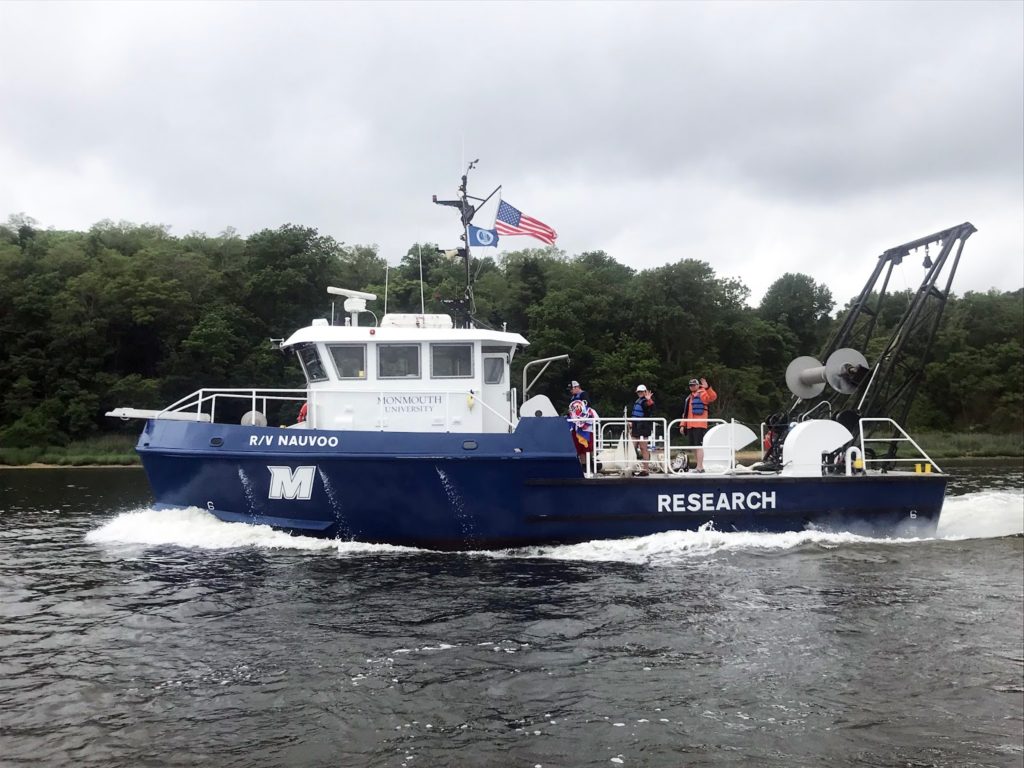
Monmouth U, unveils 49-foot research vessel, Nauvoo

Monmouth University’s research vessel, Nauvoo, on the Shrewsbury River
Karl Vilacoba reports for Monmouth University:
HIGHLANDS, NJ – Monmouth University leaders, faculty and students were joined by state and federal officials today to unveil the newest and largest member of the university’s research vessel fleet – the 49-foot Nauvoo.
The acquisition of the Nauvoo will enable the Monmouth University Urban Coast Institute (UCI) to conduct research, educational and contract work at a larger scale than ever before. It will also substantially enhance in-house research and monitoring capabilities to meet increasing faculty and student demand within the School of Science’s Marine and Environmental Biology and Policy Program.
The vessel will make it possible to take full classes and large groups on the water and work on the open ocean up to 20 nautical miles offshore. Overnight research trips on the water are now possible, as the vessel has a head and the capacity to berth seven.
“Few universities throughout the East Coast have a research vessel of this class,” Monmouth University President Grey Dimenna said. “The Nauvoo will advance our growth as a premier marine research and policy center in the region. For students interested in marine science, this is yet another great reason to come study at our beautiful coastal campus.”
The Nauvoo is outfitted with state-of-the-art technologies including a side-scan sonar system that provides highly detailed views of underwater terrains. The vessel will provide critical support for in-house scientists and students, and additional capacity to work collaboratively with government agencies, academic institutions and NGOs on areas of critical concern such as oyster restoration, shore erosion and channel shoaling.
Originally built as a U.S. Coast Guard buoy tender, the Nauvoo was later transferred to the National Oceanic and Atmospheric Administration (NOAA), which provided it to the University in 2017 at no cost. The vessel has since undergone extensive maintenance and improvement work. It joins two smaller UCI-maintained vessels that have long served the university’s primary marine field operations and research needs – the 18-foot Little Hawk and 27-foot Seahawk.
“We thank NOAA for this valuable contribution to the marine science and education work taking place at Monmouth University,” UCI Director Tony MacDonald said. “The Nauvoo will provide students with a truly transformational learning experience, and further advance the UCI’s mission to develop the best available science to support healthy and productive coastal ecosystems and sustainable communities.”
“We are thrilled to help support Monmouth University’s developing marine research program with the donation of our 49-foot research vessel, R/V Nauvoo,” said Jon Hare, director of NOAA’s Northeast Fisheries Science Center, which includes the NOAA Sandy Hook Laboratory.
The Nauvoo will provide the university with a platform for expanding collaborative research with NOAA and other universities and regional partners. “We are very pleased that the vessel will continue to play an important role in our strong and growing cooperation with Monmouth University in pursuit of our shared vision to responsibly manage our marine resources,” Hare said.
Among the current university projects the vessel will aid are a probe of sediment contamination in New York Harbor; ongoing research on distributions and behaviors of the endangered Atlantic sturgeon and sharks off the New Jersey and New York coasts; collaboration with Rockefeller University on testing regional waters for environmental DNA (eDNA) fragments that can confirm the presence of fish and other marine organisms; studies of harmful algae blooms in coastal waters; water quality monitoring and testing; and fisheries surveys for state and federal agencies.
New Jersey State Sen. Vin Gopal and Assemblyman Eric Houghtaling, who represent the coastal district that includes Monmouth’s West Long Branch campus, presented a resolution honoring the critical research work performed by the university.


Monmouth U, unveils 49-foot research vessel, Nauvoo Read More »

Colorado aligning with California on stricter auto emissions

Fourteen states have now bucked the EPA to adopt stricter emissions standards.


Jack Ferrell charges his Nissan Leaf in Paonia, Colorado, at one of only a handful of electric vehicle charging stations in Western Colorado. Brooke Warren/High Country News

By Alex Davies

[This article was originally published by WIRED and is reproduced in High Country News as part of the Climate Desk collaboration] 

Colorado just moved away from Washington, D.C., and it’s headed toward California. On Monday, Governor John Hickenlooper ordered his state’s Department of Public Health and Environment to establish a Low Emission Vehicle program that goes beyond the federal standards to align with the Golden State’s more stringent rules.
Hewing to California’s emissions rules will keep Colorado on the track the EPA set for the country as a whole during the Obama administration: Each automaker’s fleet must get about 36 miles per gallon on average by 2025. And this move lets the state — whose many valleys can trap smog and exacerbate its effects — make sure that whatever happens in Washington, it’s still moving toward the goal Hickenlooper set last year, to reduce greenhouse gas emissions by 26 percent by 2025.
“Colorado has a choice,” Hickenlooper said in a statement accompanying his signature of Executive Order B 2018 006. “Every move we make to safeguard our environment is a move in the right direction.”
A choice between two paths. The federal rules regulating greenhouse gas emissions from passenger vehicles apply in every state. But California, by virtue of Section 177 of the 1963 Clean Air Act, has the right to set its own standards, as long as they’re stricter than the national rules. The other 49 states can’t do that, but they can decide to follow California’s rules instead of those set by the feds.
Now, California’s right to go its own way — and other states’ right to follow — has become a bulwark against the EPA’s move to roll back emissions standards. Because California is the country’s largest market, automakers design their cars to meet its rules. It’s less expensive than making one version of a car for clean California and another for the other dirtier states.
That also explains why climate change skeptic and EPA administrator Scott Pruitt has talked about going after that special status. “Cooperative federalism doesn’t mean that one state can dictate standards for the rest of the country,” he said in a statement in April.
That kind of fight would require a messy legal and legislative process, but whether or not Pruitt makes the move, California has friends on this road trip. Colorado is the 14th state to adopt its standards. It also happens to be the first that isn’t on the East or West Coast and the first to make the move since Donald Trump became president and Pruitt took over the EPA.
“It makes sense that Colorado would follow California,” says Carla Bailo, president and CEO of the Center for Automotive Research. And it makes sense that the state adopted the Low Emission Vehicle rules but did not take on Cali’s Zero Emission Vehicle program, which demands automakers sell at least some vehicles that don’t pollute at all. Given the mountain state’s topography, lots of people drive trucks and SUVs, which don’t lend themselves to electric propulsion. Tesla, with its Model X, and Jaguar, with its I-Pace, may not agree. But for Colorado, one step away from D.C., and one step toward California, is probably enough for now.
Alex Davies covers transportation for WIREDHe was previously a reporter for Business Insider. A New York native, he lives in San Francisco.

Colorado aligning with California on stricter auto emissions Read More »

Pennsylvania waste company partners with chemical industry to test recycling of flexible plastic packaging

JP Mascaro & Sons to participate in MRFF pilot

DeAnne Toto edits for Waste Today:

The Materials Recovery for the Future (MRFF) research program has partnered with Audubon, Pennsylvania-based J.P. Mascaro & Sons Inc. to pilot single-stream curbside recycling of flexible plastic packaging (FPP). The company’s TotalRecycle material recovery facility (MRF) in Berks County, Pennsylvania, will process the material, demonstrating the technical and economic feasibility of recycling FPP from residential single-stream recycling programs.
[EP Editor’s Note: Single-stream is the residential system in which all designated recyclables – metal/glass/plastic + papers – are placed at the curb in a single bin and non-recyclable waste is put in a separate bin]
MRFF is a project of the Foundation for Chemistry Research and Initiatives, a 501(c)(3) tax-exempt organization established by the American Chemistry Council (ACC), Washington. Its members include The Procter & Gamble Co.TargetThe Dow Chemical Co., PepsiCoNestlé USANestlé Purina PetCareAmcor, ACC, Flexible Packaging AssociationLyondellBasell IndustriesThe Plastics Industry AssociationSealed AirSC Johnson, the Canadian Plastics Industry Association and the Association of Plastic RecyclersChevron Phillips Chemical Co. also recently joined the program, according to the ACC.    
“Our MRFF collaborative is excited to partner with J.P. Mascaro and demonstrate the recyclability of flexible plastic packaging,” says Steve Sikra, MRFF chairperson and associate director of global research and development for Procter & Gamble, Cincinnati. “We are all committed to the success of this program and look forward to adding recycled flexible packaging into the circular economy.
Sikra adds, “As a side benefit, we expect to see the quality of J.P.’s other recycling streams improve as the flexible plastics are processed.”
FPP—which includes films,wraps, bags and pouches—is not widely recycled today; however, it is a growing fraction of the packaging stream because of its light weight and ability to provide enhanced product performance and protection. According to Resource Recycling Systems (RRS), Ann Arbor, Michigan, the recycling system consultancy which conducts the MRFF research program, 12 billion pounds of the material is introduced into the market for consumer use every year, and it is the fastest growing form of packaging.
RRS estimates TotalRecycle will produce 3,100 tons per year of high-quality postconsumer FPP feedstock for various end market uses that are being tested.
The pilot is expected to generate data to help inform municipalities and the recycling industry on the most efficient and economical ways to recycle FPP. This will turn used FPP materials, typically destined for disposal, into a bale that can be sold to a variety of end markets, the ACC says.
Mascaro Director Of Sustainability and TotalRecycle General Manager Joseph P. Mascaro says, “Our company is thrilled to partner with the MRFF partners on this project. We are confident that the pilot will be successful and will generate industry data to show FPP generators, municipalities and the recycling industry that FPP can be efficiently and economically recycled and marketed instead of being landfilled.”
Van Dyk Recycling Solutions, Stamford, Connecticut, will add equipment in the form of optical sorters to Mascaro’s TotalRecycle facility that will target FPP and direct the material out of the single-stream material flow, the ACC says.
The pilot program will begin in late 2018 with the installation of the sorting equipment, according to the association. After an internal testing period, TotalRecycle will begin accepting FPP for recycling from the municipal residents it serves. From equipment order to acceptance of FPP in curbside carts, the pilot program is expected to last two years’ time, the ACC adds.
More information about the pilot or on joining MRFF is available from the ACC’s Emily Tipaldo at emily_tipaldo@americanchemistry.com.

Pennsylvania waste company partners with chemical industry to test recycling of flexible plastic packaging Read More »