Strap in and buckle up for Trump’s trade war with China

 1:37
China: United States ‘opening fire’ on world with tariff threats
China warned July 5 the United States is “opening fire” on the world with its tariff threats.
David J. Lynch, Danielle Paquette and Emily Rauhala
report for the Washington Post
The United States prepared Thursday to impose tariffs upon Chinese goods, a long-threatened move that is expected to prompt Beijing to retaliate against American products and to plunge the two countries into a costly and increasingly unpredictable trade war.
U.S. customs officers will begin imposing duties on $34 billion in Chinese goods beginning at 12:01 a.m. Friday. Chinese officials have said they will respond with equivalent action against a range of American goods, including pork, poultry, soybeans and corn, and President Trump last month vowed to hit an additional $200 billion in Chinese goods if Beijing did so.
Even if eventually reversed, the moves will mark a historic break with nearly a quarter-century of growing integration between the U.S. and Chinese economies. The U.S. tariffs — intended to spare consumers by aiming at industrial products — are designed to force China to drop numerous trade practices that the president says discriminate against U.S. companies.
After months of rhetorical exchanges between Washington and Beijing, the imposition of the new import taxes makes real a conflict that has rattled markets, scrambled corporate supply networks and chilled business investment.
“I don’t think this is going to get resolved easily and I think these tariffs are going to hurt the U.S. economy,” said Rufus Yerxa, president of the National Foreign Trade Council, which represents multinationals such as Coca-Cola, Ford, and Microsoft.
The exchange of tariffs comes as trade-related cracks are beginning to appear in an otherwise robust U.S. economy, according to minutes of the Federal Reserve Board’s most recent meeting June 12 and 13, which were made public Thursday.
1.00
 1:06
Trump threatens China with tariffs on $200 billion in products
President Trump escalated his trade war with China on June 18, and threatened to put in place tariffs on $200 billion worth of Chinese goods. 
Farmers fear the loss of export sales as U.S. trading partners like China erect trade barriers in response to Trump’s tariffs, while businesses across the country “indicated that plans for capital spending had been scaled back or postponed as a result of uncertainty over trade policy,” the Fed said.

Strap in and buckle up for Trump’s trade war with China Read More »

Debate over plastic bags takes a new twist in New Jersey

Jockeying continues over legislation — or some other initiative to curb spread of plastic — as Murphy’s decision awaited

plastic bags


Tom Johnson reports
for NJ Spotlight:
It was only a single line-item veto in a $37.4 billion state budget, but it has fueled speculation over the fate of a controversial bill to impose a nickel fee on single use carry-out bags.
Gov. Phil Murphy blocked the diversion of funds targeted for lead abatement projects in the budget, a move welcomed by environmental and other advocates who want to see more resources dedicated to eliminating childhood exposure to lead.
In approving a state spending plan for the new fiscal year, the governor eliminated language that would have shifted at least $23 million raised by fees on plastic and paper bags to the general budget instead of lead programs as originally intended.
But Murphy has not yet decided even whether to sign the plastic bag fee bill (A-3267), which was fast-tracked through the Legislature during budget deliberations late last month. “No final decision has been made regarding the legislation,’’ said Dan Bryan, a spokesman for the governor.
The issue boils down to what is the best way to curb what some view as the pervasive spread of plastics in the environment — an outright ban on plastic bags or a fee that will encourage consumers to switch to more environmentally-friendly alternatives.
In this case, the Legislature chose a fee on both plastic and paper single use carry-out bags, a step favored by the New Jersey Food Council, which remains hopeful the governor will endorse that option.
“If approved, New Jersey will be recognized as enacting the most impactful disposable bag law in the country and an environmental leader for other states to model,’’ said Linda Doherty, president of the food council.

Many environmental groups oppose fee

But many environmental groups oppose the bag fee, saying it does not work as well as a ban on plastics; the fee is too small to discourage plastic bag use; and it will end up preempting local bans passed by communities, like Jersey City and Hoboken.

Debate over plastic bags takes a new twist in New Jersey Read More »

Look who’s getting ready to rumble over electric vehicles

 report for Bloomberg:


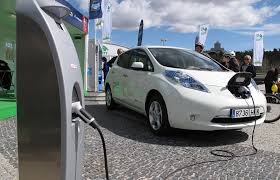
A red-hot electric vehicle market has triggered a face-off between Big Oil and utilities.
Oil majors, who’ve sold fossil fuels to cars for a century, are now moving into an electricity sector that’s preparing for exponential growth. The problem is that utilities, the primary power suppliers for a century, have the same idea.
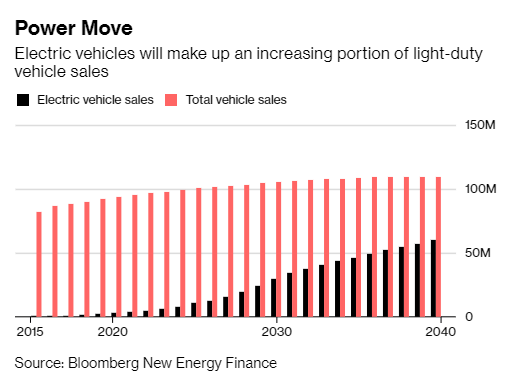
BP Plc predicts electric vehicle sales will surge by an eye-watering 8,800 percent between 2017 and 2040, making it an attractive business for oil companies as demand for gasoline and diesel are forecast to slow. Big Oil will have to battle the traditional utilities for charging at people’s homes, on the road and even offices of green-car owners.
“It’s the banging together of” industries “in a way that’s never happened before,” said Erik Fairbairn, the founder and CEO of Pod Point Ltd., one of the U.K.’s largest electric-vehicle charging companies. Power providers are, for the first time, meaningfully interacting with car companies and the oil industry “is realizing if they get this wrong then the requirement for them in the future is significantly diminished,” he said.
The logic for oil companies is clear. Gasoline and diesel sales have been a backbone of their business since the internal combustion engine went commercial at the turn of the last century. But with drivers now becoming more conscious about emissions and the environment, most analysts forecast growth in demand of these fuels to slow and eventually drop.

Look who’s getting ready to rumble over electric vehicles Read More »

Rhode Island sues oil companies over climate change

Miranda Green and Timothy Cama report for The Hill:

THE OCEAN STATE VS. OIL: Rhode Island’s attorney general sued a dozen oil and natural gas companies and their affiliates Monday in state court, accusing them of causing climate change and not sufficiently mitigating its effects.
Attorney General Peter Kilmartin (D) said Rhode Island is uniquely harmed by global warming, with its more than 400 miles of shoreline, fishing industry, marine economy and other factors.
“Rhode Island is especially vulnerable to the effects of climate changes that is now on our doorstep with sea level rise and an increase in severe weather patterns, as seen by the extensive damage caused by storms in the past several years, including Super Storm Sandy and the floods of 2010,” Kilmartin said in a statement.
“The defendants’ actions for the past several decades are already having and will continue to have a significant and detrimental impact on our infrastructure, economy, public health, and our eco-systems, and will force the state to divert already-limited resources to mitigate the effects of climate change, thereby diminishing resources for other vital programs and services.”
Who the suit targets: The defendants in the lawsuit include big companies across the petroleum supply chain, including Exxon Mobil Corp., Chevron Corp., ConocoPhillips Co., Marathon Oil Corp. and Hess Corp.
Industry responds: The National Association of Manufacturers said such a lawsuit isn’t productive.
“It’s time for politicians and trial lawyers to put an end to this frivolous litigation,” said Lindsey de la Torre, executive director of the group’s Manufacturers’ Accountability Project.
“Taxpayer resources should not be used for baseless lawsuits that are designed to enrich trial lawyers and grab headlines for politicians. This abuse of our legal system does nothing to advance meaningful solutions, which manufacturers are focused on every day.”
What happens now: It’s anybody’s guess how the lawsuit will play out, but the recent record of climate lawsuits by governments against fossil fuel companies is not good.
Just last month, a federal judge dismissed similar claims by San Francisco and Oakland, Calif., against major oil companies. Judge William Alsup said the science of climate change and its link to fossil fuels is solid, but it’s not a place for the courts to get involved.

Read more. 

Like this? Click to receive free updates

Rhode Island sues oil companies over climate change Read More »

NJ lawmakers hold final, pre-summer session tomorrow

State House Complex - Trenton

By Frank Brill, EnviroPolitics Editor


In addition to the hotly-contested (as always) state budget bill (S2823/A4303) that the governor and legislature now finally agree upon, both houses will consider several environmental bills tomorrow, Monday, July 2, 2018, at what could be their last voting session prior to the Fall.

In the Senate, they are:

S542 (Oroho / Singleton) – Designates High Point State Park as High Point Veterans’ State Park.
Electric mountain bicycleS731 (Greenstein / Turner) – Permits operation of low-speed electric bicycles. Is this an environmental bill? We’re not sure but decided to list it as such. You know, fresh air, etc.


In the Assembly, they are:

A1237 (McKeon / Vainieri Huttle / Tucker) – Requires State parks, forests, and other natural and historic areas to remain open to public for seven days if emergency is declared due to failure to enact general appropriation law as prescribed by NJ Constitution.
hempA1330 (Gusciora / Pinkin / Reynolds-Jackson) – Directs Dept. of Agriculture to create pilot program to research cultivation of industrial hemp. No, hemp and pot are not the same. Hemp is for rope. Its botanical cousin is for brownies and chillin.  


Like this? Click to receive free updates


NJ lawmakers hold final, pre-summer session tomorrow Read More »

Class warfare at heart of drama over NJ tax increases


Charles Stile reports for NorthJersey.com:


The state just narrowly avoided a government shutdown, as New Jersey’s top two Democrats played out a tax fight cloaked in class warfare.

Gov. Phil Murphy, who spent most of his career mingling among, and making money with, Wall Street titans, took a soak-the-rich approach to fellow millionaires. It’s time for them to pony up and pay “their fair share,” Murphy argued.

“New Jersey’s millionaires are making out just fine,” Murphy said Friday after all-day talks with the legislative leadership collapsed. “They were protected by Governor Christie and they are receiving a significant tax break from President Trump. This is crunch time.”

On the other side stood Senate President Stephen Sweeney, the burly ironworker and union official. Sweeney emerged as the millionaires’ chief protector, even though Sweeney voted five times to boost the millionaires tax during the tenure of his “frenemy,” Republican Gov. Chris Christie.


Sweeney argued that President Donald Trump’s tax overhaul changed the landscape. Corporations saw a steep tax cut under Trump and now should pick up the slack. Murphy, Sweeney said, is shielding corporations over people.

“He (Murphy) is more concerned about protecting corporations that had billion-dollar windfalls from Donald Trump,” Sweeney bristled on Friday. “That’s what he wants to do. But he would rather raise taxes on the people of the state of New Jersey. Enough.”

The budget fight was really a parochial, New Jersey power struggle between Sweeney, a statehouse veteran and conservative Democrat, and Murphy, a self-styled progressive who is holding his first elected office. The budget squabble was Murphy’s baptism by fire.

But the tax fight also took place during a tumultuous time in the Democratic Party, when the Trump presidency has roiled the liberal, grassroots base with anger and activism. It is an anger that propelled a 28-year-old activist to topple one of the most powerful House Democrats in last week’s New York congressional primary.


Class warfare at heart of drama over NJ tax increases Read More »