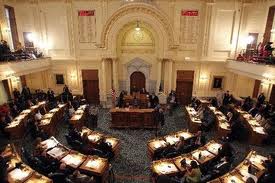
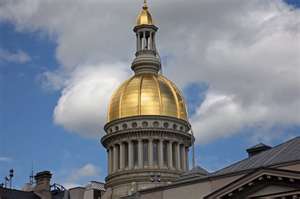
Who decides how TTF billions will be spent in New Jersey?

                                                                                                                                                           Kadmy/Bigstock

John Reitmeyer writes in NJ Spotlight:

Senate President rejects Republican senator’s claim that new commission could politicize how projects are selected

Stephen Sweeney

Senate President Stephen Sweeney speaks during a news conference in Linden yesterday to announce state funding for a long-planned road project.
After last year’s renewal of the Transportation Trust Fund, there’s now $2 billion in state dollars to spend on infrastructure improvements every year in New Jersey. But that has also raised the question of exactly who decides which projects deserve top priority — the governor and his administration’s transportation officials or a special four-person commission that’s been championed by lawmakers?
Like this? Use form in upper right to receive free updates
See popular posts from the last 30 days in right column —
>>

A measure that’s expected to make it out of the Legislature in the coming weeks will ensure the new capital-project approval commission has the final say, though not until a year from now.

The passage of what’s being called the “TTF cleanup bill” will also make sure that a planned $2 billion in spending on infrastructure improvements during the state fiscal year that begins in early July can go forward even though the new commission has yet to be assembled.
And despite complaints from some lawmakers that the new commission could politicize New Jersey’s transportation-funding process and even be unconstitutional, Senate President Stephen Sweeney (D-Gloucester) said he remains committed to establishing the new format. He also disputed claims that the new selection method could be unconstitutional.

Who decides how TTF billions will be spent in New Jersey? Read More »

Is Hudson rail tunnel sunk if Trump pulls Obama grant?


WNYC News Online reports
:
Despite campaign promises to rebuild America’s infrastructure, President Donald Trump has said he will cancel grants like the one that would pay half the estimated $24 billion price tag for the Gateway Program, which would add a second rail tunnel under the Hudson River and upgrade rail infrastructure in New Jersey and New York.
The funds were originally promised by President Barack Obama.
But if Trump doesn’t deliver the money, John Porcari, the interim head of the Gateway Development Corp., said the agency will seek financing from a public-private partnership. He added that under the partnership the massive transit project might even be finished earlier.
The Gateway Development Corp. is a nonprofit corporation made up of current and former federal, Amtrak, NJ Transit, and Port Authority officials.
Like this? Use form in upper right to receive free updates
See popular posts from the last 30 days in right column —
>>

Is Hudson rail tunnel sunk if Trump pulls Obama grant? Read More »

How bad is pharmaceutical pollution in the Hudson River?


Scott Fallon reports for
The Record:


Scientists are taking samples of the Hudson River this month in an ambitious plan to measure how much pharmaceutical pollution gets washed into the waterway during heavy rains and to pinpoint its source.

Anti-depressants, blood pressure medicine, decongestants and other medicines have already been detected in the Hudson in preliminary samples. The latest round of testing is a larger sweep of the river, including the portion that passes by New Jersey, at a time of the year when pollution overall is washing into the Hudson at a greater rate due to runoff and sewage overflows.

Residue from medicine has made its way into rivers, streams and sources of drinking water for decades, but scientists have only begun identifying it recent years as testing has improved.

Little is known about their health effects on humans, but pharmaceuticals have had a major impact on wildlife. The Hudson study comes on the heels of a federal report that showed male fish in New Jersey’s Wallkill River — a tributary of the Hudson — were developing female reproductive characteristics, mostly likely due to hormone-based drugs that made their way into the water.

Read the full story here

 
Like this? Use form in upper right to receive free updates
See popular posts from the last 30 days in right column — >>

How bad is pharmaceutical pollution in the Hudson River? Read More »

FERC signs off on PennEast Pipeline; Battle moves to DEP

Tom Johnson reports for NJ Spotlight:

Even with FERC Environmental Impact Statement, pipeline could face uphill fight at Department of Environmental Protection, Delaware River Basin Commission

PennEast pipeline

Credit: Susan Phillips/StateImpact Pennsylvania
With a key federal win in hand, the PennEast natural-gas pipeline takes its fight to a more local venue, seeking essential permits from the state of New Jersey and the Delaware River Basin Commission.
The Federal Energy Regulatory Commission issued a Final Environmental Impact Statement for the PennEast Pipeline Co.’s approximately 120-mile conduit on Friday, a step likely to be followed by approval of a certificate of public convenience and necessity once the commission adds a member and gains a quorum.
The approval, coming after a contentious three-year review by the feds, shifts the dispute to the New Jersey Department of Environmental Protection and the DRBC, where the $1 billion project faces scrutiny from agencies with many outstanding questions, particularly the impact of the pipeline on drinking water in the region.
“Both could be really significant hurdles,’’ predicted Tom Gilbert, campaign director for ReThink Energy NJ and the New Jersey Conservation Foundation. “FERC’s flawed review of the PennEast project failed to thoroughly examine the significant environmental impacts the pipeline would cause.’’

Read the full story Related:
Bateman vows to continue to fight PennEast
PennEast gas pipeline clears a big regulatory hurdle Like this? Use form in upper right to receive free updates
See popular posts from the last 30 days in right column — >>


FERC signs off on PennEast Pipeline; Battle moves to DEP Read More »

EP Podcast #18 – Rail mayhem, sexual harassment, bats battling back (casinos too) and a cleric with no shame

In this week’s Episode (#18), we look back at some of the top political and environment stories featured April 3-7 in our daily newsletter, EnviroPolitics 

Listen to the episode here  

You can subscribe to our podcast for fee on:
iTunes (Podcast App on your iPad, iPhone)

Stitcher (Android)
Player FM
MixCloud

and other popular podcast services.

It’s easy to do and you’ll never miss a future episode.

See and hear all previous 16 episodes 

Questions? Email: frankbrilljr@gmail.com or 609-577-9017

EP Podcast #18 – Rail mayhem, sexual harassment, bats battling back (casinos too) and a cleric with no shame Read More »

Pa coal-energy plant affecting downwind infants in NJ?

Coal-fired Portland Generating Station in Pa. NJDEP photo

Scott Fallon reports for The Record:

Environmental officials said for years that a coal-fired power plant on the Delaware River in Pennsylvania harmed New Jersey residents by spewing air pollution across state lines.

Now it appears they have proof.

A study published this week by a team of scientists shows New Jersey mothers living as far as 20 to 30 miles downwind from the Portland Generating Station had a greater chance of having babies with low birth weight.

The study said babies born in Morris, Sussex, Hunterdon and Warren counties from 1990 to 2006 were 17 percent more likely to be born with very low birth weight – under 3⅓ pounds – and 6.5 percent more likely to be born with low birth weight – under 5½ pounds.


Like this? Use form in upper right to receive free updates
See popular posts from the last 30 days in right column— >>

Pa coal-energy plant affecting downwind infants in NJ? Read More »