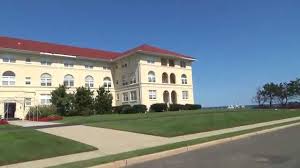
Maserati says toot toot to New Jersey, Hello Michigan

Maserati is moving its North American headquarters ()


Fiat Chrysler Automobiles announced plans internally Tuesday to move the North American headquarters of its Italian luxury auto brand Maserati from Englewood Cliffs to the former Walter P. Chrysler Museum on the grounds of FCA’s headquarters in Auburn Hills, Michigan.


“The idea is to bring us into Auburn Hills while remaining distinct and separate from the other FCA brands,” Tom Shanley, head of Maserati North America, said in a statement to The Detroit Free Press while attending the New York International Auto Show. “We have our separate office space; we will be sharing that office space with Alfa Romeo.”

Moving headquarters to the Auburn Hills campus will save Fiat Chrysler Automobiles money and cut down on executive travel despite the fact that year-over-year sales for Maserati were up 13.2 percent in October.

Shanley did not say how many people would be moving to Michigan, but he stated that only a few positions would remain in Englewood Cliffs.

“We will have limited operations (in New Jersey) from the technical side of our business,” he said in a statement.

Maserati, headquartered in Modena, Italy, has had its North American headquarters in Englewood Cliffs since 2002.

Like this? Use form in upper right to receive free updates
See popular posts from the last 30 days in right column —
>>

Maserati says toot toot to New Jersey, Hello Michigan Read More »

More New Yorkers than ever contesting property tax bills


Advocate Steinberg helps homeowners fight to reduce their tax bills. (Photo:Buck Ennis)


Aaron Elstein reports for Crain’s:


Springtime means the start of baseball season. It’s the time to put away winter coats and plan a seder or Easter egg hunt. It also marks the beginning of an increasingly popular pastime in New York: fighting property tax bills.

Last week the city began holding hearings at which people can argue that their home or office building is not worth as much as assessors say. A record 55,000 tax appeals have been filed this year, and though the rules say no hearing is supposed to last more than 15 minutes, it nevertheless is likely to take until November for the 20 hearing officers at the city Tax Commission to clear the dockets.

“It’s a long, long season,” Myrna Hall, the commission’s operations director, said with a sigh.

The season has grown even longer in the past decade as more people protest their ever-rising property tax bills.

These days about 35% more appeals are filed each year than were filed a decade ago. That’s more than triple the growth rate of new properties on the tax rolls. Property taxes are the city’s largest source of income, and revenue from them has doubled in the past 10 years, reflecting a surge in real estate values and rents.

There’s no end in sight. The de Blasio administration is forecasting property tax revenue will rise by more than 5% annually for the foreseeable future.

Read the full story here


Like this? Use form in upper right to receive free updates
See popular posts from the last 30 days in right column —
>>

More New Yorkers than ever contesting property tax bills Read More »

Osprey population flying high again over New Jersey coast

Back in 1975, New Jersey’s osprey population plummeted to fewer than 70 breeding pairs. The latest count shows 515 nesting osprey couples and 150 breeding pairs of eagles, most of them along Barnegat Bay.


Conserve Wildlife Foundation of New Jersey, a nonprofit that builds and repairs marshland nesting platforms for the birds, is facing potential funding cutbacks and seeks volunteer support.

Brenda Flanagan has the story for NJTV NEWS.


Osprey population flying high again over New Jersey coast Read More »

The March for Science on April 22 – A good idea or not?

                                                                 July 2016 climate protest in Philadelphia  (John Minchillo/AP Photo)

NewsWorks reports today:

Scientists and science fans are planning a March for Science on April 22nd, calling for the attention “to defend the vital role science plays in health, safety, economies and governments.” As a response to the election of President Trump, the march has sparked a debate within the science community.
Earlier this morning on Radio Times, Marty Moss-Coane talked with climate scientist and Columbia University professor, James Hansen, about science’s role in political activity. He said he wants to focus on solutions.  
“We’ve filled this law suit against the federal government to try to force them to do their job,” Hansen said. “The Citizens Climate Lobby who advocate a carbon fee and dividend. We need these correct policies.”
However, Robert Young, a geologist from Western Carolina University said that politicizing science will not help with creating better science-based policy.

We’re not going to convenience the professional climate change skeptics,” Young said. “Rather than marching on Washington, I’ve suggested that we need to march into our local communities.”
To hear more about what the science community is discussing, listen to the full interview on Radio Times.
Like this? Use form in upper right to receive free updates
See popular posts from the last 30 days in right column —
>>

The March for Science on April 22 – A good idea or not? Read More »

How do you say Happy Birthday, Jacob in Swedish?

From the New York Times‘ Daily Briefing, Chris Stanford writes:

Over a dinner of crayfish in Stockholm in 1924, two men decided that Sweden needed its own car manufacturer, one that would make vehicles suitable for the harsh local climate and whose guiding principle was safety.

From their idea came Volvo — a Latin translation of “I roll” — which rolled its first car off the assembly line 90 years ago today. The original model, the ÖV4, was
affectionately called “Jakob.”


A Volvo shipment to the U.S. in 1960.
Stan Wayman/LIFE Picture Collection, via Getty Images

The Swedes were hardly the first to produce automobiles; Karl Benz and Henry Ford, among others, had been at it for decades.
In 1999, Ford Motor bought Volvo, which was then sold in 2010 to Geely, a Chinese automaker, for $1.3 billion.

For the new owner, buying Volvo was momentous: “We are like a poor farm boy pursuing a famous movie star,” Li Shufu, Geely’s chairman, said.

By the end of next year, the company, which is still based in Sweden, plans to make
up to 100,000 cars annually in South Carolina.

It’s a head-spinning tale of globalization that started over a humble meal almost a century ago.

Like this? Use form in upper right to receive free updates
See popular posts from the last 30 days in right column — >>


How do you say Happy Birthday, Jacob in Swedish? Read More »

How a judge scrapped Pa. families’ tainted-well verdict


Sharon Kelly and Steve Horn report for DESMOG:

For many residents of Carter Road in Dimock, Pennsylvania, it’s been nearly a decade since their lives were turned upside down by the arrival of Cabot Oil and Gas, a company whose Marcellus Shale hydraulic fracturing (“fracking”) wells were plagued by a series of spills and other problems linked to the area’s contamination of drinking water supplies.
With a new federal court ruling handed down late last Friday, a judge unwound a unanimous eight-person jury which had ordered Cabot to pay a total of $4.24 million over the contamination of two of those families’ drinking water wells. In a 58 page ruling, Magistrate Judge Martin C. Carlson discarded the jury’s verdict in Ely v. Cabot and ordered a new trial, extending the legal battle over one of the highest-profile and longest-running fracking-related water contamination cases in the country. Read more

Like this? Use form in upper right to receive free updates
See popular posts from the last 30 days in right column —
>>

How a judge scrapped Pa. families’ tainted-well verdict Read More »