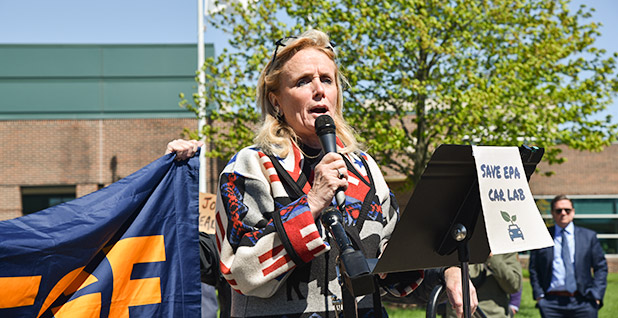
PennEnvironment sees Trump, Detroit driving in reverse

Hummer backing up


David Masur
, executive director of PennEnvironment, with offices in Philadelphia and Pittsburgh, is encouraging the members of his organization and others to let the nation’s three major automakers know that Americans do not support the current efforts of Detroit and the Trump administration to reverse progress on automobile mileage standards.  


Masur writes:


Dear _____,

Nearly a decade ago as the recession was crashing down on our economy, Detroit’s “Big Three” automakers were scrambling to stay afloat after putting all their eggs into the basket of big, gas guzzling SUVs—a vehicle that the public had little desire to buy with rising gas prices at the pump.

Now those same auto companies just convinced the Trump administration to overturn climate-fighting fuel-efficiency standards that would have cut global warming pollution by 6 billion tons by 2030.  Those standards drove the industry to innovate with fuel-efficient cars, hybrids and now electric vehicles. [1]

If the whole thing sounds like a story you’ve heard before, you’d be correct.  For years, the auto-industry fought these same fuel-efficiency standards as they tried to build bigger and bigger SUVs. Even as hybrid cars like the Toyota Prius were selling like hotcakes, Detroit’s Big Three continued building larger SUVs.  And inevitably their failed products helped lead to a multibillion-dollar bailout by us, the American taxpayers—hoping they’d learn their lesson. 
Instead, last week major auto-makers sat down with President Trump to persuade him to undo the very fuel-efficiency standards that helped cut pollution and save their industry.

It’s time for the U.S. to put cars that burn too much gasoline in our rear-view mirror. Unfortunately, the order this week by Trump’s EPA is a green light to keep making dirty gas guzzling cars that pollute our air, endanger our health and threaten our children’s future.

Sincerely,
David Masur
PennEnvironment Executive Director

PS—forward this to your friends and family and tell them to take this urgent action TODAY!

[1]  “Trump targets Obama’s global warming emissions rule for cars“, The Hill, March 15, 2017.  


—————————————————————————
If you click on either of the links above you’ll be taken to a form. Enter your name, e-mail address, etc., and a letter to the big three will be automatically generated and sent.  

It’s an easy way to help pressure the automakers. It’s also a clever marketing technique, as the information supplied helps
PennEnvironment build its database for future communications and, no doubt, fundraising requests. 


Like this? Use form in upper right to receive free updates

See popular posts from the last 30 days in right column —
>>

PennEnvironment sees Trump, Detroit driving in reverse Read More »

Terhune to lead Scarinci Hollenbeck’s environment section

Todd W. Terhune

The Scarinci Hollenbeck law firm has named Partner Todd W. Terhune as Section Chief of its Environmental and Land Use Law Group.


Terhune, who joined Scarinci Hollenbeck as a partner in 2015, brings almost three decades of experience in the environmental field, practicing first as a licensed Professional Engineer and, for the past 17 years, as an environmental attorney.


A partner in the firm, Terhune has handled some of the largest and most complicated brownfield and redevelopment projects in the State. He has also worked on a wide range of environmental issues arising out of real estate and business transactions, as well as in regulatory compliance and enforcement matters. 


Terhune routinely appears before the New Jersey Department of Environmental Protection and the United States Environmental Protection Agency.


The growing full-service law firm, with over 65 attorneys in New York, New Jersey and the District of Columbia, Scarinci Hollenbeck is comprised of six core practice areas: Transactional, Environmental, Litigation, Intellectual Property, Public Law and Labor and Employment, each of which encompasses several sub-practice groups.


Like this? Use form in upper right to receive free updates
See popular posts from the last 30 days in right column —
>>

Terhune to lead Scarinci Hollenbeck’s environment section Read More »

Renewed fracking battle coming along the Delaware River?


Susan Phillips and Jon Hurdle report for StateImpact:


Defenders of a longstanding de-facto moratorium on natural gas drilling in the Delaware River Basin say there are gathering signs of a renewed push to allow natural gas production by the industry and its allies.
Environmental groups including Delaware Riverkeeper Network say officials from the Delaware River Basin Commission, which is composed of representatives from New York, New Jersey, Pennsylvania, Delaware and the federal government, have been in talks with member states about finalizing work on oil and gas regulations that began before a de-facto moratorium was imposed seven years ago.
Opponents of any move to open the basin to shale gas development also worry about a lawsuit brought by a group of Wayne County landowners who challenge the DRBC’s right to regulate drilling.
And they fear that there will be new pressure from the Trump administration, via the U.S. Army Corps of Engineers, its representative on the DRBC, to allow gas drilling at the eastern edge of the Marcellus Shale.
The debate over gas drilling near the Delaware River dates back seven years. In May 2010 the DRBC’s five Commissioners voted unanimously to hold off on any decisions regarding drilling in the Delaware River Basin until new regulations were adopted. The de-facto moratorium imposed by the Commission prevents drilling for natural gas in Pennsylvania’s Wayne and Pike counties, as well as parts of southern New York, until the DRBC establishes its own regulations. If their rules are more stringent than state regulations, the DRBC rules would trump those in Pennsylvania.
In early November, 2011, the DRBC posted draft regulations, but cancelled the vote by commissioners after then-governor of Delaware, Jack Markell, said he would vote against them. Since then, the commission has remained silent on gas drilling, while commission staffers worked behind the scenes. New York has since banned fracking.
Like this? Use form in upper right to receive free updates
See popular posts from the last 30 days in right column —
>>

Renewed fracking battle coming along the Delaware River? Read More »

Settlement with VW could be windfall for cleaner NJ air

Tom Johnson reports for NJ Spotlight:  

New Jersey is beginning to map out how it will spend the $65.3 million it is entitled to stemming from a settlement involving Volkswagen’s cheating on diesel emissions tests on millions of vehicles.
If legislation now pending is passed, money from the $1.2 billion settlement with the U.S. Environmental Protection Agency would be used to reduce diesel emissions at the ports of Elizabeth and Newark, as well as fund the installation of electric vehicle charging stations across the state.
The bill (S-3029), sponsored by Sen. Bob Smith (D-Middlesex), is one of a dozen clean energy initiatives scheduled to be considered by the Senate Environment and Energy Committee on Monday.
The Volkswagen funds could provide an important impetus to begin addressing long-recognized air pollution problems plaguing New Jersey, but too often neglected by officials, according to environmental groups.
The Volkswagen scandal revolves around the company equipping vehicles, including a half-million in the U.S., with software to cheat on diesel emission tests. The company has faced both criminal and civil complaints related to the issue.
For New Jersey, it offers an opportunity to deal with problems posed by diesel emissions from trucks around the ports, a long-standing issue with residents in Newark and Elizabeth, where hundreds of vehicles traverse local streets each day, spewing particulates and other unhealthy pollutants.
“Diesel emissions are one of one of the nastiest sources of air pollution out there,’’ said David Pringle, campaign director for Clean Water Action. “It’s also a source of particulate pollution and clearly linked to the skyrocketing rates of asthma that we see.’’
In the past, efforts to clean up those emissions have failed to achieve ambitious targets, leaving many frustrated by the lack of action.
Under Smith’s bill, an undetermined portion of the New Jersey settlement would be used to fund various programs to curb diesel emissions, including incentives to replace older-model diesel trucks delivering and picking up containers at the ports. Money also would be available to acquire advance marine-emissions control-pollution control equipment at the port and to invest in electric or other zero-emission vehicles.
The legislation also would make other funds available to develop and build electric infrastructure for the deployment of private and public charging stations. Environmentalists often criticize state efforts to encourage greater use of zero-emission vehicles, citing the lack of public charging stations for electric cars.
By most estimates, there are fewer than 500 electric charging stations in New Jersey, far too few to discount range anxiety among drivers who may want to purchase the vehicles. Besides contributing to smog pollution, the transportation sector is the biggest source of greenhouse-gas emissions in the state.
Under the settlement, every state has to come up with a plan to spend its allocation, according to Jeff Tittel, director of the New Jersey Sierra Club. “We need a bill to spell out where the money will be going,’’ he said. “New Jersey has not put together a plan yet to make plug-in stations a reality.’’
Like this? Use form in upper right to receive free updates
See popular posts from the last 30 days in right column —
>>

Settlement with VW could be windfall for cleaner NJ air Read More »

Neighbors trading solar energy on the Brooklyn Microgrid

Patrick Schnell, a participant in the Brooklyn Microgrid, with solar panels on his roof. (Kevin Hagen, NYT)


Brooklyn is known the world over for things small-batch and local, like designer clogs, craft bourbon and artisanal sauerkraut.

Now, it is trying to add electricity to the list.

In a promising experiment in an affluent swath of the borough, dozens of solar-panel arrays spread across rowhouse rooftops are wired into a growing network. Called the Brooklyn Microgrid, the project is signing up residents and businesses to a virtual trading platform that will allow solar-energy producers to sell excess-electricity credits from their systems to buyers in the group, who may live as close as next door.

The project is still in its early stages — it has just 50 participants thus far — but its implications could be far reaching. The idea is to create a kind of virtual, peer-to-peer energy trading system built on blockchain, the database technology that underlies cryptocurrencies like Bitcoin.

The ability to complete secure transactions and create a business based on energy sharing would allow participants to bypass the electric company energy supply and ultimately build a microgrid with energy generation and storage components that could function on their own, even during broad power failures.

“Community members can work both individually and collectively to help meet demand in an efficient way,” said Audrey Zibelman, who recently resigned as chairwoman of the New York State Public Service Commission, which regulates the state’s utilities.

“It takes a central procurer — in this case, historically, the utility — out of the mix,” she continued, “and really sets the market where they’re not buying and selling to the utility but they’re identifying each other’s need and willingness to buy and sell.”

The project is but one example of how rapidly spreading technologies like rooftop solar and blockchain are upending the traditional relationships between electric companies and consumers, putting ever more control in the hands of customers. Across the globe, upstart companies like LO3 Energy, which is designing the Brooklyn experiment with the industrial giant Siemens, are building digital networks that offer the promise of user-driven, decentralized energy systems that can work in tandem with the traditional large-scale grid or, especially in emerging economies, avoid the need for a grid at all.

In Australia, where Ms. Zibelman will soon run the nation’s energy markets, a company called Power Ledger announced the start of a residential electricity trading market based in blockchain last year at a housing development in Perth.

In Bangladesh, where an estimated 65 million people lack access to a central grid, ME SOLshare has been developing peer-to-peer trading networks of rural households with and without rooftop solar systems. Producer-consumers there — known as prosumers — can sell excess power into the network, where neighboring homes and businesses can buy it in small increments with a cellphone.

And in Germany, Sonnen, a leading supplier of home batteries and smart energy products and services, has created a web of about 8,000 customers, both with and without solar on their roofs, who are trading their stored energy among one another.

“Peer-to-peer is slowly but surely becoming a reality,” said Olaf Lohr, Sonnen’s head of United States business development. “This really is a very disruptive technology. The customers are also the owners — they are the producers of the energy. There is no centralized feed-in from one big power plant.”

In New York, the Brooklyn microgrid is conceived to work with the conventional grid, which is in the midst of a reboot under Gov. Andrew M. Cuomo’s directives to make it more flexible, resilient and economically efficient while reducing greenhouse-gas emissions. That effort, known as Reforming the Energy Vision, or REV, includes encouraging the development of microgrids and more active community participation.

The ideal power system, said Richard L. Kauffman, who as the governor’s chairman of energy and finance is leading that effort, is one that combines large power plants and transmission lines with clusters of smaller-scale producer-consumers, “where electrons can flow in more than one direction and supply and demand of electricity is dynamic — and that’s different than the grid is today.”

Peer-to-peer power sharing is consistent with that vision, he said, though a number of regulatory changes are necessary for it to take off.

The State Public Service Commission has already taken a few of them, including last week approving new ways to determine pricing for electricity from renewable energy projects that more accurately reflect the value to the grid based on geographic location, timing and other factors yet to be determined. But Lawrence Orsini, LO3’s chief executive, said the state still needed to determine how to define his company and its network of participants before it could get its market up and running, a move he anticipates by June.

Read the full story

Like this? Use form in upper right to receive free updates
See popular posts from the last 30 days in right column —
>>

Neighbors trading solar energy on the Brooklyn Microgrid Read More »

Pa seeks grant, loan repayment from bankrupt Aquion

Darrell Sapp/Post-Gazette

During a tour of Aquion Energy in 2012, then-U.S. Commerce Secretary John Bryson, left, talks with, from left, Aquion CEO Scott Pearson, chief technical officer Jay Whitacre and then-Pittsburgh Mayor Luke Ravenstahl.


Daniel Moore reports for The Pittsburgh Post-Gazette: 


Aquion Energy, which filed for Chapter 11 bankruptcy last week, received nearly $19 million in grants and loans from the Pennsylvania Department of Community and Economic Development.

Because Aquion, a Carnegie-Mellon University spin-out focusing on battery technology, failed to hold up its end of the bargain in terms of job creation, the agency said it will pursue full recovery of that money in the bankruptcy reorganization proceeding.

Full story here 

Pa seeks grant, loan repayment from bankrupt Aquion Read More »