Bill in Wyoming would rope and tie wind and solar energy


A wind turbine stands on property used by the MidAmerican Energy Co. Eclipse Wind Farm.  Daniel Acker/Bloomberg
Wyoming’s legislature is considering a bill that would effectively outlaw renewable energy in the state.
The so-called “Electricity Production Standard” proposes to penalize utilities in Wyoming for generating electricity from solar and wind energy.

The bill would allow electric power to be generated using one of six pre-approved sources, including oil, natural gas, nuclear, hydropower and coal, to be used by Wyoming utility companies for electricity generation. Neither solar nor wind energy are included on the list of allowed fuel sources.
If the bill is passed, utilities in Wyoming would incur a penalty of $10 per megawatt hour whenever they used wind or solar to produce electricity for state customers.

“I don’t know how seriously to take it,” Rep. Marti Halverson, R-Etna, told the Jackson Hold News & Guide. “My guess is that it’s a little push back to the legislation that is being passed in other states that’s saying, ‘No coal, no how.”
The proposed legislation is arguably the most benighted of the half-baked proposals to promote coal energy floated to date in coal-friendly states.

“Coal production has been a cornerstone of the modern Wyoming economy since the 1970’s, and has served as Wyoming’s most stable source of tax revenues over the past four decades,” according to a 2015 study by the Center for Energy Economics and Public Policy at the University of Wyoming in Laramie.
The study, “The Impact of the Coal Economy on Wyoming,” states that in 2012 coal production alone accounted for 11.3% of gross state product, 4.7% of total labor income and 1.8% of in total state employment. Direct taxation on coal production in 2012 accounted for $1.3 billion in total state and local government revenues.

 
Like this? Use form in upper right to receive free updatesSee popular posts from the last 30 days in right column — >>


Bill in Wyoming would rope and tie wind and solar energy Read More »
EPA water rule revived by U.S. appeals court in NYC case

Schoharie Reservoir in NY State


Jonathan Stempel reports for Reuters
:

A divided U.S. appeals court on Wednesday revived an Environmental Protection Agency rule permitting government agencies to transfer water between different bodies, such as rivers and lakes, without needing to safeguard for pollution.

Reversing a lower court ruling in the widely followed case, a 2-1 panel of the 2nd U.S. Circuit Court of Appeals in New York said the EPA acted reasonably in 2008 in adopting its “Water Transfers” rule, over the objections of environmental groups.

The decision is a victory for New York City, and will help it provide its 8.5 million residents with “a reliable supply of clean and safe drinking water,” said Hilary Meltzer, deputy chief of the New York City Law Department’s environmental law division.

At issue was whether the EPA, citing Congressional intent, properly exempted the city from needing a Clean Water Act permit to draw water from the upstate Schoharie Reservoir, through an 18-mile tunnel discharging sediment-laden water into the Esopus Creek popular with trout fishers, and later to city faucets.


Like this? Use form in upper right to receive free updates
See popular posts from the last 30 days in right column — >>

EPA water rule revived by U.S. appeals court in NYC case Read More »

DRBC lifts drought watch, urges efficient water use

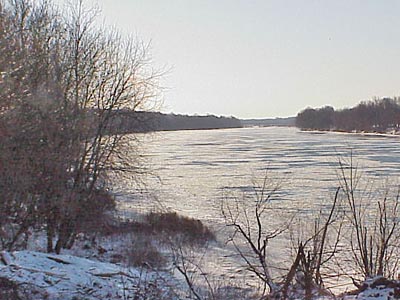
Delaware River winter view – DRBC photo taken in 2000


The following is taken from a DRBC news release:


The Delaware River Basin Commission (DRBC) today announced the termination of its drought management special permit in effect since Nov. 23, 2016, when the basin was placed in a drought watch.

“Due to recent precipitation and snow melt, combined storage in three large upper basin reservoirs has achieved and sustained a sufficient level for five consecutive days to result in automatic termination of the basinwide drought watch,” said DRBC Executive Director Steve Tambini.

“Although upper basin reservoir storage has rebounded in recent weeks automatically ending the drought watch operations, other indicators such as groundwater levels, stream flows, precipitation, soil moisture, and local reservoir storage have not all recovered,” said Tambini. “As a result, various state-issued drought watches and warnings based on those indicators remain in effect across most of the basin.”

“DRBC continues to urge all water users to maximize water efficiency wherever possible and to fully cooperate with requests by the basin states to curb water use where drought watches and warnings have been issued based on local conditions,” added Tambini. “The importance of a coordinated response by all water users cannot be overstated.”

The DRBC’s primary drought management objective, which complements the basin states’ drought response efforts, is to provide for conservation of regional reservoir storage for purposes of water supply and flow augmentation in the Delaware River and salinity control in the Delaware Estuary (i.e., the tidal river and bay). 

The upper basin reservoirs which determine DRBC drought stages are located in the Catskill Mountains at the headwaters of the Delaware River in New York State. These three New York City reservoirs provide about half of the city’s water supply and support a minimum flow target in the Delaware River at Montague, N.J. established by the U.S. Supreme Court Decree of 1954. Storage, releases, diversions, and flow targets in the DRBC drought management plan are determined in advance and must have the unanimous concurrence of the parties to the decree, which include the four basin states and New York City.

Combined storage in the three upper basin reservoirs had been as low as 39.3% of capacity in late November 2016. The reservoirs are currently at about 58% of capacity, which is approximately 70 billion gallons below normal for this time of the year.

By transitioning out of the drought watch stage, out-of-basin diversions to New York City and portions of New Jersey established by the decree will return to normal levels. In addition, the Delaware River flow objective at Montague and a second flow objective at Trenton, N.J. will also return to the normal targets of 1,750 cubic feet per second (cfs) and 3,000 cfs, respectively.


Like this? Use form in upper right to receive free updates
See popular posts from the last 30 days in right column — >>

DRBC lifts drought watch, urges efficient water use Read More »

Philly joins initiative seeking to cut building energy by 50%


PlanPhilly reports:


In a policy framework for advancing green building in Philadelphia published in January, the Delaware Valley Green Building Council (DVGBC) announced that it’s leading the formation of Philadelphia 2030 District, a private sector-led initiative to reduce energy use, water consumption, and transportation-related emissions from the building sector 50 percent by 2030 at a district scale.

By doing so, Philadelphia will be joining Los Angeles, Toronto, Pittsburgh, Austin, San Francisco and 10 other cities participating in 2030 District, a project that already covers almost 300 million square feet of new and existing commercial building space.
“This is a strategy to mitigate climate change, ultimately,” Katie Bartolotta, DVGBC’s policy and program manager told PlanPhilly.
Buildings are the single-greatest source of carbon pollution in Philadelphia, according to the City of Philadelphia Office of Sustainability, and are responsible for 60 percent of citywide carbon emissions.
“Right now, buildings are contributing to the problem, but strategies for reducing energy use in buildings is part of the solution,” Bartolotta said. “The city has a goal to reduce greenhouse gas emissions 80% by 2050. If you want to make strides in reaching that goal, reducing greenhouse gas emissions from the building sector is a really good target area to focus a lot of resources on.”
Like this? Use form in upper right to receive free updates
See popular posts from the last 30 days in right column — >>

Philly joins initiative seeking to cut building energy by 50% Read More »

Is this who you want to protect the nation’s environment?

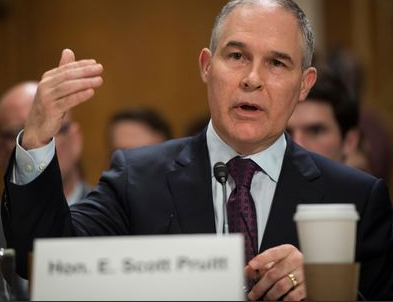
Scott Pruitt testifying today at EPA confirmation hearing


In an op-ed piece in the NY Times today, Eric Schaeffer writes:

The president-elect’s pick to run the Environmental Protection Agency is the antithesis of what the nation should expect in the next administrator of the agency responsible for protecting human health and the environment.

Attorney General Scott Pruitt of Oklahoma has built his career suing the agency he would oversee to roll back its protection of the nation’s air and water, and challenging the very idea of federal action to control pollution.

At the same time, while Mr. Pruitt preaches the gospel of states’ rights, his record suggests he has been far from aggressive in enforcing environmental laws in his own state. Given his anti-regulatory mind-set, skepticism about global warming and support from the industries he would regulate, the Senate, which is set to begin to consider his nomination on Wednesday, should reject him.

His tenure in Oklahoma is instructive. Mr. Pruitt disbanded the environmental protection unit in the attorney general’s office and created a “federalism unit” to litigate against “overreach by the federal government.” Much of that overreach, in Mr. Pruitt’s view, was by the E.P.A.

A spokesman for Mr. Pruitt told The New York Times recently that environmental “bad actors” were still being held accountable by his office. But the paper noted that many of the actions cited by his office were initiated by his predecessor. And The Times reported that Mark Derichsweiler, a state environmental official who oversaw a major water pollution case, retired in 2015 because, in his own words, he was frustrated with Mr. Pruitt’s approach of standing up for business “at the expense of people who have to drink the water or breathe the air.”

Whatever Mr. Pruitt has done to actually protect the environment, he certainly hasn’t bragged about it. During his six-year tenure, his office issued more than 700 news releases announcing enforcement actions, speeches and public appearances, and challenges to federal regulations. My organization could not find any describing actions by Mr. Pruitt to enforce environmental laws or penalize polluters.

By contrast, more than 50 of those news releases promoted his efforts to sue the E.P.A. and challenge its authority. Among the examples: “Pruitt to Testify Before Congress on E.P.A. Abuses,” “Pruitt and Republican Governors Association Challenge Destructive Regulations on Hydraulic Fracturing,” “Pruitt to Appeal E.P.A. Decision on Regional Haze Rule.”

Read the full piece here


Related stories:
 
Like this? Use form in upper right to receive free updates
See popular posts from the last 30 days in right column — >>

Is this who you want to protect the nation’s environment? Read More »

If you thought the wait time for your bus was long…

During a legislative hearing in Trenton that was convened yesterday to dig deeper into the more than $30 billion capital plan that was put forward by the Port Authority earlier this month, lawmakers questioned high-ranking agency officials about a proposed new Port Authority Bus Terminal and learned that it might not be complete until of 2030–or later.

Demand at the current 1950s-era facility is projected to increase by 10 percent by 2020, and up to 50 percent by 2040.

Read John Reitmeyer’s NJ Spotlight story here

Like this? Use form in upper right to receive free updates
See popular posts from the last 30 days in right column — >>


If you thought the wait time for your bus was long… Read More »