NJ recyclers celebrate signature of electronic-waste bill

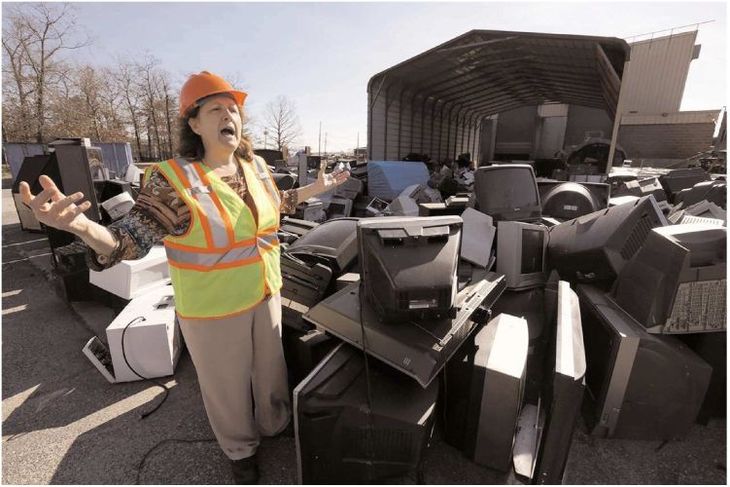
Electronic waste that’s been piling up in Cape May County, NJ

** UPDATED to add related NJ Spotlight story**

New Jersey’s recycling community is celebrating a major victory today with Gov. Chris Christie’s signing into law of S-981/S-2375.

The legislation revamps the state’s troubled electronic-waste recycling program and clarifies the responsibility of computer and television manufacturers to provide free, statewide recycling of worn-out TV and computer monitors and related products.

Municipal and county programs, saddled with rising program costs in recent years (formerly borne by manufacturers) have been forced to pass on the costs to residents or close down their e-waste collection and recycling programs.

In many cases where the programs were no longer available, local officials reported an increase in illegal dumping.

The legislation was supported by a host of environmental organizations and by the New Jersey Association of Counties.

It was opposed by the electronics manufacturers and by the
New Jersey Business and Industry Association and the state Chamber of Commerce. 

The
Association of New Jersey Recyclers, a client of our sister business, Brill Public Affairs, was a prominent advocate for the legislation and released a media statement hailing the bill signing.

Related news stories:


Like this? Use form in upper right to receive free updates
See popular posts from the last 30 days in right column — >>


NJ recyclers celebrate signature of electronic-waste bill Read More »
NJ Rate Counsel: Disputed high-voltage line not needed

transmission tower high-speed transmission line

Tom Johnson reports for
NJ Spotlight:


The New Jersey Division of Rate Counsel has weighed in against a controversial 10-mile-long transmission line to be built along a New Jersey Transit railroad route, saying the project is no longer needed.
In expert testimony filed with the state Board of Public Utilities on Friday, the office’s consultant argued that changing conditions in the electric sector make the line unnecessary and other steps could be taken to address reliability concerns.
The filing bolsters the case of opponents of the $75 million project, which has stirred widespread opposition among residents in surrounding communities, some of whom had opposed the project when it was first proposed in another form more than two decades ago.
Like this? Use form in upper right to receive free updates
See popular posts from the last 30 days in right column — >>

PJM Interconnection, the operator of the nation’s largest power grid, identified the project as necessary for reliability purposes back in 2011. But the rate counsel’s consultant disputed that assessment, suggesting a number of alternatives could also be considered.

The expert, Peter Lanzalotta, argued that numerous other technical approaches to improving reliability were ignored, including distributed generation, a form of localized power sources, and smart grid technologies.
In his filing, the consultant recommended that the BPU defer its review of the project, pending consideration of other alternatives, route costs, and impacts.
In addition, the consultant echoed arguments made by opponents of the project, who have insisted since the undertaking was first identified, peak electricity loads for the company have decreased significantly.
The latest load forecasts by PJM lower the peak load projected in 2031 and 2032, the consultant noted. “Both of these load levels are lower than the load levels discussed above at which the common-cause contingencies were found to cause a need for system reinforcement,’’ the consultant said.
“The need for this project, which was initially determined in 2011, has been diminishing ever since,’’ Lanzalotta said. When the project may be necessary is uncertain, he said. Based on the 2016 load forecast, it does not appear to fall within PJM’s 15-year planning horizon, he added.
JCP&L cited reliability concern in making a case for the 230-kilovolt transmission line, enhancement to substations, and technology upgrades. When it filed the case, JCP&L said it hoped to begin the project by June 2017, with a planned in-service date of June 2019.
The project is the latest of a spate of transmission projects undertaken by the state’s electric utilities, which are under pressure from state and federal regulators to modernize the grid and improve the reliability of their systems.

Like this? Use form in upper right to receive free updates
See popular posts from the last 30 days in right column —
>>


NJ Rate Counsel: Disputed high-voltage line not needed Read More »

Energy & Enviro Bills in Committee, Trenton Jan 9-12 2017


MONDAY, JAN 9 2017  

A-1628  Rodriguez-Gregg, M. (R-8); Holley, J.C.
(D-20) 
Codifies DEP’s New Jersey Recycling Awards Program to
annually recognize outstanding recycling achievements.
Related Bill: S-2777
    Jan 9, 2017 –  Senate
Environment and Energy
S-142  Madden, F.H. (D-4)
Requires DEP to establish certification program for septic system inspectors.
    Jan 9, 2017 – For discussion only: Senate Environment and Energy
S-1808  Van Drew, J. (D-1); Diegnan, P.J. (D-18)
Designates striped bass (Morone saxatilis) as New Jersey saltwater fish.
Related Bill: A-3342
    Jan 9, 2017 –   Senate Environment and Energy
S-2490  Smith, B. (D-17); Bateman, C. (R-16)
Provides for protection of public’s rights under public trust doctrine.
Related Bill: A-4092
    Jan 9, 2017 –   Senate Environment and Energy
S-2689  Greenstein, L.R. (D-14)
The “Green Building and Infrastructure Tax Credit Act”; provides tax credits for certain green buildings and wood utility poles.  Related Bill: A-1355
    Jan 9, 2017 –   Senate Environment and Energy
S-2777  Cruz-Perez, N. (D-5); Van Drew, J. (D-1)
Codifies DEP’s New Jersey Recycling Awards Program to annually recognize outstanding recycling achievements.  Related Bill: A-1628
    Jan 9, 2017 –   Senate Environment and Energy
SR-93  Bateman, C. (R-16)
Urges DEP to revise and update Statewide Water Supply Plan and urges citizens of State to conserve water.   Related Bill: AR-200
    Jan 9, 2017 –   Senate Environment and Energy
THURSDAY, JAN 12 2017

A-441
  Eustace, T. (D-38); Benson, D.R. (D-14); Zwicker, A. (D-16)
Establishes solar power incentive program.
    Jan 12, 2017 – Assembly Telecommunications and Utilities

A-2401  McKeon, J.F. (D-27)
Expands programs in BPU to include low-interest loans
and grants to municipalities for energy efficient programs and innovative
energy technologies.
    Jan 12, 2017 –  Assembly Telecommunications and Utilities
A-2828  McKeon, J.F. (D-27)
Establishes financial incentives for certain energy
providers to conduct energy audits.
    Jan 12, 2017  – Assembly Telecommunications and Utilities
A-4274  Houghtaling, E. (D-11); Andrzejczak, B. (D-1)
Requires EDA, in consultation with Department of
Agriculture, to establish loan program for certain vineyard and winery capital
expenses. 
Related Bill: S-2727
    Jan 12, 2017 – Assembly Commerce and Economic Development
A-4304  Conaway, H. (D-7)
Requires compilation of, and public access to, tests
of soil lead levels.
    Jan 12, 2017 – Assembly Housing and Community Development
A-4305  Conaway, H. (D-7)
Requires soil testing to determine lead content prior
to certain home sales.
    Jan 12, 2017  – Assembly Housing and Community Development
A-4306  Conaway, H. (D-7)
Requires DEP to adopt Statewide plan to reduce lead
exposure from contaminated soils and drinking water.
    Jan 12, 2017  –  Assembly Housing and Community Development
ACR-151  Diegnan, P.J. (D-18); Eustace, T. (D-38)
Urges construction of microgrids at municipal
facilities in New Jersey.
    Jan 12, 2017  –  Assembly Telecommunications and Utilities 

Like this? Use form in upper right to receive free updates

See popular posts from the last 30 days in right column — >> 

Energy & Enviro Bills in Committee, Trenton Jan 9-12 2017 Read More »

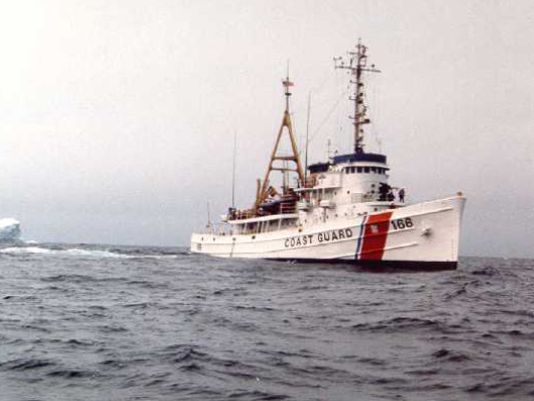
Burial at sea delayed for famed ‘Perfect Storm’ ship

The Tamaroa


Scott Fallon reports for
The Record:


The Coast Guard cutter that helped rescue seven people during “The Perfect Storm” has still not been cleared by federal environment officials to be sunk off the New Jersey coast.


Delaware officials had wanted to add the Tamaroa to an artificial reef it shares with New Jersey before the end of 2016, but the U.S. Environmental Protection Agency is still waiting for lab results to see if the storied ship is free from cancer-causing PCBs, an agency spokesman said.

The reef attracts large game fish and is a boon to diving and the Garden State’s $1.7 billion recreational fishing industry.The sinking has been highly anticipated among many current and retired service members ever since news of the Tamaroa’s fate broke in October. The ship became famous in 1991 when its crew conducted two rescue missions during a storm that produced 40-foot waves and 70 mph wind gusts off the New England coast. Their heroics were documented years later in the book and film “The Perfect Storm,” starring George Clooney and Mark Wahlberg.

The 73-year-old ship, which served in World War II as the USS Zuni, had been undergoing an extensive cleanup at a shipyard in Norfolk, Va., in preparation for the sinking. That involves removing all hazardous material, including PCBs, or polychlorinated biphenyls. 


Once the most widely used chemicals in electrical equipment, PCBs were banned in 1979 when they were found to cause cancer and other serious ailments. 

David Sternberg, an EPA spokesman, said the agency is waiting for lab reports from the Delaware Department of Natural Resources and Environmental Control to see if there is still contamination. The EPA would then inspect the ship onsite.

“Once given the OK from EPA and the U.S. Coast Guard, Delaware and New Jersey will be able to proceed with the sinking,” Sternberg said.


Like this? Use form in upper right to receive free updates
See popular posts from the last 30 days in right column — >>

Burial at sea delayed for famed ‘Perfect Storm’ ship Read More »

OK tries stronger measures to stop fracking earthquakes

Oklahoma's fracking boom has brought a surge in earthquakes
Zahra Hirji reports for Inside Climate News:
Oklahoma regulators released for the first time guidelines aimed to reduce the risk of major earthquakes being generated from fracking operations, including a mandate to immediately shut down operations in the event of a quake measuring 3.5 or higher on the Richter scale.
State officials at the Oklahoma Corporation Commission have tried a series of steps in recent years to bring down the number of earthquakes likely linked to local oil and gas activity. All the previous initiatives, however, focused only on underground oil and gas wastewater disposal triggering earthquakes, not hydraulic fracturing activities used to stimulate a well before extraction.
The new voluntary rules, which are now in effect, instruct companies on how to respond to magnitude 2.5 earthquakes or greater that strike within 1.25 miles of their fracking operations.
If the nearby earthquake has a magnitude of at least 3.5, for example, the company should suspend operations and cooperate with state officials on subsequent steps. For smaller earthquakes, state officials will contact companies but it may not necessarily result in a shutdown.
Like this? Use form in upper right to receive free updates
See popular posts from the last 30 days in right column — >>

The state’s oil and gas areas most likely to be impacted by the guidelines are called the South Central Oklahoma Oil Province (SCOOP) and the Sooner Trend Anadarko Basin Canadian and Kingfisher counties (STACK). There are about 35 active fracking operations in the SCOOP and STACK, according to Matt Skinner, a spokesman for the Oklahoma Corporation Commission, and those numbers are expected to increase next year.
Since early July, geologists identified more than a dozen small earthquakes, all less than magnitude 3.0, across the SCOOP and STACK that weren’t near any deep wastewater injection wells. Experts say these events could be linked to nearby fracking operations.
But most of the state’s earthquakes, including the bigger events, have occurred elsewhere;  experts say they are likely tied to wastewater disposal.
Oklahoma has experienced thousands of earthquakes since 2009, when oil and natural gas production increased. The state had a record-high 3,309 earthquakes of at least magnitude 2.5 in 2015.
While the number of total earthquakes has declined this year—2,073 have been measured with at least a magnitude of 2.5 through Dec. 19—the number of big earthquakes has set a record, according to Jeremy Boak, director of the Oklahoma Geological Survey. In September, for example, the largest earthquake in the state’s history struck, a magnitude 5.8 earthquake near Pawnee.
Like this? Use form in upper right to receive free updates
See popular posts from the last 30 days in right column — >>
 

OK tries stronger measures to stop fracking earthquakes Read More »

Private money fixed Bayonne water; now time to pay up


Brenda Flanagan reports for NJTV NEWS:
“I can’t afford it. You know, I just can’t afford it any more,” said Sandra Richardson.

Bayonne native Richardson walks dogs for a living and says she can’t keep up with her rapidly rising water bill. Rates have jumped almost 28 percent since Bayonne privatized its water utility in 2012.

“My last bill was over $400. Yeah for three months,” she said. “I think it’s ridiculous. I can’t afford, for something as basic as water.”

Residents complain and post bills on Bayonne Talks’ Facebook page. For people on fixed incomes, it forces hard choices.

What does Mark Schutte do without?
 
“TV, internet. You figure out how to cut down on a few things,” he said.

But the 80-year-old system needed millions in upgrades and — like many city councils across New Jersey and the nation — Bayonne’s had avoided biting that bullet for decades.

“And then suddenly, you know, they have to pay the piper. And they have to go in and do this work, and the rates go up significantly,” said New Jersey Division of Rate Counsel Director Stefanie Brand.

“They get a large increase all at once and that’s much harder for ratepayers to bear.”

Instead of trying to upgrade the crumbling infrastructure on its own, Bayonne forged a 40-year partnership contract with $150 million in up-front financing from the private Wall Street equity firm Kohlberg Kravis Roberts. [20112 announcement of the public/private venture]
 

The city used that money to pay off old debts, dissolved its MUA and brought in SUEZ Water to run, maintain and upgrade the drinking, storm and wastewater facilities. SUEZ rep John Ludington says it found a rusted, leaking mess.


Like this? Use form in upper right to receive free updates
See popular posts from the last 30 days in right column — >>

Private money fixed Bayonne water; now time to pay up Read More »