Sniffing out what’s befouling the Navesink River

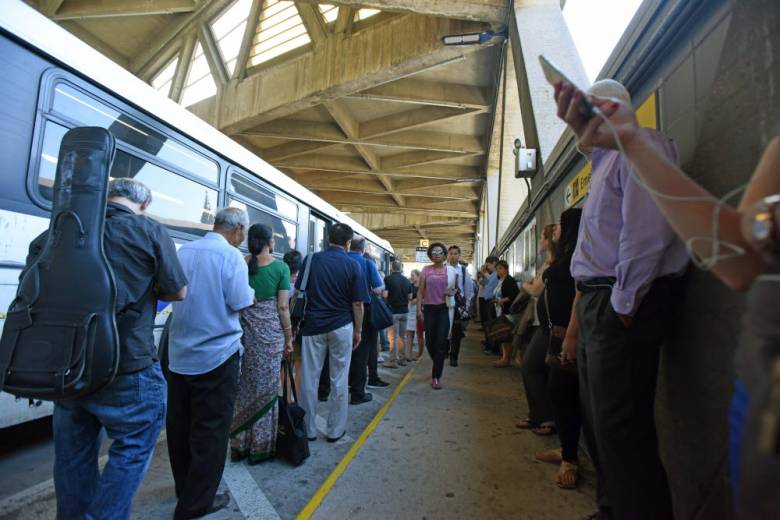
Navesink River pollution meeting Tuesday in Rumson, NJ (EnviroPolitics photo) 


    If there was any doubt about the determination of environmental groups, the
New Jersey DEP, local officials, and residents to reverse the trend of declining
water quality in the Navesink River they were dispelled last night by the large
crowd of people who sat patiently for hours in a humid hall in Rumson, listening
to presentations about the problem and possible solutions.

John T. Ward covered the event for Red Bank Green and reports:

An alarming rise in bacterial pollution levels of the Navesink River drew more than 100 people to the historic Bingham Hall in Rumson on a humid summer night Tuesday.
Among many questions to be addressed were what’s causing a rise in fecal coliform levels, and how can it be stopped?
“We all know what the smoking gun is: stormwater runoff,” Christopher Obropta, a specialist in water resources with the Rutgers Cooperative Extension.
The event, organized by Clean Ocean Action, came 18 months after the the New Jersey Department of Environmental Protection suspended shellfish harvesting in 566 acres of the Navesink because of unacceptably high levels of fecal coliform, bacteria that occur in the intestines of warmblooded animals. This February, the DEP finalized the downgrade.
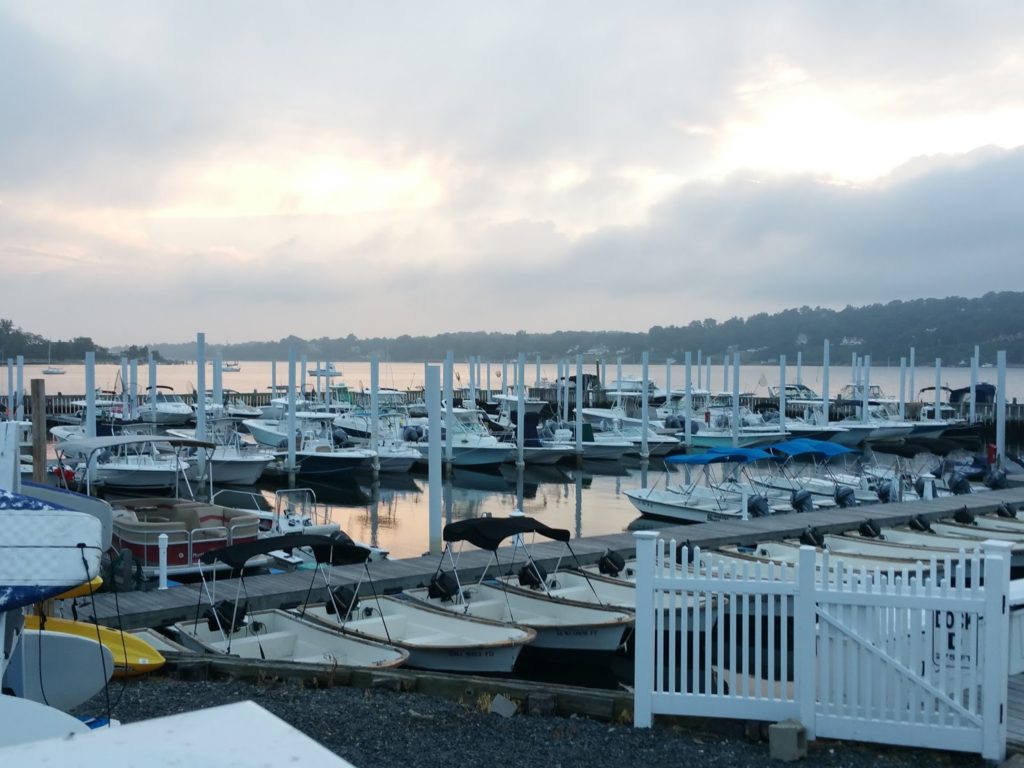
Marina on the Navesink River in Rumson, NJ (EnviroPolitics)

Cindy Zipf, Clean Ocean Action’s founder and executive director, told the audience that the purpose of the event was to rally not only government agencies but environmental organizations and individuals to attack the problem.

“We’re going to lose that final direct-harvest clam bed [in the New York region] if we don’t do something,” she said. Invoking the ocean-dumping of raw sewage that gave rise to the Sandy Hook-based nonprofit in 1984, she said, “nobody thought we could bring back the ocean, but we did.”
Clean Ocean Action attorney Zach Lees unveiled the findings of a yearlong study he authored that takes a comprehensive historical and scientific view of the Navesink.
Among its findings: the waterway is “safe for boating,” according to the DEP, but doesn’t meet swimmable water quality standards.
“We’re still getting fecal counts over what we consider safe for swimming,” Lees said. Zipf called the safe-boating designation “a pretty low bar.”
Here’s the full report: COA Navesink Pathogens 062816
The event featured presentations by a handful of experts, including Bob Schuster, of the DEP’s bureau of marine water monitoring, who described changes in agency’s nonpoint source tracking program aimed at expediting the delivery of data about pollution levels to municipal officials, with the aim of attacking bacterial incursions at their sources.

Read the full story here

Related news story: Navesink River’s water quality under review

Like this? Use form in upper right to receive free updates
See popular posts from the last 30 days in right column — >>

 

Sniffing out what’s befouling the Navesink River Read More »

Bottled-up projects may get open space funding soon in NJ

Deal could end ongoing argument between lawmakers and Christie that has stalled projects to preserve farmland, historic structures, undeveloped land

Tom Johnson reports today in NJ Spotlight:

 A last-minute compromise yesterday resolved an impasse on how to spend up to $146 million for open-space preservation, with the Legislature approving a slightly modified version of a bill initially conditionally vetoed by the governor.
The agreement reached late in the afternoon of a marathon legislative session averts prolonging a dispute between the governor’s office and lawmakers that had held up projects to protect farmland, historic structures, and undeveloped land — as well as to enhance existing parks.
The legislation (S-2456) won approval in both houses without debate, in contrast to the acrimony the issue had previously raised. It now heads to the governor’s desk where Christie has signaled his willingness to go along with the compromise, a step that also avoids a possible override vote by the Legislature.
The new bill provides a framework for how money taken from the state’s corporate business taxes will be used to fund a range of conservation projects, including buyouts of flood-prone properties in the state. That issue was a concern mentioned by Gov. Chris Christie, lawmakers, and some environmentalists.
By ending the months-long stalemate, towns, counties, and nonprofit groups will obtain the funding for preservation projects for the first time since voters approved a constitutional amendment in a statewide ballot question in 2014.

Like this? Use form in upper right to receive free updates

See popular posts from the last 30 days in right column — >>

For proponents of the issue, the bill marks a victory, since it would not use proceeds from the corporate business taxes to pay for salaries and maintenance at state parks, as was done in the current fiscal year, which ends Thursday. Christie had proposed diverting nearly $20 million in open-space funds again in his budget submitted to the Legislature earlier this year.
The Democratic-controlled Legislature has proposed its own diversion to pay for park salaries and maintenance, siphoning off $20 million from the Clean Energy Fund. That tactic was tried, too, last June, but the money was line-item vetoed by the governor.
In a statement issued after the vote, Sen. Bob Smith (D-Middlesex), the sponsor of both preservation bills, said the compromise will implement the intended goals of the amendment voters approved in 2014.
“It will also ensure that open-space funds are not used for administrative costs like salaries, and will dedicate 4 percent to the Blue Acres program,’’ Smith said. The 4 percent allocation amounts to roughly $2.6 million.
Ed Potosnak, chairman of the New Jersey Keep It Green coalition, representing more than 100 conservation, park, and recreational organizations backing the bill, lauded the compromise.
“It really upholds the will of the voters,’’ he said. “It will pay for preservation programs.’’
With the continuing impasse over how to spend the money, many of those preservation programs have run out of funds to preserve agricultural land and historic buildings, according to proponents of the bill.
Jeff Tittel, director of the New Jersey Sierra Club, said it is a positive that money from the constitutional amendment will be freed up to be spent, but the compromise leaves many issues still to be worked out. They include possible plans to privatize some operations at the state Department of Environmental Protection and the agency’s long-term funding needs.
Related: Christie cuts last-minute open space deal to avoid first veto override 

Like this? Use form in upper right to receive free updates
See popular posts from the last 30 days in right column — >>


Bottled-up projects may get open space funding soon in NJ Read More »

Are Pennsylvania lawmakers ready to sell out state parks?

David Masur, director of the advocacy organization PennFuture, just posted the following alert:


Our state parks are the crown jewel of Pennsylvania’s great outdoors. From Ricketts Glen to Presque Isle to Ohiopyle—our state parks add immeasurable value to Pennsylvania’s incredible natural heritage.

Yet as you read this email, politicians in Harrisburg are fast-tracking legislation that could open up our state parks to the highest bidder. This proposal, House Bill 2013, would create a new steering committee dominated by political and business interests instead of conservation, recreation and ecological protection. 

And if passed, it could lead to state parklands being razed and replaced with office buildings, golf courses and other intrusive development projects that will inevitably destroy the scenic and wild beauty that we cherish in Pennsylvania’s state parks. 

This vote could happen as early as TODAY. Email your state senator and representative now and tell them to oppose legislation that may open the door to selling our state parks to the highest bidder.

With more than 120 state parks—at least one park within 25 miles of every Pennsylvanian—these public lands are our pride and joy. Yet House Bill 2013 sends our parks down the slippery slope of privatizing and destroying them for private gain. Our public lands shouldn’t feed the pocketbooks of such interests. 

Plus, the agency that oversees our parks already has the ability to review proposals for private ventures—such as concession sales and other services that make our parks more accessible and enjoyable. But HB2013 would put the power into the hands of the corporate interests —not the scientists and experts at the Department of Conservation and Natural Resources (DCNR) whose entire role is to protect our public lands.

So help us protect our parks before it’s too late—email your state legislators today and ask them to oppose this sneak attack on our state parks. 

Our state parks are public lands owned by and entrusted to the people of Pennsylvania—not the highest bidder who cares only about how to make a buck at the expense of our treasured parks.

Like this? Use form in upper right to receive free updates
See popular posts from the last 30 days in right column — >>

Are Pennsylvania lawmakers ready to sell out state parks? Read More »

Bill aims at keeping solar energy shining in New Jersey

A proposed commission would look at the fundamentals of the solar industry, including whether ratepayers should continue to subsidize it

solar


Tom Johnson reports today in NJSpotlight:

The future of the state’s solar industry could begin taking shape today, when the Senate votes on a bill aimed at averting a collapse of the sector and mapping its long-term course.

The legislation (S-2276), backed by a broad coalition representing solar firms, developers, and clean-energy advocates, is the latest tweak to a decade-old system that encourages solar installations by giving owners of the arrays financial incentives for the electricity they produce.
Solar advocates warn that without some modifications, the market could crash within a few years, drying up investment in the sector, causing the layoffs of thousands of installers, and increasing reliance on more polluting forms of generating power, such as natural gas.
Beyond ramping up in the short term how much solar should be installed in New Jersey, the bill also would set up a commission to study what steps the state should take to continue to nurture the industry, and perhaps more importantly, whether it should even continue to have ratepayers subsidize its growth.
Like this? Use form in upper right to receive free updates
See popular posts from the last 30 days in right column — >>

Currently, the solar market is doing very well. The prices — dubbed solar renewable energy certificates (SRECS) — owners of systems earn for the power their panels produce run in the $265 range, with federal tax incentives making the technology an even more lucrative investment.
Perhaps too much so, according to the state Division of Rate Counsel. The office, which represents ratepayers’ interests, has expressed concern about the measure’s impact on utility customers who pay a surcharge on their bills to subsidize the SRECs. By its estimate, the bill could cost ratepayers an additional $276 million.
That view is disputed by the bill’s proponents, who argue it will not increase costs but only accelerate the requirement that more than 4.1 percent of the state’s electricity come from solar, a mandate largely met by making more SRECs available sooner rather than later.
A similar strategy was adopted in 2012 when the solar market collapsed and the price of the solar certificates dropped dramatically. By most accounts, it worked, leading the tactic to be used one final time, according to Sen. Bob Smith (D-Middlesex), the sponsor of the bill. “That’s it,” he said before his committee voted out the bill earlier this month.
Division of Rate Counsel Director Stefanie Brand worries that when the mandates for solar fall off in 2021, the industry will come back before the Legislature to lobby again to accelerate requirements for more solar installations.
Her office pushed unsuccessfully for an amendment to the bill that would create a market monitor to track the sector and to make sure ratepayers were not paying too much to stimulate the industry. Legislators have rejected the proposal so far.
Instead, many of those issues will be up to the commission established by the legislation. Beyond studying whether the price of the solar certificates is fair, it would also make recommendations to the governor and Legislature about how much solar the state needs to build in the future.
Clean-energy advocates have argued that with state law mandating steep reductions in emissions contributing to global warming, solar needs to play much more of a significant role in New Jersey’s future. Critics, however, say too much reliance on solar will push up already high energy costs.

Like this? Use form in upper right to receive free updates
See popular posts from the last 30 days in right column — >>



Bill aims at keeping solar energy shining in New Jersey Read More »

Energy, enviro bills posted for votes in Trenton – 6/27/16


Energy and environment bills posted for floor votes
Monday (6/27) in the NJ Assembly and Senate


ASSEMBLY VOTING SESSION
12:00 Noon
A-2080  Mukherji, R. (D-33); Pintor Marin, E. (D-29);
Eustace, T. (D-38)
Authorizes municipalities to establish program for
public or private financing of certain renewable and energy efficiency, micro-grid,conservation, and storm resiliency  projects through the use of voluntary special
assessments for certain property owners.
Related Bill: S-1570
      
A-2763  Mazzeo, V. (D-2); Mosquera, G.M. (D-4);
Mukherji, R. (D-33)
Enters NJ in Interstate Wildlife Violator Compact.

Related Bill: S-1933

A-3882
  Spencer, L.G. (D-29); Chaparro, A. (D-33);
Caride, M. (D-36)

Changes submission and notice requirements for
short-term and long-term financing for environmental infrastructure projects.
Related Bill: S-2287
    
A-3883  Zwicker, A. (D-16); Green, J. (D-22);
Andrzejczak, B. (D-1); Tucker, C.G. (D-28)
Authorizes New Jersey Environmental Infrastructure
Trust to expend certain sums to make loans for environmental infrastructure
projects for FY2017.
Related Bill: S-2292
     
A-3884  Chiaravalloti, N. (D-31); Mukherji, R.
(D-33); Caputo, R.R. (D-28)
Appropriates funds to DEP for environmental
infrastructure projects for FY2017.
Related Bill: S-2293
     
A-3901  Singleton, T. (D-7); Zwicker, A. (D-16);
DiMaio, J. (R-23)
Establishes Hunterdon-Somerset Flood Advisory Task
Force. 
Related Bill: S-166


ACR-132  Land, R.B. (D-1); Schaer, G.S. (D-36); McKnight,
A.V. (D-31)
Approves FY 2017 Financial Plan of NJ Environmental
Infrastructure Trust.

Related Bill: SCR-109

S-166  Bateman, C. (R-16); Doherty, M.J. (R-23)

Establishes Hunterdon-Somerset Flood Advisory Task
Force.
Related Bill: A-3901
    
 —————————————————————————————————————

SENATE VOTING SESSION
12:00 Noon
S-2044  Lesniak, R.J. (D-20); Whelan, J. (D-2)
Prohibits certain possession, sale, trade,
distribution, or offering for sale of shark fins.

Related Bill: A-3945

S-2276
  Smith, B. (D-17); Bateman, C. (R-16)

Establishes NJ Solar Energy Study Commission and
modifies State’s solar renewable energy portfolio standards.
   
S-2287  Bateman, C. (R-16); Smith, B. (D-17)
Changes submission and notice requirements for
short-term and long-term financing for environmental infrastructure projects.
Related Bill: A-3882
     
S-2292  Greenstein, L.R. (D-14); Kyrillos, J.M.
(R-13)
Authorizes New Jersey Environmental Infrastructure Trust
to expend certain sums to make loans for environmental infrastructure projects
for FY2017.
Related Bill: A-3883
     
S-2293  Whelan, J. (D-2); Gordon, R.M. (D-38)
Appropriates funds to DEP for environmental
infrastructure projects for FY2017.
      
SCR-109  Smith, B. (D-17)
Approves FY 2017 Financial Plan of NJ Environmental
Infrastructure Trust.

Like this? Use form in upper right to receive free updates
See popular posts from the last 30 days in right column — >>


Energy, enviro bills posted for votes in Trenton – 6/27/16 Read More »

The bi-state agency that can’t build it on time or on budget

The Record‘s Paul Berger has the story:

Five years ago, the George Washington Bridge Bus Station was a mess. Its dingy,
un-airconditioned concourse was stifling in the summer. Storefronts were vacant.
Television monitors that showed buses arriving on the platform failed regula
rly.

“The seating area was so small you usually had to fight for a seat,” said Laura Vogel, a commuter.

Still, the building provided the basics. You could buy a snack, grab a bottle of water, and ride an escalator to the bus platform above or to the subway station below. That was until a few years ago, when the Port Authority shut down the stores and, soon after, closed down large parts of the station for what was supposed to be a quick renovation.

Apart from the thousands of commuters who use it daily, few people pay attention to this bus station in northern Manhattan.


But more should.

The past 10 years of setbacks, delays, cost overruns and passenger struggles are a warning of the potential hazards facing hundreds of thousands of bus commuters waiting for the replacement of the Port Authority’s landmark bus terminal near Times Square.

The Port Authority Bus Terminal serves 67 million passengers per year. Its replacement, billed by the agency as “one of the largest, most complex transit terminals in the country,” is expected to cost about $10 billion. The chairman of the Port Authority, John Degnan, has vowed to replace the midtown terminal in the next seven to 10 years. But it has taken the agency about as long to perform a $200 million renovation on this small station in Washington Heights, which serves about 5 million passengers annually.

“This is not a complicated project and it’s not about building lots of new infrastructure — it’s about making improvements to an existing facility,” said Rich Barone, director of transportation programs for the Regional Plan Association. “Something like that should be measured in a matter of a few years; it shouldn’t take almost a decade. If it takes that long, how long will it take to get these really big projects done?”

Today, at the temporary George Washington Bridge Bus Station, there’s nowhere to buy a drink or a snack. The ticket office, waiting room and bathrooms are in a trailer on Fort Washington Avenue. There are no escalators. Passengers must trudge up and down a three-story staircase to reach the street and then walk another block or two to the subway where they face several more flights of stairs.

Although the Port Authority offers street-level bus pickup for people with disabilities who call ahead, on most days physically challenged passengers, as well as mothers with children and people with luggage, can be seen hauling themselves up the steep staircase to their bus.

“A lot of people avoid the station,” said Vogel, the commuter. She is 60 and lives in Englewood. “I don’t want to do those stairs any more.”

The agency’s chairman, Degnan, visited the George Washington Bridge Bus Station last year to see the project for himself after receiving complaints from state Sen. Loretta Weinberg, D-Teaneck, whose residents, especially older residents, were struggling at the station.

“Frankly, the Port Authority has not coated itself with glory in the way this project been managed over the long period of time it’s been under way,” Degnan said on Wednesday.

“We’ve got to do a better job in the future of managing these kinds of projects. I have no excuse why it’s taken 10 years to get this done.”

Like this? Use form in upper right to receive free updates
See popular posts from the last 30 days in right column — >>


The bi-state agency that can’t build it on time or on budget Read More »