Is revised NJ Energy Master Plan too fossil-fuel heavy?


Dozens of speakers asked the New Jersey Board of Public Utilities (BPU) to update the state’s 2011 Energy Master Plan with increased goals for renewable energy at a public hearing Monday afternoon at Stockton University, ” Michelle Brunetti Post reports in the Atlantic City Press.
“I’m embarrassed our master plan seems to focus on fossil fuels,” said Ron Hutchison of Northfield, a member of 350.org, which works to combat global warming.
Like many other speakers, he said the plan should take into account the social costs of using carbon-based fuels, including the price of dealing with climate change, rising sea levels, and health problems from particulate air pollution. 

Many asked the BPU to return to standards in the 2008 Energy Master Plan, calling for 30 percent of the state’s energy to come from renewable energy such as wind and solar by 2021. That percentage was decreased to 22.5 percent in the 2011 plan.
About 70 people came out to give their input, or listen to others. Speakers took up almost the full four hours, from 1 to 5 p.m.
BPU President Richard Mroz ran the meeting. He opened by saying the state has been doing well meeting the 2011 plan’s five major goals of driving down energy costs, creating a diverse portfolio of clean new energy generation in-state, rewarding efficiency and conservation, promoting emerging technologies and using renewables.

New Jersey League of Women Voters President Nancy Hedinger said she was disappointed the public hearings were being held in August, a time when many people are vacationing and cannot participate.

Richard Jackson, executive director of the New Jersey Energy Coalition, made up of 55 members including all the state’s major electric and gas utilities, said he hoped the new master plan puts emphasis on investment in electric and natural gas infrastructure projects that improve efficiency and safety, and lower costs.
Before the hearing, environmental groups and renewable energy promoters, including the New Jersey Sierra Club, Fishermen’s Energy350.org, Environment New Jersey, Clean Water Action, and Citizens United for Renewable Energy held a news conference to call for approval of renewable energy projects such as the Fishermen’s Energy wind farm.
 
Like this? Click here for free updates
Social media icons below make it easy to share


Recent blog posts: 

Is revised NJ Energy Master Plan too fossil-fuel heavy? Read More »

Did NJ Pinelands pipeline battle just end without a vote?


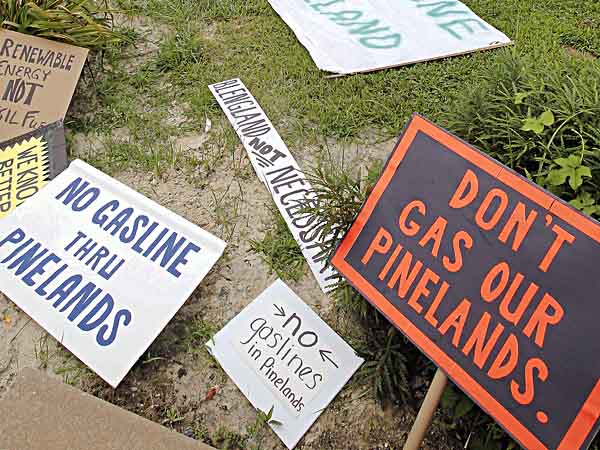
Did the cantankerous battle over a natural gas pipeline through the Pinelands just end without the firing of a single shot? 


That may be the case as the Pinelands Commission staff on Friday issued a “Certificate of Filing” which declares that an application from South Jersey Gas to build the 22-mile natural gas pipeline along roads through the Pinelands is complete and ready for review.

It also eliminates the need for an approval vote by the full commission, something that critics of the pipeline feared had been cinched with Gov. Chris Christie’s contested
 appointment of a new commissioner to replace a panel member who had cast the ‘no’ vote that sunk the pipeline on a previous occasion. 
Christie’s new Pinelands nominees trigger enviro alarms


Environmentalist fought the appointment which narrowly passed the Senate on March 16. Pinelands supporters outraged by vote to replace Commission member who voted against pipeline

Since then, opponents have been dreading an expected new vote, so Friday’s action 
came as a surprise–although equally unwelcome–and made some wonder if the new appointee also had decided to vote against the plan. 

Matt Katz,
in NJ Spotlight, reports that Commission Executive Director Nancy 
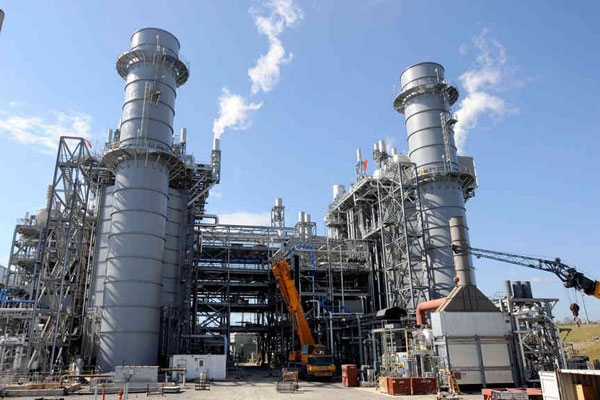
Wittenberg told the commission that the decision “does not need to come before them for a vote because the project is a private development for use only within the Pinelands, and the gas pipeline will feed a power plant that will provide electricity to the area.”


Briana Vannozzi filed the video report at the top for NJTV News.


Like this? Click here for free updates

The social media icons below make it easy to share


Recent blog posts: 


Did NJ Pinelands pipeline battle just end without a vote? Read More »

Water contamination bill sitting on Gov. Christie’s desk

A bill sponsored by NJ Assemblyman Herb Conaway that requires the Department of Environmental Protection to establish maximum contaminant level for 1,2,3-
18 trichloropropane in drinking water is awaiting a signing decision by Gov. Chris Christie.


Conaway, a physician and a Democrat, represents the 7th Legislative District comprising municipalities in Burlington County.In the  video, he explains the reason why he introduced A-3954 and why he thinks the governor should sign it.


The contaminant, not currently regulated by drinking-water standards, was found in Moorestown NJ’s water supply last October, causing town officials to shut down two of its primary wells. Toxin leads Moorestown to shut two wells


Like this? Click here for free updates

The social media icons below make it easy to share


Recent blog posts: 

Water contamination bill sitting on Gov. Christie’s desk Read More »

New Jersey says it will hire a consultant on offshore wind

New Jersey plans to bring on a consultant to advise it on developing offshore wind farms, a step that may finally move New Jersey to act on a five-year-old legislative mandate, Tom Johnson reports today for NJ Spotlight.

Board of Public Utilities President Richard Mroz said the yet-to-be-hired consultant would help the state write regulations essential to developing wind turbines off the Jersey coast. The regulations, four years behind schedule in being adopted, would spell out a financing mechanism to have utility customers fund the projects.

Mroz told the Senate Judiciary Committee of the agency’s plans during a reconfirmation hearing yesterday, at which senators criticized the board for not moving quicker to comply with a law aimed at promoting offshore wind farms. Mroz and fellow BPU Commissioner Joseph Fiordaliso won confirmation from the Senate later in the day.

“Why hasn’t the BPU done its job?’’ asked Sen. Bob Smith (D-Middlesex), a leading proponent of the state moving more aggressively on developing renewable energy.

“Institutionally, the BPU has failed us in the establishment of wind energy.’’

Without the regulations, it would be difficult, if not impossible, to line up financing from Wall Street to help fund the projects, which could easily run to more than $1 billion. The regulations would pay the developers for the electricity the wind turbines produce through credits paid for by ratepayers.

Critics of the administration of Gov. Chris Christie have long complained about the lack of action on offshore wind, something the governor had supported during his first campaign. Some claim that the BPU has done nothing but deny offshore project applications since Christie began exploring the possibility of a run for President and started courting large, potential campaign contributors like  the Koch Brothers who are heavily invested in fossil fuels and have underwritten efforts to discount or oppose alternative energy technologies like wind and solar. What do you think? Is the BPU plan to hire an offshore energy consultant, sincere or simply a delaying tactic? Use the comment box below to share your thoughts.


Like this? Click here for free updates

The social media icons below make it easy to share


Recent blog posts: 

New Jersey says it will hire a consultant on offshore wind Read More »

Environment and energy bills signed by NJ Gov. Christie

NJ Gov. Chris Christie and Lt. Gov. Kim Guadagno

Although he has spent most days recently on the presidential campaign trail, New Jersey Governor Christie is still signing, vetoing and conditionally vetoing bills.

Among those which that he most recently signed into law are:

S-2420/A-3838 (Smith, Bateman/McKeon, Eustace, Gusciora, Benson) – Increases electric power net metering capacity threshold to 2.9 percent of total annual kilowatt-hours sold in State.


SCS for S-2567/AS for A-4025 (Sweeney, Oroho, Smith, Greenstein, Thompson/Mazzeo, Andrzejczak, Space, McHose, Pinkin) – Creates “Fishing Buddy License”


S-2599/A-4121 (Bateman, Smith/Spencer, Schepisi) – Provides certain definitions for biofuels under “Motor Fuel Tax Act”


S-2825/A-4316 (Sweeney, Greenstein/Mazzeo) – Increases efficiency and transparency in distribution of Superstorm Sandy aid money


S-3023/A-4558 (Ruiz, Oroho/McKeon, Spencer, Wimberly) – Appropriates $4,750,000 from various Green Acres funds for grants to certain nonprofit entities to acquire or develop lands for recreation and conservation purposes


A-4559/S-3022 (McKeon, Spencer, Wimberly/Codey, Doherty) – Appropriates $88,592,361 from “Garden State Green Acres Preservation Trust Fund” and various Green Acres bond funds for local government open space acquisition and park development projects


Bills he has vetoed conditionally (amendments offered to assure his signature)
  

S-2489/ACS for A-3859 (Sweeney, Whelan, Oroho/Greenwald, Coughlin, Bramnick, Singleton, Rible, Lagana) – CONDITIONAL – Permits public-private partnership agreements for certain building and highway infrastructure projects; provides for EDA oversight.

S-2784/A-3856 (Van Drew, Whelan/Andrzejczak, Johnson) – CONDITIONAL  Provides maximum sales and use tax imposition amount for sales and uses of boats and vessels; establishes grace period for imposition of use tax on certain boats and vessels used by resident purchasers.

See copies of any of the above bills on the NJ Legislature’s website


Like this? Click here for free updates

The social media icons below make it easy to share


Recent blog posts: 

Environment and energy bills signed by NJ Gov. Christie Read More »

Five years after mandate, still no soil compaction standard


** VIDEO INTERVIEWS BELOW**


One of the questions examined on Monday at a special joint summer session of the NJ Senate and Assembly environment committees in Lavallette was what is holding up the implementation of soil compaction standards that were mandated in legislation enacted
five years ago.


Why is soil compaction a problem? Here’s how Senate committee chairman Bob Smith (D) describes soil compaction:

“When a bulldozer drives over dirt (at a construction site), the soil becomes compacted to the point that it’s just as bad as if you put in a concrete surface. The question is, when you do construction, should you restore soil so that it’s permeable again so that water can go through the soil and go back to the groundwater?”


Why was a meeting held on the shoreline of the Barnegat Bay such an appropriate place to discuss it? 


Many years of rapid residential and commercial development in formerly rural Ocean County brought with it miles of newly paved roads and parking lots and compacted soil beneath homeowners’ lawns. During rainstorms, water that no longer is absorbed into the soil runs off and enters storm sewers, creeks and rivers that ultimately transport it (and the lawn fertilizers, pesticides, and street oil that it carries) to Barnegat Bay.

For years, scientists at Rutgers University have been monitoring the environmentally devastating results the pollution has inflicted on the Bay, a much loved fishing and boating destination, and have been calling for measures to stem the runoff.

The state legislature and Gov. Chris Christie responded five years ago with two laws. The first limited the amount of nitrogen in lawn fertilizer products sold in the state. The second directed the state Department of Agriculture to develop standards for soil compaction that developers and landscapers would be required to meet on new projects.

The fertilizer law is in effect. The soil law, now five years old, still has not produced final compaction standards.

Video interviews with two meeting participants


Dr. Stanley Hales of the Barnegat Bay Partnership discusses the delay in the adoption of statewide soil compaction standards and why it is hurting Barnegat Bay.


Helen Henderson of the American Littoral Society provides information on a soil compaction remediation project that produced dramatic results.
Care to add to the discussion on soil compaction? Share your experience and opinions in the comment box below.

Five years after mandate, still no soil compaction standard Read More »