Maersk renews lease with NY/NJ ports ahead of schedule

Danish A.P. Moller – Maersk and the Port Authority of New York and New Jersey (PANYNJ) will continue their long-lasting partnership well into the second half of the 21st century. The two companies agreed to extend the lease of the APM Terminals Elizabeth’s lease by 33 years through December 2062. The extension comes several years ahead of the current contract expiring in 2029. 

By Malte Humpert, gCaptain

Danish A.P. Moller – Maersk and the Port Authority of New York and New Jersey (PANYNJ) will continue their long-lasting partnership well into the second half of the 21st century. The two companies agreed to extend the lease of the APM Terminals Elizabeth’s lease by 33 years through December 2062. The extension comes several years ahead of the current contract expiring in 2029. 

The early renewal paves the way for significant infrastructure investments to further expand the port’s capacity and transport speed. Recent modernization efforts at the facility have already brought in $200m, including two state-of-the-art ZPMC Super-Post Panamax ship-to-shore (STS) cranes.

The proposed deal is now awaiting final approval from the Port Authority’s Board of Commissioners later this week.

“We are deeply honored and grateful for Chairman Kevin O’Toole and Executive Director Rick Cotton’s support to extend our lease at APM Terminals Elizabeth,” said Keith Svendsen, CEO, APM Terminals.

The APM Terminals’ facility accounts for 25 percent of annual container volume at the port and employs more than 1,110 workers of the International Longshoremen’s Association (ILA). The expansion plans are set to create additional jobs and support U.S. economic growth. 

The operation at the port set new records for throughput in 2024. It is the second-largest container terminal on the U.S. East Coast. 

Upgrades will include the optimization of the terminal layout and electrification of the container handling operation.


If you like this post, you’ll love our daily environmental newsletter, EnviroPolitics. It’s packed daily with the latest news, commentary, and legislative updates from New Jersey, Pennsylvania, New York, Delaware…and beyond. Please do not take our word for it, try it free for a full month

Maersk renews lease with NY/NJ ports ahead of schedule Read More »

NY councilman wants city to drop pension investments in Tesla

By Elizabeth Kim, The Gothamist

As Elon Musk slashes spending and targets federal agencies, his once popular electric carmaker Tesla is taking a beating. Protests have erupted at dealerships across the country, including in New York City; Tesla owners are selling off their cars and the stock price is plummeting.

Justin Brannan, a Democratic City Council member who’s running for city comptroller, is vowing to aim another dagger at the company if elected — by leading an effort to have the city pensions divest completely from Tesla holdings worth an estimated $1.2 billion.

“Elon Musk is coming for us,” Brannan told Gothamist in an interview. “Why should we be investing retirees’ hard-earned pension funds in a guy who’s already shown that he’s got New York City in the crosshairs?”

Read the full story here


If you like this post, you’ll love our daily environmental newsletter, EnviroPolitics. It’s packed daily with the latest news, commentary, and legislative updates from New Jersey, Pennsylvania, New York, Delaware…and beyond. Please do not take our word for it, try it free for a full month

NY councilman wants city to drop pension investments in Tesla Read More »

Pennsylvania racing to install EV chargers before Trump pulls plug

By Scott Sturgis, Philadelphia Inquirer

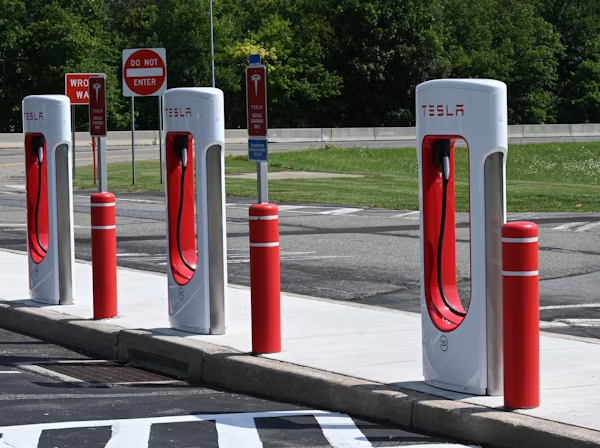
The Trump administration has tried to pull the plug on the federally funded EV charger program designed to electrify America’ highways, but that isn’t stopping Pennsylvania from charging ahead.

The $7.5 billion National Electric Vehicle Infrastructure program was included in the Bipartisan Infrastructure Law passed in 2021, and aimed to build out charging infrastructure in all 50 states.

But a Feb. 6 letter from the Federal Highway Administration pulled back much of that money, leaving states scrambling to determine exactly what they could do.

Pennsylvania is among the states in a position to forge ahead.

“Kudos to PennDot — PennDot was on it,” said Ingrid Malmgren, senior policy director for the EV advocacy nonprofit Plug In America. “They really have been paying attention, they’ve been making plans, they have chargers up and running. They’re definitely ahead of other states.”

PennDot announced at the end of last month that three new NEVI chargers have been added to the network, giving the Philadelphia region’s EV owners more freedom to plan trips west to Pittsburgh, with a station near the Pennsylvania Turnpike at Carlisle, and north to upstate New York, with another on I-81 just south of the border. A third station near Chambersburg has also come online, bringing the total number of stations to eight, with three more to come soon, PennDot said.

The three new stations join five already in service in the Commonwealth, including one in Aston, Delaware County.

Read the full story here


If you like this post, you’ll love our daily environmental newsletter, EnviroPolitics. It’s packed daily with the latest news, commentary, and legislative updates from New Jersey, Pennsylvania, New York, Delaware…and beyond. Please do not take our word for it, try it free for a full month

Pennsylvania racing to install EV chargers before Trump pulls plug Read More »

New Jersey housing bill for farm workers sent to governor

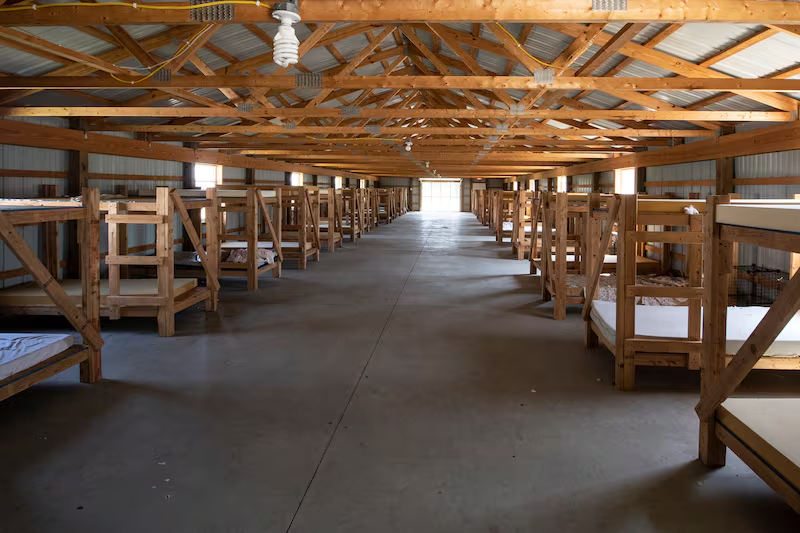
Migrant farmworkers housing on a South Jersey cranberry farm. Jose F. Moreno / Inquirer Staff Photographer

From the Assembly Republican News

     New Jersey Assemblyman Alex Sauickie’s bill permitting farmworkers to live onsite was passed by the full Assembly on Monday, advancing it to the governor’s desk.

     The bill (A4501/S3353) updates New Jersey’s Right to Farm Act to include the right to house workers on commercial farms, protecting landowners from public or private nuisance lawsuits.

     “This bill recognizes that farmworkers often need to respond quickly to emergencies that could threaten crops or livestock,” said Sauickie (R-Ocean).

     Under the bill, the amount of onsite housing must correlate to the labor needed to operate the farm. It would apply to full-time workers who are not family members of the landowners and operators. The employees also could not be charged rent.

     “Equine farm employees already have this right, so this bill brings consistency to the law and provides clarity for municipalities and landowners,” Sauickie added.

     In New Jersey, full-time equine farm employees are allowed to reside within the same building or facility where the horses are kept or boarded.

     The bill passed the Senate in January.

     “Living on the premises gives employees the 24/7 access they need to support the farm and the future of New Jersey’s agriculture industry,” Sauickie said.

If you like this post, you’ll love our daily environmental newsletter, EnviroPolitics. It’s packed daily with the latest news, commentary, and legislative updates from New Jersey, Pennsylvania, New York, Delaware…and beyond. Please do not take our word for it, try it free for a full month

New Jersey housing bill for farm workers sent to governor Read More »

Trump chills clean energy manufacturing boom

President Donald Trump steps off Air Force One as he arrives in Palm Beach, Florida, on Friday.
President Donald Trump has vowed to dismember the Inflation Reduction Act, raising concerns by businesses that are planning to build U.S. factories. | Brendan Smialowski / AFP via Getty Images

By Benjamin Storrow, Politico, March 17, 2025

onald Trump and Joe Biden share one thing in common: a love of manufacturing.

But the similarities end there. The former president lavished subsidies on manufacturers that churn out clean energy components like solar panels, wind turbines and electric vehicle batteries. The current president favors tariffs on imported goods to help American factories and has pledged to slash the Biden-era subsidies.

The resulting uncertainty for clean energy manufacturers is already starting to bite.

Canceled manufacturing projects through the first 2 1/2 months of 2025 totaled roughly $8 billion, far exceeding the $1.6 billion terminated during all of last year, according to Atlas Public Policy. The canceled projects include a transmission cable factory in Massachusetts, a battery plant in Arizona and an EV component factory in Georgia.

“It’s really very risky right now,” Alex Zhu, the CEO of the solar cell maker ES Foundry, told me for a story today about the state of clean tech manufacturing. And he’s one of the lucky ones: ES Foundry recently opened a cell factory in South Carolina, the second of its kind in the U.S.

Trump isn’t the only reason for the new skittishness. Manufacturing is a tough business, and China dominates clean technology. A slowdown in the Chinese economy means the country has surplus capacity to ship solar panels, batteries and EVs around the world.

That’s good news if you’re in the market to, say, build a utility-scale solar development because panels are dirt cheap. But it’s bad news for anyone outside China trying to make a living fabricating solar panels because, again, they’re dirt cheap.


If you like this post, you’ll love our daily environmental newsletter, EnviroPolitics. It’s packed daily with the latest news, commentary, and legislative updates from New Jersey, Pennsylvania, New York, Delaware…and beyond. Please do not take our word for it, try it free for a full month

Trump chills clean energy manufacturing boom Read More »

Trump’s deportations puts the squeeze on Pa’s mushroom industry

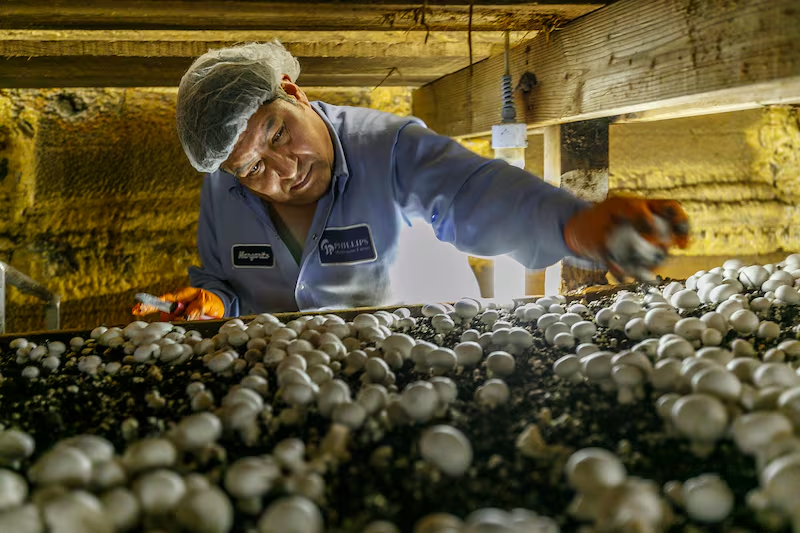
Margarito Diaz, a longtime worker at Phillips Mushroom Farms in Kennett Square, harvests white button mushrooms on March 25, 2019. MICHAEL BRYANT / Staff Photographer

By Hazel Velasco Palacios and Kathleen Sexsmith, The Conversation, March 22 2025

“I had never worked with mushrooms before,” Luis said, reflecting on his time in Chester County’s mushroom industry. “But my family has always worked in agriculture, so I like it. I’m used to hard work.”

Luis, whose name is a pseudonym to protect his identity, is part of the latest wave of immigrant workers who have, for decades, come to Chester County to work in Pennsylvania’s $1.1 billion mushroom industry. He is a Venezuelan migrant who was granted Temporary Protected Status, or TPS, under the 2023 designation. TPS allows foreign nationals already in the U.S. to remain for six, 12, or 18 months — regardless of how they entered — if their home country is deemed too dangerous for them to return.

In February, President Donald Trump terminated TPS for Venezuelans who received protection under the 2023 expansion. According to the Department of Homeland Security, this designation had allowed approximately 348,000 Venezuelans to remain in the U.S. legally, with many eligible for work authorization. Meanwhile, Venezuelans who were granted TPS under the earlier 2021 designation can retain their status until Sept. 10, 2025. This provides temporary relief but leaves their long-term status uncertain.

The termination of TPS for many Venezuelans, along with Trump’s broader immigration policies — including stricter border enforcement, increased deportations, and tighter restrictions on work permits and asylum protections — will likely shrink the pool of available workers in Pennsylvania’s mushroom industry and other agricultural and food industries.

Changing face of the mushroom workforce

The mushroom industry in Pennsylvania has been shaped and sustained by major waves of U.S. immigration since the late 19th century.

William Swayne, a Quaker florist, is credited with beginning mushroom cultivation in Kennett Square, a small borough in Chester County, in the 1880s.

However, it was Italian immigrants, who began arriving in the early 20th century, who transformed Kennett Square, which bills itself as the “mushroom capital of the world.”

Today, Pennsylvania produces 69% of all mushrooms sold in America, according to the U.S. Department of Agriculture.

Chester County alone produced 199 million pounds of mushrooms — mostly white button mushrooms — in the 2023-24 season. While Chester County remains the hub of production, mushroom farms also extend into adjacent Berks County and parts of northeastern Maryland.

Yet, workforce instability remains a pressing issue, as the industry has struggled for decades to recruit and retain workers.

Read the full story here


If you like this post, you’ll love our daily environmental newsletter, EnviroPolitics. It’s packed daily with the latest news, commentary, and legislative updates from New Jersey, Pennsylvania, New York, Delaware…and beyond. Please do not take our word for it, try it free for a full month

Trump’s deportations puts the squeeze on Pa’s mushroom industry Read More »