The Environmental Protection Agency plans to eliminate its scientific research arm, firing as many as 1,155 chemists, biologists, toxicologists and other scientists, according to documents reviewed by Democrats on the House Committee on Science, Space and Technology.
The strategy is part of large-scale layoffs, known as a “reduction in force,” being planned by the Trump administration, which is intent on shrinking the federal work force. Lee Zeldin, the administrator of the E.P.A., has said he wants to eliminate 65 percent of the agency’s budget. That would be a drastic reduction — one that experts said could hamper clean water and wastewater improvements, air quality monitoring, the cleanup of toxic industrial sites, and other parts of the agency’s mission.
The E.P.A.’s plan, which was presented to White House officials on Friday for review, calls for dissolving the agency’s largest department, the Office of Research and Development, and purging up to 75 percent of the people who work there.
The remaining staff members would be placed elsewhere within the E.P.A. “to provide increased oversight and align with administration priorities,” according to the language shared with The New York Times by staff members who work for Democrats on the House science committee.
If you like this post, you’ll love our daily environmental newsletter, EnviroPolitics.It’s packed daily with the latest news, commentary, and legislative updates from New Jersey, Pennsylvania, New York, Delaware…and beyond. Please do not take our word for it, try it free for a full month
The last remaining structure of a World War II-era manufacturing plant near a marshy area at the Jersey Shore was torn down last week as part of a $37.5 million effort to preserve over 1,000 acres of wilderness.
The water tower at the former Harbison Walker Magnesite in Lower Township, Cape May County, was brought down March 13.
After the surrounding buildings were demolished, the tower became a unique feature of the Higbee Beach Wildlife Management Area, a state-guarded area that is a habitat for osprey, peregrine falcons, merlins, kestrels, cooper hawks and sharp-shinned hawks.
Crews pulled the tower down, causing it to creak before landing with a ground-shaking thud. The landmark structure will be dismantled and deposed offsite, a spokesperson for the New Jersey Department of Environmental Protection told NJ Advance Media.
The demolition is part of an effort to restore a tidal flow to the marshlands.
If you like this post, you’ll love our daily environmental newsletter, EnviroPolitics.It’s packed daily with the latest news, commentary, and legislative updates from New Jersey, Pennsylvania, New York, Delaware…and beyond. Please do not take our word for it, try it free for a full month
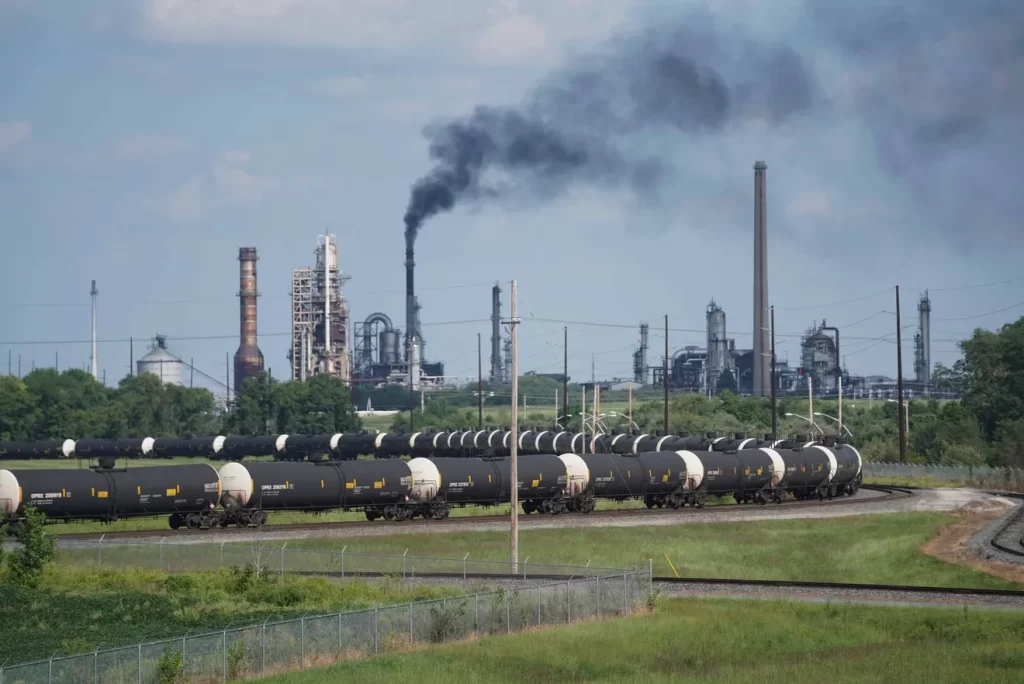
Around a year and a half after a $500,000 grant was approved under the Biden administration for the Clean Air Council to track areas around Delaware’s largest polluter, a letter was sent from the EPA’s grant management office to the nonprofit organization letting them know that its work is no longer aligned with the mission of the new administration’s EPA.
Dozens of similar grants were canceled the same day, under the logic that environmental justice initiatives are inherently discriminatory.
If you like this post, you’ll love our daily environmental newsletter, EnviroPolitics.It’s packed daily with the latest news, commentary, and legislative updates from New Jersey, Pennsylvania, New York, Delaware…and beyond. Please do not take our word for it, try it free for a full month
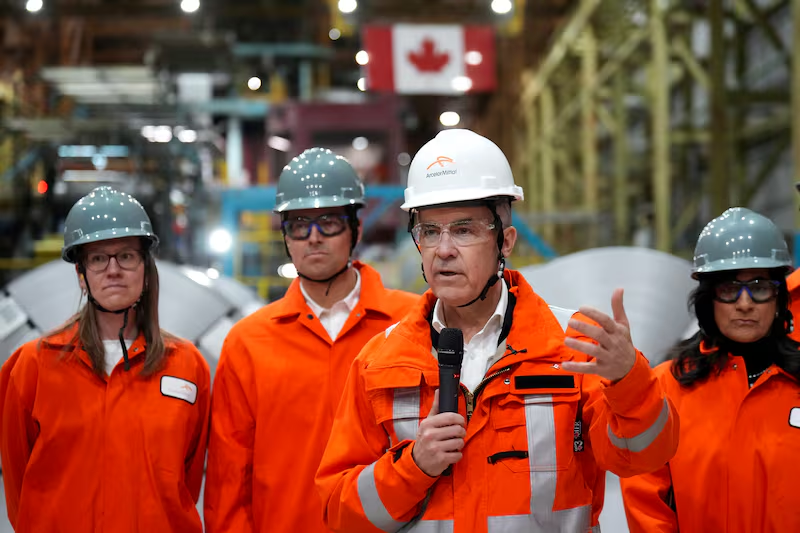
Canadian Prime Minister Mark Carney (second from right) speaks to steel workers after touring the ArcelorMittal Dofasco steel plant in Hamilton, Ontario, on March 12. Nathan Denette / AP
Every year, Pennsylvania businesses sell hundreds of millions of dollars’ worth of motorcycles, machinery, chocolate, and coffee to companies and consumers in Canada.
Canadian businesses, for their part, export $1.2 billion worth of steel and aluminum products annually to the Keystone State, commodities that are used in everything from building and construction to beer cans and consumer electronics.
Now, amid an escalating global trade war that has rattled financial markets and sown uncertainty across the economy, those are among the products that face new taxes that are straining commerce between Pennsylvania and its biggest trading partner.
“Pennsylvania’s economy is reliant on international business, and that looks like trade. It looks like our ability to attract foreign direct investment, to get international companies to open here and hire Pennsylvanians to help our economy and create jobs,” said Lauren Swartz, chief executive of the nonprofit World Affairs Council of Philadelphia.
“Doing things that limit our ability to access that 96% of the world that lives outside of the U.S., and 74% of global economic growth that occurs outside of the U.S., is going to be felt here at home,” said Swartz, a former Philadelphia deputy commerce director.
Pennsylvania sent more than $14 billion in goods to Canada in 2024, with top exports including machinery, cocoa, plastics, pharmaceuticals, iron, and steel.
Canada’s taxes on certain U.S. exports affect Pennsylvania products that last year combined for a total of $2.56 billion in sales, according to an Inquirer analysis of Canadian government trade data.
Trump, a Republican, has given a variety of reasons for the new economic posture toward Canada, from stemming the flow of illegal drugs across the border to reviving domestic manufacturing — all the while musing about annexing the longtime U.S. ally.
Some American steel and aluminum companies have cheered Trump’s moves, saying foreign companies have long flooded the U.S. market with cheap products subsidized by their governments, making it hard to compete.
Other business leaders have been less sanguine. William Oplinger, CEO of Pittsburgh-based aluminum maker Alcoa, said in February that the president’s tariffs on that commodity could cost 100,000 U.S. jobs.
Local companies are closely monitoring news out of Washington to see how trade policy develops. Northeast Philadelphia helicopter manufacturer Leonardo sources most of its metal products from Quebec, according to Swartz. Michael Cooper, a spokesperson for the Italian company, which employs about 1,000 workers at its Philadelphia assembly plant, said it is “still too soon to comment and evaluate these possible measures.”
Swartz said the products that go back and forth between Pennsylvania and Canada are mostly “inputs to making other things.” Tariffs, she said, will “impact manufacturers and jobs.”
“And each of those inputs that is getting tariffed — perhaps back and forth many times, in something as complex as a vehicle that’s being manufactured, or a big piece of equipment — has to be paid for by someone,” Swartz said.
That will likely mean higher prices for consumers, she said.
If you like this post, you’ll love our daily environmental newsletter, EnviroPolitics.It’s packed daily with the latest news, commentary, and legislative updates from New Jersey, Pennsylvania, New York, Delaware…and beyond. Please do not take our word for it, try it free for a full month
Cortland Standard building. Photo (cc) 2009 by Doug Kerr.
ByDan Kennedy, What Works, March 17, 2025
While Trump’s chaotic on-again, off-again tariffs are wreaking havoc with our retirement accounts, they’ve also resulted in the end for a daily newspaper in New York State.
The Cortland Standard, a family-owned daily, is shutting down in part because of Trump’s 25% tariff on goods from Canada, including newsprint, according to a story posted on the paper’s website. The 157-year-old paper was one of the five oldest family-owned newspapers in the U.S.
The Cortland Standard Printing Co. will file for Chapter 7 bankruptcy protection. Seventeen employees have lost their jobs.
“I hoped this day would never come,” publisher and editor Evan C. Geibel was quoted as saying. “I’m so very grateful to my colleagues and the community for what they’ve done for me, my family and each other.”
Cortland, a city of about 17,000, is located in central New York, about halfway between Syracuse to the north and Binghamton to the south. It is also served by a digital news outlet called the Cortland Voice, which was founded in 2015.
If you like this post, you’ll love our daily environmental newsletter, EnviroPolitics.It’s packed daily with the latest news, commentary, and legislative updates from New Jersey, Pennsylvania, New York, Delaware…and beyond. Please do not take our word for it, try it free for a full month
“I can confirm we are investigating,” said Brett Hambright, a spokesperson for the office.
Last week, Edward Louka, first assistant district attorney to Bucks County District Attorney Jennifer Schorn, told residents and representatives of Sunoco during a public meeting that the office had asked the state to look into the spill detected in January.
“We are aware and concerned with the situation,” Louka said at the March 11 meeting. “The Attorney General’s Office has an environmental crimes section. On Feb. 13, District Attorney Schorn did refer this to them.”
Louka said that the state investigation is in its “initial stages.”
Sunoco is owned by Texas-based Energy Transfer. Representatives for Energy Transfer could not be reached Monday for comment.
If you like this post, you’ll love our daily environmental newsletter, EnviroPolitics.It’s packed daily with the latest news, commentary, and legislative updates from New Jersey, Pennsylvania, New York, Delaware…and beyond. Please do not take our word for it, try it free for a full month