Judge says no to enviros intervention in Exxon settlement

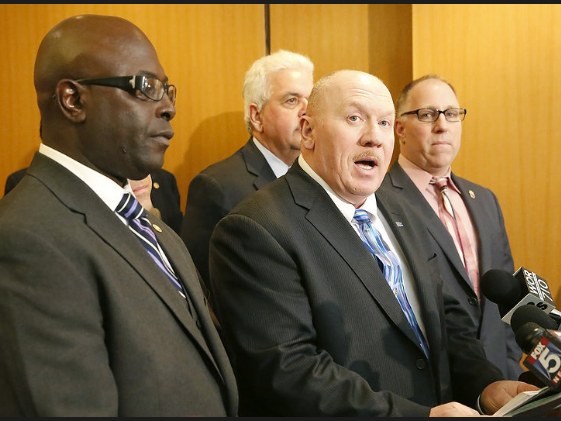
A Superior Court judge on Monday denied attempts by a coalition of environmental groups and a Democratic state lawmaker to intervene in a pollution settlement between Gov. Chris Christie’s administration and Exxon Mobil, S. P. Sullivan writes today in NJ.com.

The decision comes as the judge prepares to rule on the $225 million deal, which administration officials have defended as the largest of its kind in New Jersey history.

Critics, including state Sen. Ray Lesniak (D-Union) and a collection of environmental groups, have slammed the deal because at trial, the state had claimed it was owed $8.9 billion as compensation for Exxon’s decades of pollution at two North Jersey refineries.

They filed two separate motions to intervene in the case last month, seeking to become parties to the suit.

Writing that such a move would “unduly delay” the conclusion of the decade-old lawsuit, Judge Michael Hogan ruled the groups had not proven the state Department of Environmental Protection had abandoned their obligation to serve the public interest, as they had argued in court on Friday.

In order to intervene, they would have had to have shown attorneys for the state had colluded with Exxon in drafting the deal, which resolves much of Exxon’s liability for contamination at more than a dozen industrial sites and hundreds of gas stations around the state.

But the parties, “have done nothing to overcome the presumption of adequate representation that arises when they share the same ultimate goal with an original party.” Hogan wrote. “They have not demonstrated collusion, nonfeasance, or lack of notice of the opportunity for public comments.”


Was this of value to you? Click here for free updates

The social media icons below make it easy to share


Recent blog posts: 

Judge says no to enviros intervention in Exxon settlement Read More »

NY ghost ship graveyard becomes a sightseeing destination


On the Arthur Kill along New York’s Staten Island "right colored kayaks bobbed around the rotted hull of a World War II submarine chaser that was rusted into a ghostly shell and lapped by water as salty as tears.


"The kayaks paddled by tourists then glided a few feet away to a decayed, partly submerged ferry, part of the "Graveyard of Ships" tour, which winds through a marine salvage yard in New York City that is the final resting place for dozens of working boats and military vessels."

In story for Reuters, Barbara Goldberg writes:

Once considered eyesores to steer clear of, some junkyards, underwater scrap yards and landfills are being recast as sight-seeing attractions.

Sometimes dubbed "ruin tourism" or even "ruin porn," dramatic photographs online showing deteriorated boats emerging at low tide or automobile carcasses swallowed up by lush moss are enticing the public to see the decaying sites for themselves.


"These sites are often appreciated for their authenticity or novelty value as a contemporary ruin," said Karl Kullmann, who teaches landscape architecture, environmental planning and urban design at the University of California at Berkeley.


Ruin tourism draws visitors to such famously dilapidated landmarks as the Michigan Central Train Depot and the former Packard plant in Detroit. In White, Georgia, a crumbling repository of more than 4,000 discarded automobiles encased in trees and kudzu vines known as Old Car City USA draws paying crowds from around the world. In Hot Springs, Arkansas, cycling enthusiasts flock to a re-purposed landfill that features mountain bike trails known as "Tour-de-Trash."

"This type of tourism attracts people interested in the detritus of capitalism," said Rebecca Kinney, assistant professor in the Department of Popular Culture and School of Cultural and Critical Studies at Bowling Green State University.

The Detroit structures are "decades-old reminders of the precipitous rise and fall of industry," she said.

Read the full story here


Was this of value to you? Click here for free updates

The social media icons below make it easy to share


Recent blog posts: 

NY ghost ship graveyard becomes a sightseeing destination Read More »

Pennsy’s Governor and frackers find plenty to fight over

The shale gas industry and allies of Gov. Wolf ratcheted up
rhetoric this week over a key component of the state’s stalemated budget
debate: Imposition of a severance tax on natural gas production, Andrew Maykuth
reports in the Philadelphia Inquirer.

The Marcellus Shale Coalition says the proposed tax is the
harshest in a series of hostile actions the Wolf administration has taken
against the gas industry, one of the state’s better-performing economic sectors
in the last decade.

“Since Gov. Wolf was elected, he has been talking about this
industry being successful, but his actions really don’t match the words,”
said David Spigelmyer, president of the coalition. He characterized Wolf’s
manner as a “my way or the highway” approach.

The Democratic governor is calling the severance tax a mechanism
to fund schools. The tax on gas production would generate $1 billion in its
first full year, most of which would go to education.
But $225 million
of gas-tax revenue would replace the current shale impact fee, which is
assessed on a per-well assessment and mostly goes to drilling communities.
About $10 million of the severance tax would pay for more drilling enforcement.

An additional
$55 million of the severance tax revenue would pay off a proposed $675
million state 
economic development bond issue, of which $225 million would be
allotted to energy projects, mostly renewable energy.


The shale-gas
coalition objects that the gas industry would subsidize competing green-energy
projects.

“A bill of
goods has been sold here that this is all about school funding, and frankly
it’s more about picking winners and losers and funding a broader environmental
activist agenda,” Spigelmyer said.

Pennsylvania Gov. Tom Wolf

The governor’s
team says the trade group does not speak for the entire industry. John Hanger,
Wolf’s policy chief, said some industry executives recognize the need for a
severance tax to spread shale-gas benefits across the state.

“We had
more than a few companies coming to Pennsylvania who were amazed that we had no
[shale gas] severance tax,” Hanger said of his time as environment
secretary in the Rendell administration. “Privately, they thought
Pennsylvania was being a chump for not having one.”

The sniping is
occurring amid a surge in rival ad campaigns over the state budget standoff.
Wolf on June 30 vetoed a Republican budget that did not include a severance
tax. Until the impasse is resolved, the state has no budget.

An affiliate of
the Democratic Governors Association, whose biggest source of funding is
public-employee unions, last week launched commercials bashing the vetoed GOP
plan as letting the oil and gas industry off the hook, underfunding education,
and deepening the state’s deficit.

On Monday,
Americans for Prosperity, an advocacy group founded by the billionaire energy
executives Charles and David Koch, kicked off a radio campaign that says Wolf
is “cooking up schemes to hike your taxes.”

The shale
coalition says the severance tax is only one of several unfriendly actions Wolf
has taken.

Wolf remade the Oil and Gas Technical Advisory Board, not to the industry’s
liking. It imposed stricter gas-drilling regulations, which the industry says
would raise costs without increasing environmental protections.

Pennsy’s Governor and frackers find plenty to fight over Read More »

NJ enviros get their day in court over Exxon settlement


A N.J. Superior Court judge heard two hours of testimony this morning on whether to allow seven environmental groups and a state senator to intervene in the proposed environmental damages settlement between the state and ExxonMobil. 


Following the testimony, Judge Michael Hogan said that he would announce his decision on the intervention issue on Monday or Tuesday and rule on the settlement itself next month.

The Associated Press’s Michael Catalini  reports:

The groups and (Senator Raymond) Lesniak oppose the proposed $225 million settlement on the grounds that it’s just a fraction of the $8.9 billion the state had earlier argued ExxonMobil owed. The case stretches back to 2004 when the state brought a suit alleging that over roughly a century ExxonMobil polluted two northern New Jersey sites in Bayonne and Linden.
The groups also take issue with part of the proposal that clears the company of responsibility at 16 petroleum sites across the state as well as 1,700 gas stations. The inclusion of those sites became public only in April.
“We want to be fully heard,” said Natural Resources Defense Council lawyer Margaret Brown after the hearing. “But we also want to reserve the right to appeal on the merits of the case.”
State attorney Allan Kanner argued that the groups and Lesniak should instead submit advisory briefs to the court. He said the 60-day public comment period that preceded Friday’s hearing offered ample time for them to air their views. Lesniak said such briefs would not enable him to appeal a ruling.
Kanner also argued that the groups’ proposed intervention could complicate the case and create mini trials within the larger trial.
“You cannot come into a case that’s 11 years old and be coy about what you want to do,” Kanner said.
Brown said spending more time on the case would be worth it.
“It’s already been a (roughly) 10-year case, so let’s get it right,” she said. “Delaying seems understandable to get the right answer here.”
ExxonMobil attorney Theodore Wells, arguing against the groups and Lesniak, argued if the Legislature intended for groups to intervene, it would have written it in the legislation.
Hogan questioned both sides but cautioned against inferring how he might rule based on his questions.
The proposed $225 million settlement was announced shortly before Hogan was set to rule how much ExxonMobil would have to pay. That deal touched off a wave of political opposition from the Democratic-led Legislature, which passed measures condemning the proposal.
Gov. Chris Christie has argued the settlement is a good deal for the state and represents one of the largest in history.

NJ Advance Media‘s S.P. Sullivan reports:

State officials have hailed the $225 million agreement as the largest of its kind in state history. Critics have accused Gov. Chris Christie’s administration of caving to a corporate polluter that had caused nearly $9 billion worth of damage, according to an expert report commissioned by lawyers for the state.

"There’s no one in this case representing the legal interests of the people of New Jersey," state Sen. Ray Lesniak (D-Union), who filed a motion to intervene in the case, told Judge Michael Hogan.

Lesniak joined a host of environmental groups — which include New Jersey Sierra Club, Clean Water Action, Delaware Riverkeeper, NY/NJ Baykeeper, Environment New Jersey, New Jersey Audubon, the Natural Resources Defense Council and the Environmental Law Clinic at Columbia Law School — seeking to be named a party to the suit.

Attorneys for the state and Exxon separately argued that if the groups had an interest in the case, they should have intervened prior to or during the 2014 trial.
Kanner and Ted Wells, the New York-based attorney handling the case for Exxon, each said the groups could file amicus briefs in the case, but should not be allowed to intervene.

"I was there for nine months," said Allan Kanner, the New Orleans-based environmental attorney who took on the case for the state on a contingency basis in 2004. "It was if no one cared about the trial."

Selena Kyle, an attorney for the Natural Resource Defense Council, said the last-minute addition of 16 industrial sites and hundreds of gas stations to the deal — which was not part of the original suit — invited additional scrutiny to the case.

"There’s a lot to the settlement that wasn’t part of the trial record," Kyle said.
Kanner said his client, the DEP, had represented the best interest of the public, and had recently responded to the thousands of letters it received during a 60-day public comment period. That response, submitted to the court Thursday night, has been posted on the department’s website.

"The people absolutely have a right to be heard and we’re absolutely hearing them," he said.

NJ Sierra Club Director Jeff Tittel said:

We had our day in Court and the Judge heard us loud and clear on how bad this settlement is as well as the scope of pollution at these additional sites. We hope Judge Hogan makes the right decision now that he heard our message for the record. We want to intervene to protect the citizens of the state, the environment, and the public trust since the NJDEP no longer does. This deal is the biggest giveaway in state history.

NY/NJ Baykeeper Debbie Mans said:

The cleanup of this site has been dragging on for years.  ExxonMobil could simply leave the pollution in place, place a cap over it, put a fence around it and walk away.  A cleanup does not restore the natural resources or provide for a functioning ecosystem.  This is what the State’s lawsuit was about, but the proposed settlement will not go nearly far enough to restore what has been lost to the public at the hands of ExxonMobil.

Related news stories:
Judge to rule next week in Exxon case 
Christie administration failed public on Exxon deal, groups tell judge
Big legal showdown tomorrow over NJ-Exxon settlement 
Exxon New Jersey Settlement Under Fire Again

Was this of value to you? Click here for free updates
The social media icons below make it easy to share


Recent blog posts: Big legal showdown tomorrow over NJ-Exxon settlement After fracking ban enactment, NYDEC chief steps down Obama offers solar for low-income homes if NJ approves 
Pa. Gov. Wolf names members of pipeline taskforce 


NJ enviros get their day in court over Exxon settlement Read More »

Energy and environmental updates you may have missed


Valuable energy and environment news, legislation,
regulation and commentary for NJ, PA, NY & DE in our…


P.S. If you’re already signed up to receive our blog, please ignore this. Not sure? Use the signup form on the site. It will tell you if you’re on our list.


Energy and environmental updates you may have missed Read More »