Newark group, Sierra Club disagree over EPA river cleanup

EPA dredging
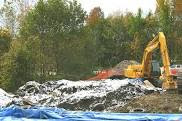
The EPA’s plan includes dredging 3.5 million cubic yards of sediment containing pollutants and toxic material from the Passaic River near Newark, NJ.

A Newark community group is defending the U.S. Environmental Protection Agency’s final plan to clean up the Passaic River, despite criticism by the New Jersey Sierra Club that the plan will fail to completely remove toxic chemicals in the severely contaminated waterway.
Jon Hurdle writes today in NJ Spotlight:
The EPA on Friday announced a $1.38 billion plan to remove 3.5 million cubic yards of sediment containing dioxin, PCBs, heavy metals, and some 100 other contaminants from the lower eight miles of the river, and then cap the riverbed with two feet of sand from bank to bank to contain remaining sediment.
The plan will be the country’s largest-ever environmental dredging project, said Judith Enck, the EPA’s Region 2 administrator, and follows years of analysis and discussion over how to clean up the badly polluted river after more than a century of industrial contamination.
The federal agency said the plan will improve water quality, protect public health, revitalize waterfront areas, and create hundreds of new jobs. “This plan is one of the most comprehensive in the nation and will help restore a badly damaged river,” said Enck, at an event attended by U.S. Senators Cory Booker and Robert Menendez, as well as Bob Martin, commissioner of New Jersey’s Department of Environmental Protection.
The river has been seriously damaged by decades of industrial pollution, notably from Newark’s Diamond Alkali factory which in the 1960s produced Agent Orange, a defoliant used in the Vietnam War. The operation resulted in contamination of the river and surrounding land with dioxin, a highly toxic substance.
The EPA’s program was immediately attacked by the New Jersey Sierra Club, whose director, Jeff Tittel, said it would not remove all the contaminants, so local residents would still be exposed to the cocktail of toxic chemicals that has contaminated fish and raised concerns about human health.
“The people in Newark and along the Passaic River have waited 40 years for a clean-up and now this toxic nightmare will continue,” Tittel said in a statement. “The EPA’s clean-up plan will not work because it will only cap the pollution.”
Tittel said the EPA should have chosen an earlier plan to dredge 8.3 miles to a depth of between 12 and 30 feet, which he said would have removed all the contaminants so that people could once again use the river for fishing and boating, as they did before the 1950s.
The EPA said there is a “reservoir of contaminated fine-grained sediment” approximately 10 feet to 15 feet deep in the lower eight miles of the river. Some 2.5 feet of that will be removed and then the riverbed will be capped with two feet of sand, except along the shoreline where the cap will consist of a foot of sand and a foot of material that will support habitat for fish and plants.
Tittel’s criticism was rejected by a community group that has contributed to the multi-year debate over how to clean up the river.
Debbie Mans, co-chair of the Community Advisory Group for the Passaic River Superfund Site, which backs the plan, called Tittel’s comments “frustrating” and claimed he was attacking the plan without understanding the issue.
“We’ve been meeting as a community group for six years and he has never come to any of our community meetings, never spoken with the community,” said Mans, who is also executive director of New York New Jersey Baykeeper, an environmental group that works to protect the harbor estuary. “The community is behind the proposal and I think it’s disappointing that a statewide group would try to step on top of them to say ‘we know what’s best’ when they haven’t spent the time in the community understanding it.”

Was this of interest to you? 


Recent blog posts: 

Newark group, Sierra Club disagree over EPA river cleanup Read More »

Legislative showdown nears over NJDEP water rules

Rarely used legislative override could prevent rules from being adopted or force DEP to rescind them

John McKeon

Assemblyman John McKeon (D-Essex)
In an unusual rebuke to the Christie administration, lawmakers moved a step closer to revoking a proposed rule that critics say will degrade New Jersey’s water and increase flooding, Tom Johnson writes in
NJ Spotlight.
The Democratic-controlled Assembly Environment and Solid Waste Committee yesterday voted along party lines to order the state Department of Environmental Protection to withdraw a yet-to-be adopted rule proposal that would overhaul flood-hazard, stormwater, and coastal-management regulations it proposed last summer.
The massive revamping of those rules is strongly backed by builders, business interests, and many in the farming community and just as staunchly opposed by environmentalists. To backers, the rules would eliminate redundancy and streamline and simplify complex rules that stifle economic growth, a priority of the DEP since the start of this administration.
“The amendments proposed by DEP threaten the very waters and natural habitats that these regulations are supposed to protect,’’ said Assemblyman John McKeon (D-Essex), the sponsor of the resolution (ACR-160).
If the resolution is passed by the Legislature, it would prevent the DEP from adopting the amended rules, or if adopted, to rescind them as against legislative intent. The override provision is a legislative tool rarely used by that body to challenges actions by the executive branch.
An identical resolution passed both houses in the last legislative session, but the DEP did not take any action on it. If the resolution wins approval again from both houses, it would revoke the rules, if adopted.
An identical resolution is scheduled to be considered by the Senate Environmentand Energy Committee on Monday, giving backers hope that the Legislature may approve the measure before it recesses for budget deliberations later this spring.

Was this of interest to you? 


Recent blog posts: 


Legislative showdown nears over NJDEP water rules Read More »

More bad news for residents near Ford paint sludge site

A toxic chemical recently discovered at the Ringwood Superfund site is more widespread than previously reported, with high levels found deep in an abandoned mine and low levels detected in brooks and near a pond, according to new data shown to the public Tuesday night by federal environmental officials.

Scott Fallon reports for The Record:

The U.S. Environmental Protection Agency said there is no public health threat from the chemical, 1,4-dioxane, a likely carcinogen, because none of the samples taken over the past year were greater than the agency’s health benchmark.

Many members of the community where Ford Motor Co. dumped an ocean of toxic paint sludge more than 40 years ago remained skeptical of the EPA’s claims during a heated three-hour meeting Tuesday night attended by at least 200 people.

Although the EPA says drinking water is not affected, members of a local Native American tribe say they often fish and drink from the waterways that go through the toxic site. The Ramapoughs say many members have suffered illness and premature death from Ford’s waste, although no link has been proved.

Tests done last year by engineers working for both Ford and the borough government showed widely varying levels of 1,4-dioxane, a chemical whose safety standards are still being determined.

The highest concentration was found deep in the Peters Mine air shaft at 140 micrograms per liter in August. That’s well above the state’s new groundwater standard of 0.4 micrograms but below the EPA’s lifetime health advisory level of 200 micrograms per liter.

Concentrations were lower closer to the surface. Samples taken from test wells west of Sheehan Drive showed a high of 38 micrograms per liter in August but dipped to a high of 17 micrograms per liter in follow-up testing in December.

When scientists tested above ground, they found 1,4-dioxane in several brooks and groundwater seeping to the surface. A high of 2.3 micrograms per liter was detected at one brook that runs through the central portion of the site. It was also detected outside the Superfund site with 0.44 micrograms per liter found in the Park Brook at the mouth of Sally’s Pond, once a popular fishing and swimming hole in Ringwood State Park.

The state Department of Environmental Protection has not yet developed a surface water safety standard for 1,4-dioxane.


Was this of interest to you? 


Recent blog posts: 

More bad news for residents near Ford paint sludge site Read More »

Apologetic EPA seeks to reassure Superfund community

EPA apologizes at Ringwood meeting

EPA project manager Joe Gowers speaks in front of Ringwood residents at a meeting
on Tuesday, March 1, 2016. – Record photo by Marko Georgiev


Federal environmental officials apologized to Ringwood, NJ residents Tuesday night for not divulging sooner the discovery of another dangerous chemical at the Superfund site where Ford Motor Co. dumped paint sludge decades ago, but they maintained it poses no imminent health threat.

The Record’s Scott Fallon reports:

At a tense meeting attended by almost 200 people — so many they couldn’t all fit in the room at Borough Hall — Environmental Protection Agency officials admitted they should not have waited three months to inform the community of the presence of the chemical, 1,4-dioxane, at concentrations in groundwater almost 100 times the state standard.
EPA project manager Joe Gowers speaks in front of Ringwood residents at a meeting on Tuesday, March 1, 2016.

MARKO GEORGIEV/STAFF PHOTOGRAPHER
Ramapough Chief Dwaine Perry argues with EPA project manager Joe Gowers at a meeting in Ringwood on Tuesday, March 1, 2016.

But EPA officials said it was unlikely that the chemical’s discovery would halt a controversial plan that would leave hundreds of thousands of tons of contamination under a protective barrier rather than having it dug out and removed, as several community members pushed for Tuesday night.


“The data doesn’t indicate that it needs to be changed,” said Joe Gowers, the EPA project manager for the site.

He said work on the barrier may begin as early as next year. The agency is still developing a cleanup plan for the contaminated groundwater flowing under the site, but residents said it was premature to install the barrier before that was done.


Read the full story here


Was this of interest to you?


Recent blog posts:

Apologetic EPA seeks to reassure Superfund community Read More »

Indicted natural gas exec dies in fiery auto crash into wall

Aubrey McClendon

** Updated to add related stories**

Former Chesapeake Energy CEO Aubrey McClendon has died in a car crash.

It took place around 9 a.m. March 2 in Oklahoma and, according to officials, the car was going very fast.
“Speed was definitely a factor in the fatality,” Oklahoma City officials said in a press conference. “He pretty much drove straight into the wall.”
On Tuesday, McClendon, 56, was indicted on conspiracy to rig bids for oil and natural-gas leases. He and other companies allegedly colluded to figure out who would win the bids.

The car wreckage from the accident that killed former Chesapeake Energy CEO Aubrey McClendon in Oklahoma City on March 2nd, 2016.

Source: KFOR | NBC
The car wreckage from the accident that killed former Chesapeake Energy CEO Aubrey McClendon in Oklahoma City on March 2nd, 2016.

Related stories:
Ex-Chesapeake Energy CEO Aubrey McClendon dies
McClendon crashed traveling at ‘high rate of speed’


Was this of interest to you?


Recent blog posts:

Indicted natural gas exec dies in fiery auto crash into wall Read More »

Enviro, Energy and Ag bills set for action in Trenton-Mar. 3


Here’s the lineup of scheduled committee action on energy, environment and agriculture bills for Thursday, March 3, in
the New Jersey Legislature:


ASSEMBLY AGRICULTURE AND NATURAL RESOURCES
2 PM
Committee Room 15, 4th Floor, State House Annex, Trenton, NJ
A-939  Wolfe, D.W. (R-10); McGuckin, G.P. (R-10)
Changes law regulating size limits of lobsters.
Related Bill: S-1157
     
A-1645  Schaer, G.S. (D-36); Webber, J. (R-26); 
Expands definition of “acquisition,” for
purposes of county and municipal open space trust funds, to include demolition,
removal of debris, and restoration of lands being acquired.
    
A-2949  Andrzejczak, R.B. (D-1); Land, R.B. (D-1)
Provides diamondback terrapins protection as non-game
indigenous species.
Related Bill: S-1625
     
 ————————————————————————-
ASSEMBLY ENVIRONMENT AND SOLID WASTE
2 PM
Committee Room 9, 3rd Floor, State House Annex, Trenton, NJ
A-223  DeAngelo, W.P. (D-14); Benson, D.R. (D-14)
Requires NJ Energy Star Homes Program incentives be
available Statewide.
      
A-231  Danielsen, J. (D-17); Pinkin, N.J. (D-18)
Establishes position of State Oceanographer.
Related Bill: S-987
      
A-1493  McKeon, J.F. (D-27); Gusciora, R. (D-15)
Clarifies intent of P.L.2007, c.340 regarding NJ’s
required participation in Regional Greenhouse Gas Initiative.
      
A-1863  Wimberly, B.E. (D-35)
Changes types of development requiring CAFRA permit
from DEP.
   
A-2529  DeAngelo, W.P. (D-14)
Provides for replacement of incandescent light bulbs in
public school buildings with energy-efficient light bulbs.
    
ACR-115  Wimberly, B.E. (D-35)
Memorializes Administrator of EPA to expedite cleanup
of Garfield Ground Water Contamination site and provide for temporary
relocation of residents affected thereby.
     
ACR-160  McKeon, J.F. (D-27); Spencer, L.G. (D-29)
Prohibits adoption of DEP’s proposed rules and
regulations to revise its Flood Hazard Area Control Act Rules, Coastal Zone
Management Rules, and Stormwater Management Rules.
Related Bill: SCR-66
      
S-987  Smith, B. (D-17)
Establishes position of State Oceanographer.
Related Bill: A-231


Was this of interest to you?


Recent blog posts:

Enviro, Energy and Ag bills set for action in Trenton-Mar. 3 Read More »