Spinoffs staying in Delaware after Dow-DuPont merger
The state and New Castle County
offered tax relief and pledged $17 million to keep DuPont strong
in Delaware, and it paid off on Friday.
offered tax relief and pledged $17 million to keep DuPont strong
in Delaware, and it paid off on Friday.
The News Journal‘s reporting team of Jeff Mordock, Scott Goss, Adam Duvernay and Matthew Albright writes:
The
state beat out Iowa and Indianapolis to land the corporate headquarters
for what will be the largest agriculture company in the nation, a spinoff that
will be created after the merger of DuPont and Dow Chemical later this year.
The
First State will become home to two of three spinoff companies that will be
created from the$130 billion
merger.
First State will become home to two of three spinoff companies that will be
created from the$130 billion
merger.
A
yet-unnamed specialty products company, which includes DuPont’s nutrition and
health unit, will also be headquartered in Delaware. The third spinoff, a
material sciences company, will be based in Dow’s hometown of Midland,
Michigan.
yet-unnamed specialty products company, which includes DuPont’s nutrition and
health unit, will also be headquartered in Delaware. The third spinoff, a
material sciences company, will be based in Dow’s hometown of Midland,
Michigan.
“One
of the key things that is nice for us is that we’ve got this great talent
here,” DuPont Chief Executive Officer Ed Breen told The News Journal
Friday. “We’ve been pleased with all of the hard work by the people at the
corporate headquarters.”
of the key things that is nice for us is that we’ve got this great talent
here,” DuPont Chief Executive Officer Ed Breen told The News Journal
Friday. “We’ve been pleased with all of the hard work by the people at the
corporate headquarters.”
Combined,
the two spinoffs are expected to generate more revenue than the
existing DuPont, according to documents filed with the Securities and
Exchange Commission. Agriculture will have about $20 billion in revenue
and specialty products is expected to produce $13 billion in revenue. DuPont
generated $25 billion in revenue in 2014.
the two spinoffs are expected to generate more revenue than the
existing DuPont, according to documents filed with the Securities and
Exchange Commission. Agriculture will have about $20 billion in revenue
and specialty products is expected to produce $13 billion in revenue. DuPont
generated $25 billion in revenue in 2014.
The new agriculture company will surpass St.
Louis-based Monsanto Co.
Louis-based Monsanto Co.
How
DE out-hustled other states to win DuPont ag unit
DE out-hustled other states to win DuPont ag unit
[News-Journal reporters Scott Goss, Matthew Albright, Jeff Mordock and Xerxes Wilson]
After two centuries of shared
history between DuPont and
Delaware, local officials had just 10 weeks to pull together a
deal that would secure the company’s future in the state it helped to
build.
history between DuPont and
Delaware, local officials had just 10 weeks to pull together a
deal that would secure the company’s future in the state it helped to
build.
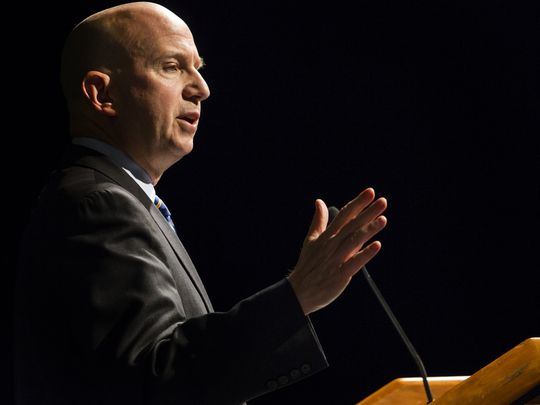 |
| DE Gov. Jack Markell Photo: Kyle Grantham – The News Journal |
That
meant putting together an incentive deal with enough tax breaks, subsidies
and capital improvement assistance to keep thousands of jobs in New Castle
County.
meant putting together an incentive deal with enough tax breaks, subsidies
and capital improvement assistance to keep thousands of jobs in New Castle
County.
It also
required working together to present an unrelenting sales pitch that
would beat out much larger states Iowa and Indiana, a feat many analysts
and other outsiders considered unlikely, if not downright impossible.
required working together to present an unrelenting sales pitch that
would beat out much larger states Iowa and Indiana, a feat many analysts
and other outsiders considered unlikely, if not downright impossible.
Seventy
days later, Delaware emerged victorious with two out of the three businesses
that will eventually be spun off from DuPont’s impending merger with The Dow
Chemical Co.
days later, Delaware emerged victorious with two out of the three businesses
that will eventually be spun off from DuPont’s impending merger with The Dow
Chemical Co.
“It
certainly wasn’t out of the question that we could lose all of it,” Gov. Jack
Markell said Friday.
certainly wasn’t out of the question that we could lose all of it,” Gov. Jack
Markell said Friday.
“That
would have been devastating,” he said. “So we put together a team of
collaborators and got to work immediately after DuPont and Dow announced their
planned merger in December.”
would have been devastating,” he said. “So we put together a team of
collaborators and got to work immediately after DuPont and Dow announced their
planned merger in December.”
That
effort paid off Friday when the companies announced plans to locate the
agriculture company’s corporate headquarters in Delaware.
effort paid off Friday when the companies announced plans to locate the
agriculture company’s corporate headquarters in Delaware.

Recent blog posts:
Spinoffs staying in Delaware after Dow-DuPont merger Read More »