Where’s the beef? Under the solar panels.


Tennessee developer thinks it’s cracked the code for mixing solar panels and cattle. Scaling the model could make it easier to build clean energy in rural America.
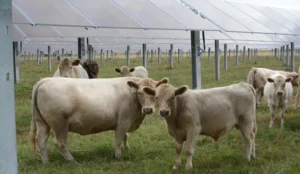
 

Ccattle underneath solar panels. (Julian Spector/Canary Media)

By Julian Spector, Canary Media, 9 November 2026

CHRISTIANA, Tenn. — As sunlight fell between the gaps in flinty November clouds, I found myself impressed by the quietness of the lawn mowers in a Middle Tennessee solar field. Instead of the obnoxious roar of diesel engines, they just produced an occasional moo.

Six months ago, Tennessee’s largest solar developer, Silicon Ranch, channeled its nomenclature and brought cattle to this 3.25-megawatt solar project. The 15-member herd rotates among 15 paddocks marked out by simple electrical wire, munching Bermuda grass that grows in the shade of the panels, which sit on higher-than-usual steel piles. The cows seem amenable to the situation, judging by how plump they’ve become in that short time.

This is the first commercially viable utility-scale project combining solar and cattle farming in the U.S., according to Silicon Ranch (an earlier 2-MW project from AES sought to prove the concept in Massachusetts’ community solar market). If the model takes off, it could boost revenues for farmers while producing more clean, cheap electricity in regions that don’t have a lot of wide-open, unused spaces to develop. And it might remedy a major obstacle to ongoing solar growth.

The U.S. builds more solar installations than any other form of power plant these days. But the industry’s upstart success story is colliding with a bulwark of local opposition from communities that don’t like the idea of this relatively new technology taking over their landscapes. One way around that conflict is to use the same land for solar power and agriculture.

The solar industry already has adopted sheep grazing as a mainstream approach to cutting grass at project sites, while supporting a secondary market for domestic meat. Researchers have also found that grasses and some crops grow better in the shade of photovoltaic panels than in an open field. But the burgeoning ​“agrivoltaics” sector has almost entirely excluded one of the major pillars of American agriculture — cattle ranching — for the simple reason that rambunctious bovines could easily wreck the carefully calibrated solar panels.

 Read the full story here.

____________________________________________________
Daily energy and environment updates. Free 30-day subscription


Where’s the beef? Under the solar panels. Read More »

Why would anyone steal used vegetable oil from restaurants ?

Technological advances have allowed whey, a once-troublesome byproduct of cheesemaking, to turn into whey powder, lactose and protein concentrates, which can be used in baked goods, infant formula, animal feed and protein supplements. BRENDAN SMIALOWSKI/AFP VIA GETTY IMAGES FILE

By Edward D. Melillo, Amherst College

Federal prosecutors recently described an interstate criminal enterprise with all the trappings of organized crime: clandestine warehouses, money laundering and stolen goods transported across state lines. The mid-September announcement stated that 19 defendants faced charges; two had just pleaded guilty, while the remainder are slated for trial in April.

The stolen material was not drugs, guns or jewels. It was leftover cooking oil.

According to prosecutors, members of the group drove trucks to restaurants in 10 states, siphoned used cooking oil from collection tanks and transported it to depots for resale. The alleged motive was simple: Used cooking oil has value. It can be refined into biodiesel. A viscous fluid that the food industry formerly considered garbage has become valuable enough to spur a large-scale criminal operation.

This oil-theft scheme points to a larger lesson. People tend to think of waste as trash, sewage, slag, manure and other seemingly useless or disgusting substances. But historians, anthropologists and geographers increasingly recognize that “waste” is a category defined by humans. Technologies, markets, laws and cultural assumptions all determine what is discarded, what is kept and why. Waste describes a material’s status, not necessarily its substance.

As an environmental historian who studies how societies transform nature into commodities, I am also interested in the other side of the process: how materials classified as waste can be converted back into things of value.

Read the full article here

Why would anyone steal used vegetable oil from restaurants ? Read More »

Opinion: NJ Power Companies Have A Meltdown At BPU Attempt To Reduce Profits

It’s very rare to see corporate representatives take off the mask in a public forum and openly and aggressively engage in a bare knuckle fight with regulators over limits on profits.

Public discussion of Corporate profits is taboo and almost always buried in all sorts of rhetoric and euphemism.

But that happened yesterday, at a NJ BPU meeting on implementing Gov. Sherrill’s Executive Order No. 1 on “utility business model” reforms.

In proposing the most important – but least reported by media – “reform” to truly freeze electric rates, EO 1 directed BPU to make recommendations about “reduction in utilities’ return on equity” (ROE).

ROE is a financial metric that measures a company’s profitability and how it generates profit from its shareholders’ equity.

Did you get that? Gov. Sherrill directed BPU to lower corporate PROFITS!

BPU met yesterday to discuss ways to do that.

Related: Candidate Sherrill said she’s freeze electric rates (New Jersey Monitor)

The most important issue discussed was in the morning metrics discussion when consultants discussed EO1, reduction in ROE, and the theory on CAPX.

As I understand things, CAPX is a reference to the Averch-Johnson Effect (often called the “CapEx bias”). It states that when a regulated utility’s authorized Return on Equity (ROE) exceeds its actual cost of capital, the utility is incentivized to maximize its capital expenditures (CapEx) because that is the only way it can grow its “Rate Base” and generate absolute profit for shareholders.

I was listening in on the phone so it is hard to be certain, but I’m pretty sure it was the PSEG lawyer who went ballistic and had a meltdown.

She harshly criticized the premise that utilities were over earning. She claimed that the premise of excess profits and the economic theory it was based on had been discredited. She objected to a lack of due process evidentiary hearings and issued a “warning” that “ radical” change in regulatory policy would risk grid reliability and she also managed to drag the unions into the opposition.

The reliability threat is basically a threat to turn off the lights if their profits are reduced.

Read the full column here

____________________________________________________
Daily energy and environment updates. Free 30-day subscription

Opinion: NJ Power Companies Have A Meltdown At BPU Attempt To Reduce Profits Read More »

Scientists teach a computer to “feel” a wind turbine’s stress before a single blade is built

Scientists taught a computer to feel a wind turbine s stress and strain before a single blade is ever built


By Daniel Garcia, Energies Media, November 4, 2026


A modern wind turbine is a machine under constant negotiation with the atmosphere. Its blades flex and twist through thousands of load cycles every hour, its controller adjusts pitch and torque in real time, and the forces rippling through its tower and drivetrain shift with every gust. Capturing all of that in a physics-based simulation is possible — but expensive, slow, and ill-suited to the rapid design exploration that the wind industry increasingly demands.

A new machine-learning framework may be starting to change that calculus.

The simulation bottleneck holding wind energy back

Aeroelastic simulations are the backbone of modern turbine engineering. They model how a rotor blade bends, twists, and vibrates under real wind loads — information that’s essential for structural certification, fatigue analysis, and control system design. Without them, engineers can’t know whether a turbine will survive 20 years of continuous operation.

Relevant inputs here include wind speed, turbulence intensity, pitch angle, and other operational parameters that define the turbine’s environment and state.

Speed is the problem. Each high-fidelity simulation run in tools like HAWC2 carries a significant computational cost, and design optimization doesn’t require one run — it requires thousands, sweeping across wind speeds, turbulence levels, and operating conditions to map out the full performance landscape. That kind of exhaustive search quickly becomes impractical.

The result is a familiar engineering tension: tools that capture physical reality most faithfully are too slow for rapid iteration, while faster methods sacrifice accuracy. The wind industry needs something in between — a lighter tool that still respects the physics.

Full post here

Daily energy and environment updates. Free 30-day subscription

Scientists teach a computer to “feel” a wind turbine’s stress before a single blade is built Read More »

Democrats won. Oil money lost.

Fossil fuel money remains one of the biggest obstacles to climate action. But last night proved it can be beaten.

An activist dressed as a fossil fuel executive pours fake gas over fake money outside Shell’s headquarters in May 2026. During the 2026 midterm elections, the U.S. fossil fuel industry lit actual money on fire trying to elect Republicans. Photo by James Willoughby/SOPA Images/LightRocket via Getty Images.

The U.S. oil and gas industry spent at least $182 million trying to elect Republicans in last night’s midterm elections1.

By Emily Atkin, Heated

It didn’t buy them very much.

Voters rejected fossil fuel allies and priorities across the country, not only stripping Republicans of control of both the House and Senate, but delivering stunning defeats in fossil-fueled governors’ races, state legislatures, regulatory commissions, and ballot measures.

Here are some notable examples.

  • Republicans lost control of the House and Senate despite large oil industry donations. Chevron gave $8.2 million, Koch Inc. gave $6.8 million, and Energy Transfer gave $2 million to the Senate Leadership Fund and Congressional Leadership Fund, according to a Public Citizen analysis. The American Petroleum Institute gave at least another $8 million to the two super PACs, which work to elect Republican majorities in Congress. Republicans still lost both chambers.
  • A Texas oil billionaire’s attempt to buy Michigan’s Senate race failed. Texas oil billionaire Tim Dunn gave $5 million to a super PAC backing Republican Mike Rogers in Michigan’s Senate race. It didn’t matter. Voters still elected Democrat Abdul El-Sayed, whose platform includes shutting down the Line 5 pipeline and transitioning to 100 percent renewable energy.
  • In fact, pretty much everything Tim Dunn tried to do failed. The ultra-Christian oil billionaire gave more than $11 million to Texas Republican PACs, with almost all of it going to Texans United for a Conservative Majority. And what happened in Texas was the polar opposite of a conservative majority. Speaking of which:
  • Chevron and fracking money couldn’t make Texans like Ken Paxton. Lone Star Liberty PAC, the group backing Republican Ken Paxton’s bid for U.S. Senate, received at least $2 million from oil and gas interests, including $200,000 from the Chevron Employees PAC and $250,000 from oil executive Russell Gordy. Fracking billionaire Farris Wilks gave another $250,000 to Paxton Victory. Voters still elected James Talarico, who campaigned on restoring federal support for renewable energy and strengthening clean air and water protections.
  • Chevron couldn’t save Susan Collins, either. The oil company gave $200,000 to Pine Tree Results PAC, the super PAC backing Maine’s Republican senator. Voters still elected Democrat Troy Jackson, ending Collins’s nearly three decades in the Senate.

Read the full post here


Democrats won. Oil money lost. Read More »

U.S. soybean oil gushes into biofuel market

The U.S. sector consumes 1.2 billion bushels of soybeans annually, but they are also being used in more than 1,000 other industrial applications


By Sean Pratt, Reporter/Analyst, The Western Producer

 
Hand with fuel nozzle with inscription BIO on a background of tank trailer with biofuel and large, round steel grain bins.
An estimated 54 per cent of the soybean oil produced by U.S. crushers will be consumed by the biofuel sector in 2026-27. Photo: Getty Images


SASKATOON — The U.S. soybean sector has reached an inflection point where more oil will be used for fuel than food in 2026-27.
 
Courtney Knupp, chief executive officer of the United Soybean Board (USB), said 54 per cent of the oil produced by crushers will be consumed by the biofuel sector, up from 48 per cent last year.
 
“Now that’s demand that farmers can count on,” she said during a recent webinar hosted by Agri-Pulse. Biodiesel and renewable diesel plants consume about 1.2 billion bushels of soybeans today, up from fewer than 100 million bu. 20 years ago.
 
“It’s a market that didn’t exist until soybean farmers invested their check-off dollars in it,” said Knupp.
 
“That’s what a calculated bet looks like when it pays off at the farmgate.”

____________________________________________________

Daily energy and environment updates. Free 30-day subscription

U.S. soybean oil gushes into biofuel market Read More »