Quanta Superfund cleanup in NJ faces yet another delay

Long-sought Edgewater cleanup faces another delay

Scott Fallon reports for The Record

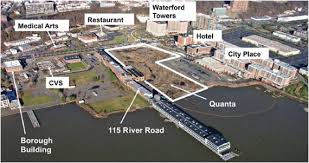
Twice a day for decades, the tide from the Hudson River has pounded the deteriorated bulkhead at the Quanta Superfund site in Edgewater, pulling coal tar, arsenic and other pollution into the waterway.

It has created an underwater toxic plume 30 feet deep near the shoreline and stretching as far as 800 feet into the river. When the plume is exposed at low tide, the area surrounded by high-end condos, restaurants and stores often smells like an oil refinery.

Work that began this fall on the site promises to halt more toxic material from leaching into the river. But plans to clean up the pollution already in the Hudson have hit yet another delay.

Environmental Protection Agency officials have said they need to take more sediment samples from the river to get a better estimation of how big and toxic the plume is.

The move has puzzled some residents and environmental advocates, considering that EPA officials said in 2011 that they were going to have a cleanup plan for the Hudson ready by the next year. 

Some fear the EPA will not require a comprehensive enough cleanup of the river after it approved a plan five years ago that entombs pollution in the ground at Quanta instead of removing it.


Read the full story

Like this? Use form in upper right to receive free updates 
See popular posts from the last 30 days in right column — >> 


Quanta Superfund cleanup in NJ faces yet another delay Read More »

Where’s Waldo? He’s easier to find than NJ’s Water Plan

 
WaldoSince 1987, kids have searched for Waldo, the main character in a series of British children’s books created by the English illustrator Martin Handford.

Since 2012, environmentalists have been searching for New Jersey’s own version of Waldo, better known as the
Statewide Water Supply Plan.

The British Waldo appears hidden among other characters and objects in pictures at the beach, in foreign locations, and even in the past.

New Jersey’s Waldo, the vanished water supply blueprint, likely hasn’t traveled very far. Most suspect it’s hidden at the Department of Environmental Protection or in that top-secret, government inner sanctum known as the Governor’s Office.

The 2016 drought, that now spans two-thirds of the state, has given environmentalists new cause to demand Waldo’s release and they are less amused than ever by all the hide and seek.


NJ Spotlight’s Tom Johnson has the details:
As New Jersey’s drought worsens, state advisers on water supply are renewing their call on the Christie administration to release a blueprint for water planning that has not been publicly updated since 1996 despite a legal requirement to do so every five years.

The Water Supply Advisory Council, a group of water company executives, nonprofits, and water users, is expected to urge Gov. Chris Christie and Department of Environmental Protection Commissioner Bob Martin to publish a new version of the Statewide Water Supply Plan that was submitted to the governor’s office in 2012 and has not been seen in public since.
Council members and many other water-supply advocates have been arguing for years that it’s not possible to plan for development without a statewide plan that anticipates where and how much water will be needed, and how its quantity and quality can be sustained for the good of consumers, businesses and the environment.
Now, advocates say the ongoing drought makes it more urgent that the state has a coordinated strategy to make it easier to avoid water shortages in affected areas, lessen impacts on water quality from sewage-treatment plants, and ease environmental stresses in areas suffering from low rainfall.
The council’s new call for publication of the plan, agreed at a meeting on November 18, follows an attempt in April 2015 which was rejected by state officials.
“We have embarrassed the executive branch on numerous occasions but they just don’t seem to care,” said Sen. Bob Smith (D-Middlesex), chairman of the Environment and Energy  Committee. “I don’t know what he’s trying to do other than avoiding reality,” he said, referring to Gov. Chris Christie.

Like this? Use form in upper right to receive free updates
See popular posts from the last 30 days in right column – >> Smith said the lack of an updated plan makes water supply vulnerable to many changes such as saltwater intrusion, lead in school water supplies, and the presence of the toxic chemical chromium 6 in some public water systems that have become known since the last report was published 20 years ago.

“It should be the overall planning document for the expansion of water supply, for the protection of existing supply, and it should weigh up the infrastructure needs,” Smith said. “You’ve got to protect your water or human beings aren’t going to do real well.”
Smith’s committee had previously called on Gov. Christie for publication of an updated plan but to no avail, he said.
It’s unclear whether the latest version of the plan is in the governor’ office, or is undergoing another update at the DEP. Brian Murray, a spokesman for Christie, declined to say why the plan hasn’t been publicly updated since 1996; whether it is still in the governor’s office, and whether there are any plans for its release.
Murray referred questions on the plan to the DEP, whose spokesman, Bob Considine, said staff there are “still gathering the most updated data” for the plan.

“We are managing New Jersey’s water supply every day while developing the draft Water Supply Plan,” Considine wrote in an mail. “When the draft plan is complete and ready for public comment, we will release it and schedule public hearings.”

Read the full story here Like this? Use form in upper right to receive free updates
See popular posts from the last 30 days in right column — >>

Where’s Waldo? He’s easier to find than NJ’s Water Plan Read More »

Gov. Christie has a sinking feeling about the NJ Capitol

    It’s a death trap, it’s a suicide rap 
   –Bruce Springsteen, Born to Run


Was Gov. Chris Christie channeling his favorite rocker today in describing the need for a $300 million renovation of the gold-domed state capitol, portions of which he said were in danger of “catastrophic failure?”


Michael Mancuso reported for NJ.com:

“Windows are literally falling out of this building,” Christie said.


“To leave the statehouse in this condition is an embarrassment,” he said. “And quite frankly it’s shameful.”
He described how sections of the executive portion of the building, which he said hasn’t been renovated in more than six decades, are sinking into the ground and could collapse. Also, the building’s heating, cooling and ventilation is in serious disrepair, Christie said, describing how 35 percent of the executive portion lacks any HVAC.
Christie called portions of the building “a trap,” citing the lack of sprinklers and fire suppression systems and the fact that areas of the building are not up to code.
The executive portion is a near block-long section of the building that faces West State Street and houses the offices of the governor, treasurer, secretary of state, their staffs and the press corps.

Like this? Use form in upper right to receive free updates 
See popular posts from the last 30 days in right column — >> 

Gov. Christie has a sinking feeling about the NJ Capitol Read More »

EPA sets first 10 chemicals for TSCA reform evaluation

Asbestos insulation

Notice sent today
by the U.S. EPA Office of Pollution Prevention and Toxics
 
Agency answers call to move forward on
chemical reform, naming asbestos among first to undergo risk evaluation
Today, EPA is
announcing the first ten chemicals it will 
evaluate for potential
risks to human health and the 
environment under TSCA
reform.
“Under the new law, we
now have the power to require safety reviews of all chemicals in the marketplace.” said Jim Jones, assistant administrator of the of Office
of Chemical Safety and Pollution Prevention. “We can ensure the public that we
will deliver on the promise to better protect public health and the
environment.”
The first ten
chemicals to be evaluated are:
·  1,4-Dioxane
·  1-Bromopropane
·  Asbestos
·  Carbon Tetrachloride
·  Cyclic Aliphatic Bromide Cluster
·  Methylene Chloride
·  N-methylpyrrolidone
·  Pigment Violet 29
·  Tetrachloroethylene, also known as perchloroethylene
·  Trichloroethylene
Toxic Substances
Control Act (TSCA) as amended by the Frank R. Lautenberg Chemical Safety for the 21st Century Act, requires EPA to publish this list by December 19, 2016. These chemicals were drawn from
EPA’s 2014 TSCA Work Plan, a list of 90 chemicals selected based on
their potential 
for high hazard and
exposure as well as other considerations.
When the list is
published in the Federal Register it will trigger a statutory deadline to
complete risk evaluations for these chemicals within three years. 
This evaluation will determine whether the chemicals present an unreasonable risk to humans and
the environment. If it is determined that a chemical presents an unreasonable
risk, EPA must mitigate that risk within two years.
Under the newly
amended law, EPA must release a scoping document within six months for
each chemical. This will include the hazard(s), exposure(s), conditions of use,
and the potentially exposed or susceptible subpopulation(s) the agency plans to
consider for the evaluation.
Additional chemicals
will be designated for evaluation, and all of the remaining Work Plan
chemicals will be reviewed for their potential hazard and exposure. For each
risk 
evaluation that EPA
completes, TSCA requires that EPA begin another. By the end of 2019, EPA must
have at least 20 chemical risk valuations ongoing at any given time.
Like this? Use form in
upper right to receive free updates 

See popular posts from the
last 30 days in right column — >> 

EPA sets first 10 chemicals for TSCA reform evaluation Read More »

Sierra Club backs creation of a NJ Solar Energy Commission


New Jersey Sierra Club Director Jeff Tittel discusses the state of solar energy development in the Garden State and explains why 

his group supports Senate Bill No. 2276, legislation that would establish a 25-member New Jersey Solar Energy Study Commission and modify the State’s solar renewable energy portfolio standards.


The bill currently is in place for a final legislative vote in the New Jersey Assembly following passage on June 27 in the Senate on a 24-12 vote and its release from the Assembly Telecommunications and Utilities Committee on October 6. 


The legislation directs the commission is to study all aspects of New Jersey’s solar
energy generation industry, and make findings and recommendations
to the Governor and Legislature on how the use of solar energy could
be expanded in the State.

Like this? Use form in upper right to receive free updates 
See popular posts from the last 30 days in right column — >> 


Specifically, the commission is to study: (1)
the need to modify or extend the State’s solar renewable energy
portfolio standards; (2) utility interconnection processes and costs; and
(3) the current solar renewable energy credit market. The commission must  issue a report to the Governor and Legislature, annually, for four
years from the date of its organization. The commission would expire
after submission of the final report. 


The bill also modifies the State’s solar renewable energy portfolio
standards. 


Under current law, electric power suppliers and basic
generation service providers must generate a certain percentage of
their electricity from solar electric power generators. The current
schedule provides for a graduated increase in the percentage of solar
energy that is required to be generated each year, culminating in 4.01
2
percent by energy year 2027. 


This bill amends the schedule to require
electric power suppliers and basic generation service providers to
generate a greater percentage of solar energy each year, culminating in
4.1 percent by energy year 2021 and thereafter. 


The bill eliminates
increased solar energy requirements for energy years 2022 through
2027. Further, the commission is to study and make recommendations
concerning any modifications or extensions to New Jersey’s solar
renewable energy portfolio standards through at least energy year
2031. 


Like this? Use form in upper right to receive free updates 
See popular posts from the last 30 days in right column — >> 

Sierra Club backs creation of a NJ Solar Energy Commission Read More »

Peco extends natural gas lines to Chester County customers who long to tie into the Pa shale boom


The Philadelphia Inquirer‘s Andrew Maykuth reports:

A utility’s announcement that it’s about to rip up a neighborhood’s streets typically generates dread among the locals.

But the mood was festive Monday in a section of Tredyffrin Township, where Peco Energy Co. had a ceremonial groundbreaking to mark the site where it will dig trenches in seven streets over the next three months to bring natural-gas service to 160 homes.

“This was a long time coming,” said Melinda Taylor, a resident of Saunders Drive in Wayne and one of the principal organizers of the effort to enlist Peco to extend gas service in the neighborhood of mid-century homes.

The Saunders-Wayne project is the largest of 10 new gas-main extensions  Peco has approved this year, after the Pennsylvania Public Utility Commission signed off on a pilot project designed to reduce the upfront cost to customers of extending gas mains into a new area. The new gas mains reach 290 customers, of which 93 have signed up for service.

Read the full story here 

Like this? Use form in upper right to receive free updates
See popular posts from the last 30 days in right column — >>

Peco extends natural gas lines to Chester County customers who long to tie into the Pa shale boom Read More »