Task force recommends changes to NJ beach-access law

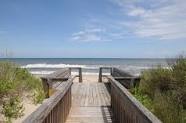
New Jersey’s shore communities could use some of the money they collect in beach badge fees to fund additional public access points to the shoreline under a proposal from a task force studying ways to improve the state’s beach access law.
Wayne Parry reports for The Associated Press:
The panel recommends increasing the overall amount of access points by returning to previous standards that mandated them every quarter-mile, instead of the current standard of every half mile.
The task force was comprised of business interests and some of the state’s leading public access advocates, and it became necessary after a court last December struck down New Jersey’s beach access regulations. A hastily passed bill restored the state Department of Environmental Protection’s authority to impose access regulations, but did not get into ways to improve public access.
Recommendations made by the business side of the panel include exempting utilities and some industry that bar public access on safety grounds from having to fund access points elsewhere, and eliminating or reducing fees for compliance with public access mandates.
Not surprisingly, most of the recommendations were supported by one half of the panel and opposed by the other. It will fall to the state senate and Environment Committee to craft a bill setting forth new beach access standards, something its chairman Sen. Bob Smith, a Middlesex County Democrat, predicted would happen in the fall. The bill would apply not only to beaches and bays, but to urban waterways throughout the state.

Read the full story here

Recent blog posts: 


Task force recommends changes to NJ beach-access law Read More »

Should fracking states put something away for a rainy day?

Natural gas drilling rig -WHYY photo by Lindsay Lazarski

States at the center of the recent oil and gas boom should prepare for the inevitable bust and put drilling revenues into permanent trust funds, says a new report from the Metropolitan Policy Program at Brookings.
Marie Cusick reports in StateImpact:

The researchers singled out Pennsylvania and argue it should enact a severance tax on gas production. Drillers currently pay a per-well impact fee, which has generated more than $860 million over the past four years. This year the fees are expected to bring in $185.5 million– the lowest amount ever.

“Pennsylvania would be wise to levy a severance tax on its oil and gas industry and deposit a portion of that in a permanent trust fund,” the authors write.
They note taxes from oil and gas development are affected by global energy markets and become a volatile revenue source if they are not in a well-managed fund. They also cite what’s known as the “resource curse,” in which economies based on natural resources grow more slowly than diverse economies.


Should fracking states put something away for a rainy day? Read More »

Former pesticide plant site in NJ added to Superfund list

Atlantic City Press graphic

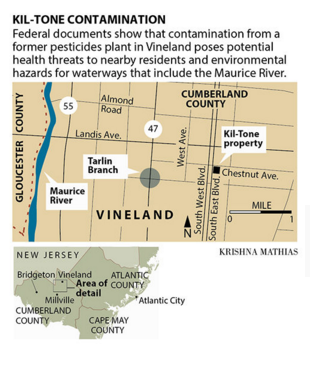
The U.S. Environmental Protection Agency announced yesterday that it has added the former Kil-Tone Company site in Vineland, N.J. to its Superfund list of the country’s most hazardous waste sites. Pesticides were manufactured at the now defunct facility, and groundwater and soil at the site, including soil in the yards of nearby homes, is contaminated with arsenic and lead.

The Sierra Club’s New Jersey chapter responded to the news by blaming New Jersey’s Department of Environmental Protection for knowing about the site for 30 years but doing noting to address it.

“We are glad to see the EPA step in, but we hope the Kil-Tone site doesn’t end up like the Shieldalloy facility,” said NJ Sierra Club Director Jeff Tittel. We need to a complete clean-up, not a cap like what the EPA is doing in Millville.

“Instead of cleaning up the site the Shieldalloy Superfund Site in Newfield, they are capping it, leaving tons of toxic material in the ground that will leach into the environment. Eventually the caps will fail, allowing these dangerous materials to pollute the groundwater and harm the community,” Tittel claimed.


In a news release on Kil-Tone, the EPA said:

Pesticides were manufactured at the now defunct Kil-Tone Company facility, and groundwater and soil at the site, including soil in the yards of nearby homes, is contaminated with arsenic and lead.
“The EPA is committed to protecting residents from the high levels of arsenic and lead at this site,” said Judith A. Enck, EPA Regional Administrator. “The EPA has contacted community members and residents throughout the process to address the pollution. Now we can do the additional sampling needed to determine the best way to clean it up.

”Arsenic is known to cause cancer, as well as many other serious health problems. Lead is a toxic metal that can cause damage to a child’s ability to learn as well as a range of adverse health effects in adults.
Even at low levels, lead can cause learning disabilities and behavioral problems in children.


The Kil-Tone Company manufactured pesticides, which included arsenic and lead, from approximately 1917 to 1926 on the property at 527 East Chestnut Avenue in Vineland, N.J. In 1926, the Kil-Tone Company sold the property to Lucas Kil-Tone Co., a New Jersey company, which is believed to have continued manufacturing pesticides at the property until at least 1933. The property is currently occupied by an unrelated and active business.

The New Jersey Department of Environmental Protection investigated the site in August 2014 and took soil and groundwater samples. The state’s discovery of high concentrations of arsenic and lead in the soil at the property and several neighboring residential properties prompted the referral of the site to the EPA for additional investigation in November 2014.

The EPA confirmed that soil at both the former Kil-Tone property and in the yards of nearby homes had unacceptable levels of arsenic and lead. In April 2015, the EPA collected surface water and sediment samples along the Tarkiln Branch to the confluence with the Maurice River. Sampling results show elevated levels of arsenic and lead related to the Former Kil-Tone Company Site.

In June 2015, the EPA sampled soil at 48 additional residential properties located near the site. An additional 31 residential homes located within the flood plain of the Tarkiln Branch were sampled in November 2015. The results show elevated levels of arsenic and lead at residential properties located within the floodplain of the Tarkiln.

The EPA has shared the sampling results with the affected residents and businesses and held a public meeting in July 2015. The EPA advised residents in April 2015 on immediate actions they should take to reduce potential exposure to the contaminated soil in their backyards.

This month EPA began work to reduce, in the short term, the potential exposure from the elevated levels of arsenic and lead at the residential properties by placing sod, stone, mulch or another barrier at the impacted areas. A final cleanup will be determined and carried out in the future.

The Superfund final designation makes sites eligible for funds to conduct long-term cleanups. The EPA received a letter from the New Jersey Department of Environmental Protection supporting the inclusion of this site to the Superfund list.


Related news stories:
EPA adds Vineland Kil-Tone site to Superfund list Kil-Tone site added to Superfund list 
Vineland residents warned against Kil-tone contamination 


Former pesticide plant site in NJ added to Superfund list Read More »

Farmers learn benefits of growing solar in their lower 40

 
One of the arguments used against solar power deployment is the amount of space needed for all of those solar panels. Although one study has shown that 0.6 percent of all land in the U.S. would be needed to completely electrify the country, the fight still goes on, even as solar and wind power technologies continue to increase in efficiency while decreasing in costs.
Leon Kaye writes in Triple Pundit:

The fight is also occurring in counties across the U.S., as landowners and farmers seek new ways to generate revenue. Most of rural America has missed out on the economic revival that has conjoined technology and urbanization in many cities, so these counties are also seeking new ways to generate tax revenues. Farmers, of course, have also taken a hit due to the ongoing slump in global commodities.

The controversy over farmers having the right to sign contract with solar and wind power companies is now taking center stage in North Carolina.
The combination of the state’s Renewable Energy Portfolio Standard (REPS), which requires utilities operating in the state to generate some electricity from renewables, along with its booming tech culture, has turned the Tar Heel State into a solar powerhouse. In fact, the Solar Energy Industries Association (SEIA) says North Carolina ranks third in the nation amongst U.S. states in total solar capacity. Last year, the installation of over 1,100 megawatts of solar power placed North Carolina in second nationally in new solar generation.
And much of this power is generated in rural counties across the state, from the northern border with Virginia to along the South Carolina state line. According to Solar Strata, one company that is riding North Carolina’s solar boom, these new solar farms are appearing on farmland where crops such as tobacco, peanuts, cotton and corn can no longer earn enough money for farmers to keep their land. Other sites are appearing on fallow land that has not been farmed in years. Companies such as Solar Strata pay rent to these farmers, with contracts that often last as long as 20 years. As quoted by one farmer who was interviewed by Joe Ryan of Bloomberg, “It gives me a way to keep the farm . . . and pass it to my grandchildren.”

Read the full story here

Related: Harvesting Sunshine (Bloomberg)


Farmers learn benefits of growing solar in their lower 40 Read More »

Whoa! Isn’t this supposed to be Trenton’s budget break?

Lobbyists and trade association executives whose careers are spent anticipating and reacting to the ebb and flow of activity in the state legislature look forward every year to the period in late March through April when all committee meetings are suspended except for the appropriations panels in each house that hold weeks of grueling hearings to prepare the next fiscal year’s state budget.

If you don’t have clients that need you to implore for funding, you can feel free to schedule a flight to a place with a warm beach and cold drinks. But not this year–at least, not next week.
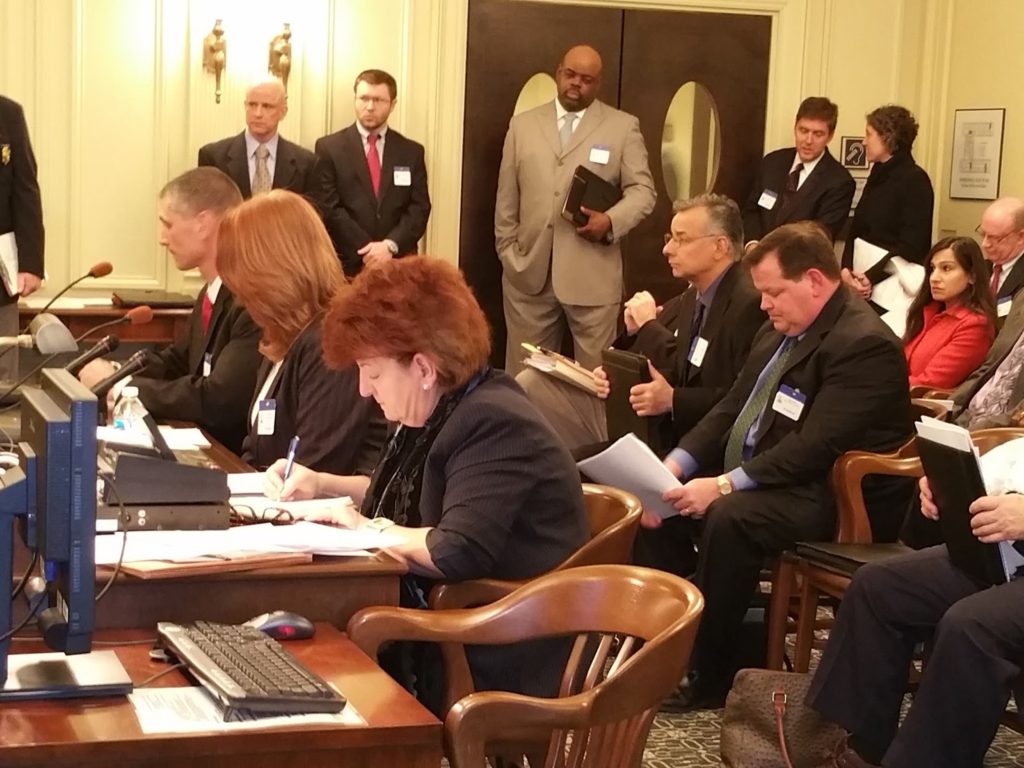
The State Assembly has scheduled a hefty number of committee meetings for Monday, April 4 and a voting session for Thursday,
April 7.

Energy and environment bills are among other pieces of legislation scheduled for action.

Here’s the lineup:

ASSEMBLY APPROPRIATIONS
4/04/16 1:00 PM
Committee Room 11, 4th Floor, State House Annex, Trenton, NJ

A-780  Andrzejczak, R.B. (D-1); McKeon, J.F. (D-27); Spencer, L.G. (D-29); Pintor Marin, E. (D-29); Dancer, R.S. (R-12); Vainieri Huttle, V. (D-37)
Implements 2014 constitutional dedication of CBT revenues for certain environmental purposes; revises State’s open space, farmland, and historic preservation programs.

A-2375  McKeon, J.F. (D-27); Gusciora, R. (D-15); Spencer, L.G. (D-29)
Revises “Electronic Waste Management Act.”
Related Bill: S-981

S-969  Smith, B. (D-17); Bateman, C. (R-16)
Implements 2014 constitutional dedication of CBT revenues for certain environmental purposes; revises State’s open space, farmland, and historic preservation programs.

S-981  Smith, B. (D-17); Bateman, C. (R-16); Greenstein, L.R. (D-14)
Revises “Electronic Waste Management Act.”
Related Bill: A-2375

ASSEMBLY ENVIRONMENT AND SOLID WASTE
4/04/16 2:00 PM
Committee Room 16, 4th Floor, State House Annex, Trenton, NJ
The committee will hear testimony from invited guests regarding the issue of lead as it relates to the State’s aging drinking water infrastructure.

A-2281  Vainieri Huttle, V. (D-37)
The “Smart Container Act” (better known as The Bottle Bill)

A-3539  Muoio, E.M. (D-15); Spencer, L.G. (D-29)
Requires public and nonpublic schools to test for and remediate lead in drinking water, and disclose test results.

A-3583  Spencer, L.G. (D-29); Muoio, E.M. (D-15); Tucker, C.G. (D-28
Appropriates $20 million from societal benefits charge to DEP for drinking water infrastructure improvements and lead abatement in City of Newark.

ASSEMBLY REGULATORY OVERSIGHT
4/04/16 2:00 PM
Committee Room 14, 4th Floor, State House Annex, Trenton, NJ

A-2082  Mukherji, A. (D-33); Pintor Marin, E. (D-29); Webber, J. (R-26)
Requires OAL to maintain Internet database summarizing all State rule-making actions.


ASSEMBLY STATE AND LOCAL GOVERNMENT
4/04/16 2:00 PM
Committee Room 13, 4th Floor, State House Annex, Trenton, NJ

A-1623  Rodriguez-Gregg, M. (R-8)
Requires use of pervious concrete by State agencies under certain circumstances.

———————————————————————————————–

ASSEMBLY VOTING SESSION

Thursday
4/07/16 1:00 PM

A-1645  Schaer, G.S. (D-36); Webber, J. (R-26); Dancer, R.S. (R-12
Expands definition of “acquisition,” for purposes of county and municipal open space trust funds, to include demolition, removal of debris, and restoration of lands being acquired.
Related Bill: S-195

A-2949  Andrzejczak, R.B. (D-1); Land, R.B. (D-1)
Provides diamondback terrapins protection as non-game indigenous species. Related: S-1625


Was this of interest to you?


Recent blog posts: 

Whoa! Isn’t this supposed to be Trenton’s budget break? Read More »

Once the worst Superfund site now to become a solar farm


Nicholas Huba reports in the
Press of Atlantic City:
Under the agreement, the township will not foreclose on the property, while Absecon-based Dewey Place LLC, the developer for the project, will pay back more than $290,000 in back taxes and interest.
Foreclosing on the property, which was once called “the most serious environmental problem in the United States,” would have delayed the redevelopment of the site, said Peter Miller, township administrator.
“If we foreclosed on the property, we would get nothing,” Miller said. “Under this agreement, we are able to recoup the taxes that are owed on the property and the property can be reused for something else.”
As part of the agreement, the developer is required pay off the back taxes and interest over the next 20 years. The first payment of $25,000 is due May 1.
Jerry Snow, a resident of the area since 2001, said he was happy with the way the cleanup was handled and happy to see something planned for the site. Snow lives a quarter mile from the former landfill.
“I’ve only heard stories of what happened with the dumping,” said Snow, 48. “Over the years they did their best to clean up what happened. They replaced the pipes and also built the treatment center.”
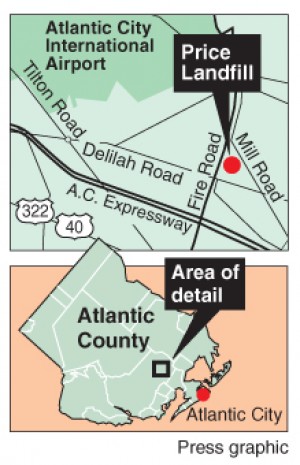
Cleaning up Price’s Pit has been a decades-long process. It was one of the first sites in New Jersey to undergo cleanup under the federal Superfund program.


Was this of interest to you?


Recent blog posts:
Once the worst Superfund site now to become a solar farm Read More »